
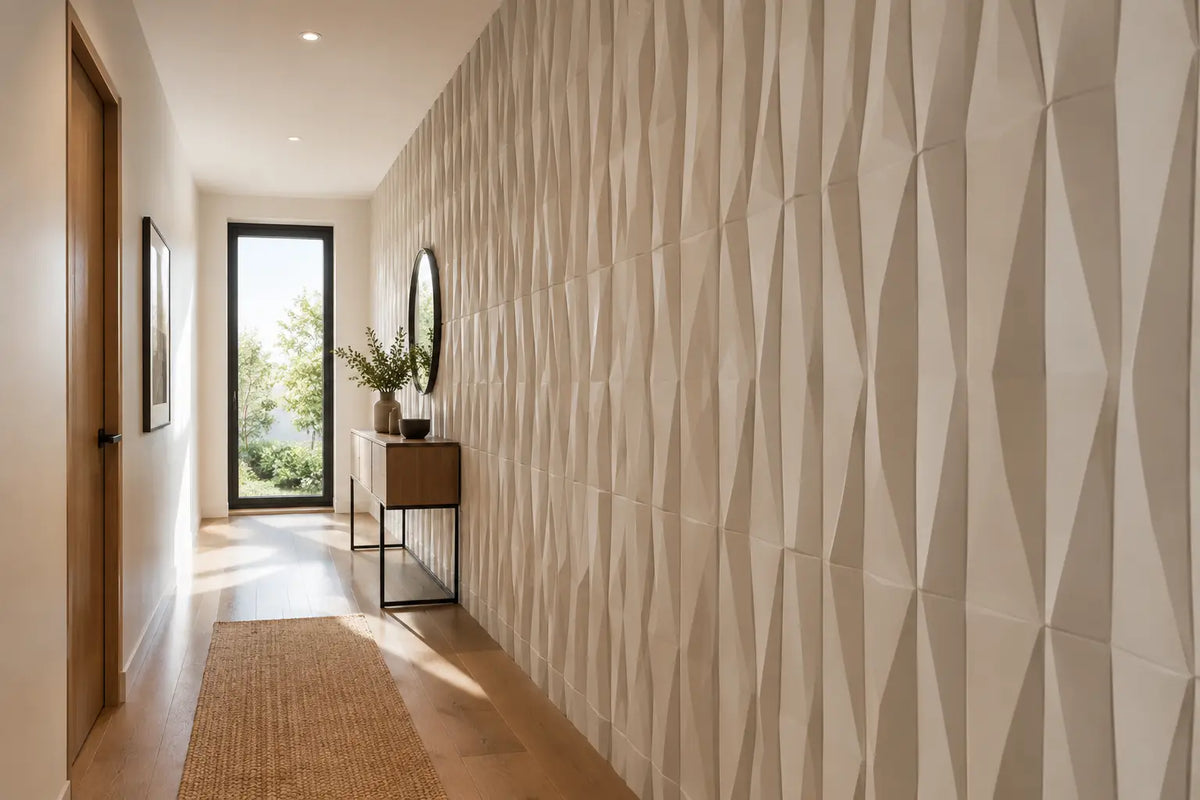
A dark hallway, a featureless entrance or a long bedroom does not necessarily need more square metres. It needs a better approach to its finishes. Asking which finish to choose for a narrow room means working on perception: capturing light, making the walls feel lighter and creating depth that naturally guides the eye.
The right finish therefore involves more than a light colour. Sheen, texture, the pattern of the wall covering, the direction of lines and the position of light sources all contribute to the impression of space. A narrow room can become brighter, more structured and considerably more elegant without losing its character.
Which finish works best in a narrow room?
In most cases, a light matt or soft-sheen finish is the most balanced choice. It diffuses light without harsh reflections while visually softening minor imperfections in the wall. Off-whites, mineral beiges, pearl greys and sandy tones bring brightness with more warmth than a brilliant white.
Satin can also be an interesting option in a busy entrance or hallway. Its surface is easier to maintain and reflects a little light. It should, however, be used sparingly: on imperfect walls or under grazing light, an overly glossy paint can highlight every flaw and create a colder impression.
Gloss finishes are rarely the best choice for a narrow room when used on every wall. They can work on a door, a niche, the lower part of a wall or an architectural detail, but their mirror effect can quickly become overwhelming. Elegance often comes from subtle contrast rather than an abundance of reflective surfaces.
The principle of controlled reflection
A narrow room needs light, but not necessarily shine. A soft-sheen finish paired with a well-positioned mirror, a diffused wall light or a wall-mounted lighting fixture creates more refined brightness than a fully lacquered wall. The eye then perceives a welcoming atmosphere rather than a simple surface effect.
If the room receives little natural light, choose a light shade with a warm undertone. A slightly ivory or linen white avoids the bluish appearance that some cool whites take on under artificial lighting. Before choosing, always look at a sample in the morning, towards the end of the day and with your lights switched on.
Using colour without flattening the room
Painting all the walls in a very light shade remains a safe solution, but it is not the only one. In a long, narrow room, the far wall can be painted a slightly deeper shade. This brings the end of the room visually closer and reduces the corridor effect, particularly when that wall is highlighted by a painting, a console table or a decorative arrangement.
Conversely, if the aim is to make a limited width less noticeable, keep the side walls light and avoid sharp contrasts from one side to the other. Two opposing walls that are too dark appear closer together. Deep shades are not off limits; they simply need a clear purpose: an alcove, a wall behind the bed or a decorative area rather than the whole room.
The ceiling also deserves attention. A white or very light ceiling increases the sense of height. In a low room, extend the wall colour a few centimetres onto the ceiling, or paint the cornice in the same shade. The visual break is less pronounced, which softens the proportions.
Adding relief without making the space feel smaller
Relief may seem risky in a small room. Yet a carefully chosen texture adds depth that paint alone cannot provide. The aim is to favour a clear pattern, with soft shadows and controlled repetition, rather than an overly dense or very pronounced pattern on all four walls.
3D gypsum wall panels work particularly well on a focal wall: at the end of a hallway, behind an entrance console table, in a narrow dining area or at the head of a bed. Their contours create a play of light that brings the wall to life, while their surface can be painted in your chosen colour to maintain a coherent palette.
Vertical lines, curves or geometric patterns?
Vertical lines draw the eye upwards and can make the most of a generous ceiling height. They work very well in an entrance or hallway, provided the relief is not too bulky. Wave patterns bring a more fluid feel: they soften hard angles and add movement to a narrow passage.
Geometric patterns suit contemporary interiors, but their scale must be appropriate. A pattern that is too small can feel busy, while a very large one risks dominating the room. In a small space, look for regular geometry, elegant shadows and a tone-on-tone painted finish.
A decorative panel does not necessarily have to cover the entire wall. A centred composition, a door surround or a vertical strip is sometimes enough to transform the space. This restraint preserves the visual flow and gives the decor a more architectural presence.
Guiding the eye with flooring and light
A wall finish becomes more effective when it works with the floor. In a narrow hallway, parquet boards laid lengthways emphasise perspective. If the room seems excessively long, laying them across the room or using a rug with transverse lines can rebalance the proportions. The right choice depends on what you want to correct: the width, the length or the lack of light.
Avoid too many transitions between the floor, skirting boards and walls. Skirting boards painted in the wall colour, or in a soft white close to the ceiling colour, create visual continuity. In small spaces, every dividing line matters.
Lighting should reveal the finish, not overpower it. Wall lights that cast light upwards and downwards make the wall look wider. An integrated LED strip in a niche, behind a panel or along a raised element highlights the texture with sophistication. Warm light, around 2700 to 3000 K, is particularly flattering to off-whites, beiges and mineral materials.
For a 3D panel, test the direction of the light before final installation. Side lighting reveals more of the relief, while frontal lighting softens it. In a very narrow passage, indirect lighting also prevents glare and keeps movement through the space comfortable.
Mistakes that make a narrow room feel narrower
The first mistake is trying to decorate everything. Busy wallpaper, highly contrasting flooring, several framed pictures and pronounced relief can compete within just a few square metres. Choose one strong feature and let the other finishes support it.
The second is choosing glossy paint to compensate for a lack of light. If the walls are not perfectly prepared, the result can feel harsh rather than bright. A quality matt finish, a carefully chosen shade and thoughtful lighting generally give a more premium result.
Finally, be careful with deep furniture. Even the most beautiful finish loses its effect when moving around becomes difficult. Choose a slim console table, wall-mounted storage, sculptural coat hooks or a compact bench. A narrow room feels more generous when the floor remains visually clear.
A finish designed as an architectural feature
For a contemporary entrance, combine matt linen-coloured paint with a wave-pattern wall panel painted in the same shade and lit by two discreet wall lights. In a hallway, a textured far wall in a deeper beige creates an elegant endpoint. In a narrow bedroom, a geometric panel behind the bed can effectively replace several accessories and establish a distinctive decorative identity.
The gypsum panels offered by Effet Marbella allow this tailored approach: they add a sculptural presence, remain paintable and contribute to the acoustic and thermal comfort of the space. The key is to use them as a precise design gesture, never simply to fill space.
Before settling on a finish, step back and look from the room's entrance. Ask yourself where the eye should rest, which wall deserves to be highlighted and what light accompanies that movement. In a narrow space, a calm, well-placed choice often transforms more than abundant decoration.


