
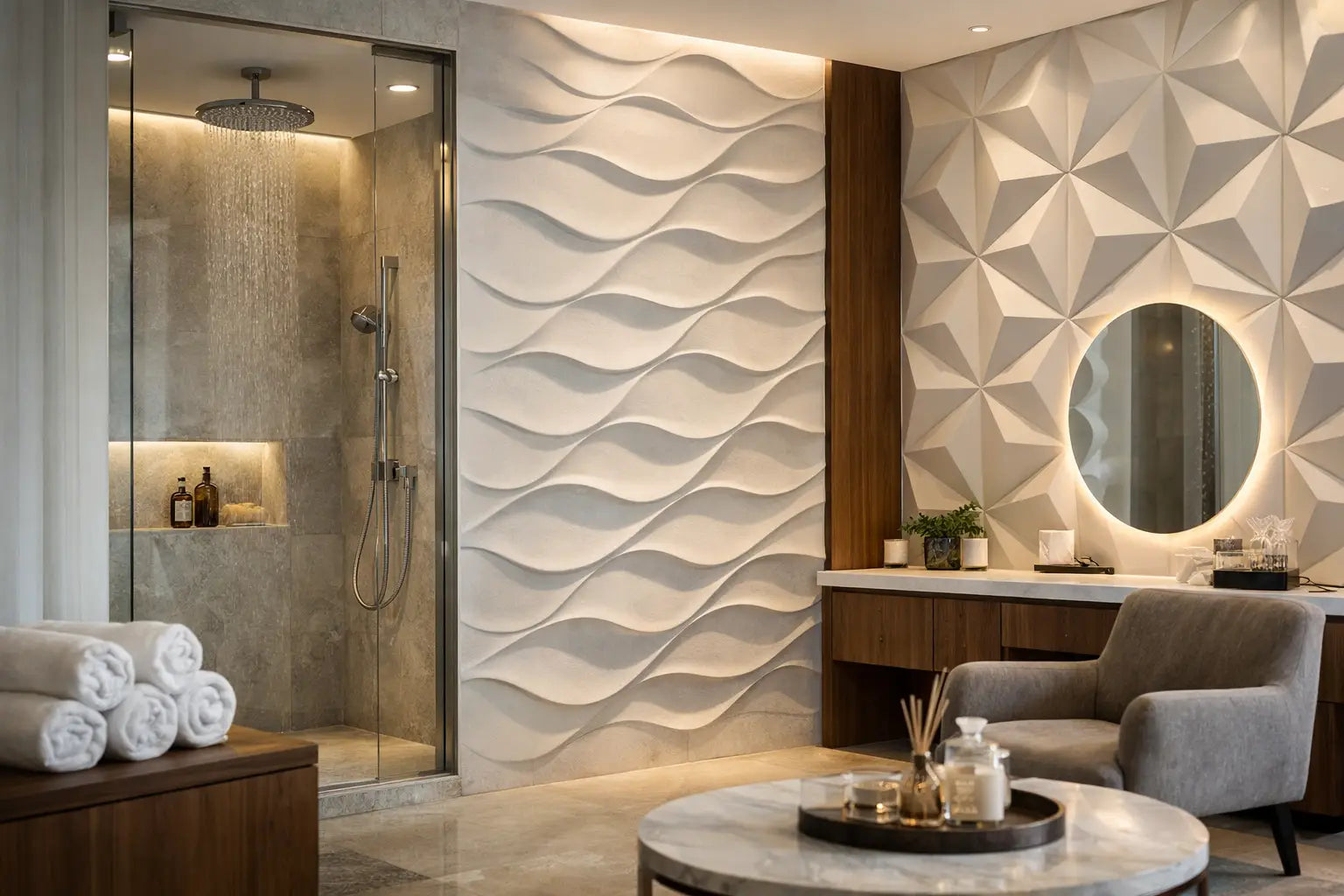
A bathroom doesn't have to sacrifice texture to remain durable. When properly chosen and installed, gypsum panels for wet rooms bring valuable architectural depth to a vanity wall, bathtub area, or toilet, without weighing down the ambiance. The condition is simple: distinguish a wet room from an area directly exposed to water splashes.
In a contemporary interior, 3D panels transform an ordinary surface into a decorative element. Plays of shadows, geometric lines, soft waves, or more sculptural patterns: the wall becomes a visual signature. But in a bathroom, aesthetics are only valuable when accompanied by rigorous surface preparation, appropriate finishing, and good ventilation.
What does "wet room" mean for a gypsum panel?
A wet room is a space where the air regularly contains more humidity: bathroom, shower room, WC, laundry room, or kitchen. This ambient humidity does not mean that all walls receive water. It is precisely this nuance that guides the choice of covering.
Decorative gypsum panels can cover walls located out of direct water flow: behind a vanity unit, on the wall opposite the shower, around a protected bathtub, in toilets, or a well-ventilated laundry room. In these locations, they create a refined decor while retaining the mineral feel and precision of the relief.
In contrast, the interior wall of a shower, the immediate surround of a bathtub used as a shower, or any area subject to repeated splashing requires a completely waterproof system designed for this purpose. A gypsum panel, even treated and painted, does not replace under-tile waterproofing, a dedicated membrane, or a coating specifically designed for permanent contact with water.
Gypsum panels for wet rooms: the right locations
The best project begins with a concrete reading of the room. Observe the water's path, window openings, the power of the ventilation system, and the proximity of water points. This step allows you to reserve the relief for areas where it will be admired for a long time, rather than exposing it unnecessarily.
The vanity wall, a natural composition
Behind a vanity, 3D panels offer a spectacular setting for the mirror and faucet. A geometric pattern structures a contemporary bathroom, while a wavy design softens a more organic composition. The relief catches the morning light or indirect lighting and gives the wall a presence that paint alone cannot create.
However, it is advisable to plan for a waterproof backsplash or a sufficient protection height immediately near the faucet, depending on usage habits. A family vanity wall sometimes receives more splashes than one might imagine. The most elegant solution is often to combine an easy-to-clean lower area with a decorative panel placed above.
Toilets and laundry room
In toilets, the decorative gypsum panel is particularly relevant. The space is often compact, but a textured wall behind the wall-hung toilet frame or facing the door immediately gives it a more sophisticated dimension. A light paint accentuates the light; a deeper shade creates an enveloping, almost hotel-like effect.
In a laundry room, the choice depends on ventilation and the risk of leaks. Panels can be placed on a wall section away from water inlets and outlets, especially to visually integrate storage or add character to a utility room. Here, practicality is key: the support must remain accessible when equipment requires intervention.
A bathroom designed as a suite
For a generous bathroom, panels help to prioritize volumes. They can highlight the dressing table area, frame a free-standing bathtub located outside the splash zone, or extend the bedroom's style into an adjoining shower room. The result is more coherent than a simple "accent wall": the decoration becomes true interior architecture.
Models compatible with indirect LED lighting are interesting when the project calls for a soft ambiance. They highlight the design of the panels while avoiding harsh frontal light. In a wet room, all electrical components must naturally be selected and installed in accordance with applicable safety regulations.
The material is not enough: the finish makes the difference
Gypsum provides a mineral touch, great fineness of detail, and a paint-ready surface. Its behavior in a wet room depends, however, on the entire system: substrate quality, bonding, joint treatment, primer, paint, and maintenance.
Before installation, the wall must be clean, dry, flat, and stable. Peeling old paint, an unresolved infiltration, or a crumbling partition should never be hidden under new decor. Correcting the cause of humidity is always more durable than masking its traces.
After bonding, the connections between panels require particular attention. A carefully prepared joint allows for the effect of a continuous sculpted surface, without visual grid lines. Once dry, the entire surface can be primed and then painted with a finish suitable for wet rooms. Quality washable paint facilitates maintenance and helps protect the surface from occasional condensation.
Color strongly alters the perception of relief. White subtly highlights shadows and visually enlarges small volumes. Sand, stone, or greige tones reinforce a warm and timeless atmosphere. A dark shade, used on a single wall and accompanied by well-thought-out lighting, reveals the depth of the pattern with a more theatrical intensity.
Ventilation, heating, and maintenance: the details that preserve the decor
No covering can compensate for a poorly ventilated bathroom. A functional mechanical ventilation system, an open window when possible, and reasonably regular heating limit condensation. After a shower, letting humid air stagnate for hours weakens paints, joints, and furniture alike.
Daily maintenance remains simple. Gentle dusting is usually sufficient, supplemented if necessary by a slightly damp, non-abrasive cloth. Harsh products, hard brushes, and extensive water cleaning should be avoided. Textures remain easy to live with when their location has been chosen with discernment.
In rental housing or for intensive use, prioritize patterns with moderate depth in high-traffic areas. They retain their decorative effect while being quicker to dust. For a master suite or a hotel project, a more assertive relief can, on the contrary, become the focal point of the space.
How to combine relief with other finishes?
The gypsum panel does not need to cover every wall to impose its elegance. In a bathroom, a single well-placed wall often suffices. It can interact with large-format porcelain stoneware, black or brass fixtures, treated wood, a mineral basin, or moisture-resistant matte paint.
The key is balance. If the tiling is heavily veined or decorative, choose a panel with a sober design to avoid overload. Conversely, when faced with smooth and calm finishes, a geometric or wavy relief becomes the element that gives rhythm to the room. Proportions matter as much as the pattern: a narrow wall will appreciate vertical lines or fine relief, while a large wall can accommodate a more expressive composition.
For renovators and professionals alike, ordering a few extra panels can be judicious. They are used for cuts, last-minute adjustments, and, if necessary, future repairs. This precaution is particularly useful when a pattern needs to be precisely matched around a piece of furniture, a niche, or an outlet.
The right choice: protected decor, never compromised
Decorative gypsum panels reveal their full potential in wet rooms when they are considered an architectural finish, not a barrier against water. Outside splash zones, with healthy ventilation and appropriate paint, they allow for the creation of durable, personalized, and profoundly elegant walls.
Before installing any panel, take the time to draw out the wet areas, light sources, and viewpoints from the door. It is often this simple plan that transforms a beautiful material into a decor enjoyed every day.


