
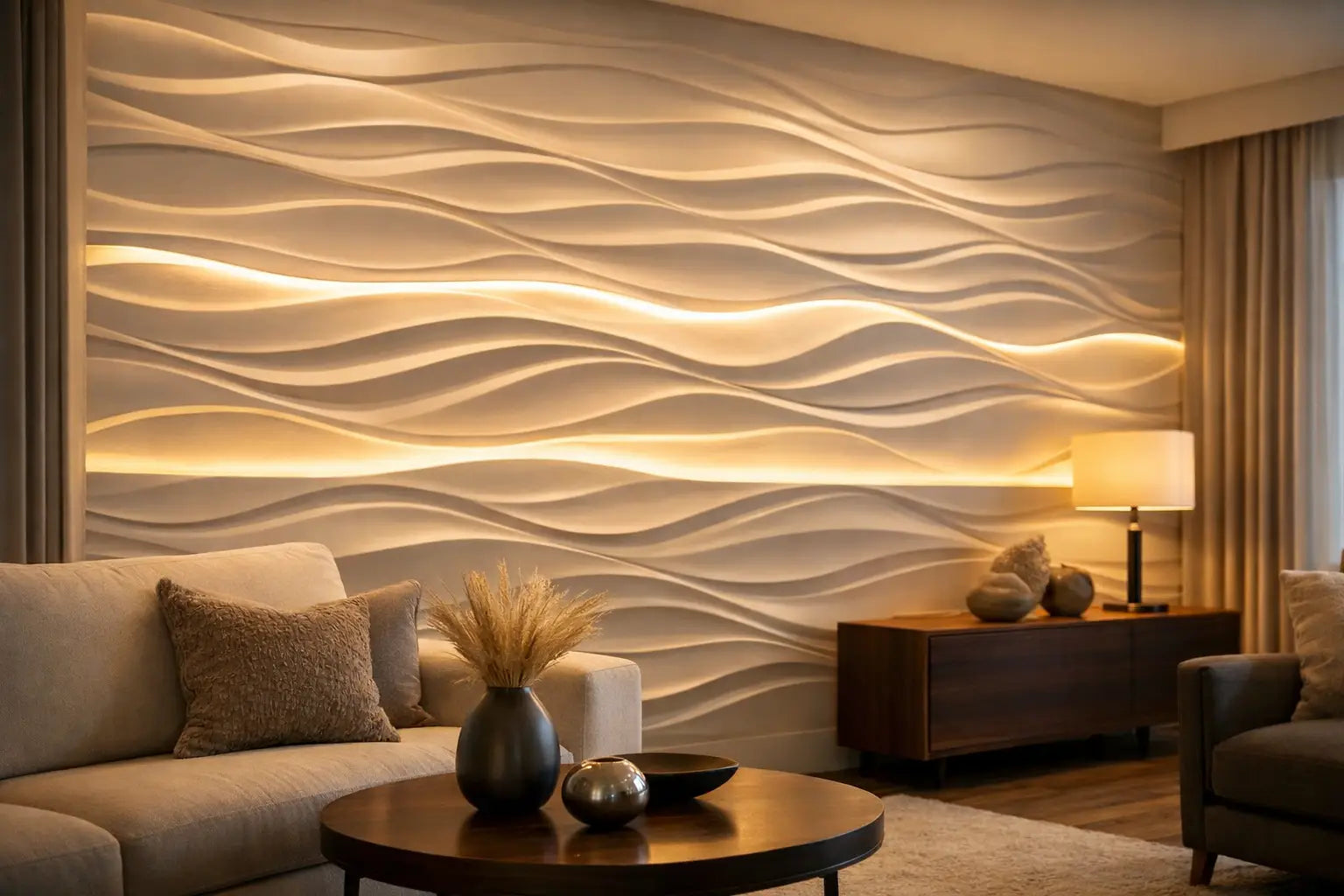
A TV wall, a headboard or a hallway can change its presence as soon as the light stops being frontal. Integrating indirect lighting into the wall allows you to highlight volumes, soften the atmosphere and give a room that architectural depth that paint alone does not create. Well thought out, it does not just illuminate: it stages materials, structures perspectives and transforms an ordinary wall into a focal point.
However, the result depends on very concrete details: the relief of the covering, the position of the LED sources, the color temperature and the quality of the finishes. It is the balance between these elements that transforms an installation from a simple lighting effect into a timeless decoration.
Why integrate indirect lighting into the wall?
Indirect lighting diffuses light by reflection, rather than sending it directly to the eyes. It is therefore particularly appreciated in living rooms, where a calmer atmosphere is sought after the functional light of the day. Behind a screen, around a decorative panel or on the periphery of a wall, it also reduces visual contrasts and gives a more enveloping feeling of space.
Its interest becomes even more evident on a textured surface. A textured wall captures light at different angles: hollows become deeper, lines sharper and shadows evolve according to the time of day. A grazing light thus reveals the design of a geometric panel, while a softer light accompanies the curves of a wavy pattern.
The goal is not to multiply the effects. A single luminous line, placed in the right place, can be enough to bring character to a living room or a bedroom. In a contemporary interior, this restraint maintains the elegance of the project while allowing the materials to express themselves.
Integrating indirect lighting into the wall in three essential choices
Define the desired effect before choosing the light
Start by looking at the wall from a distance and identifying its role in the room. Is it a decorative background for a sofa, a media wall, an entrance or a headboard? This question determines the shape of the lighting.
A vertical LED line visually lengthens a modest ceiling height. A light concealed in the upper part gives an impression of a lighter ceiling. A halo behind a central panel draws the eye to a precise composition, for example a framed television or a decorative work. In a bedroom, a light placed behind the headboard brings a hushed presence without replacing the reading lamps necessary for daily comfort.
It is preferable to draw the light path from the design of the wall. Adding an LED strip afterwards is still possible, but the integration will rarely be as precise as with a reservation, a profile or a panel designed to receive the lighting.
Choose a suitable color temperature
For a living room, bedroom or dining room, a warm light between 2700 K and 3000 K generally creates the most flattering atmosphere. It enhances beige, sand, terracotta, wood tones and deep paints, while maintaining a feeling of comfort.
A shade around 4000 K may be suitable for an entrance, a dressing room or a workspace, where the perception of details is more important. However, it requires more caution on a decorative wall: combined with a too cold white, it can make the relief harder and less welcoming.
The dimmer is often the best choice. It allows the same wall to be used as a discrete luminous element in the evening and as a more assertive decorative accent during a reception. Simply check the compatibility between the LED strip, its power supply and the chosen dimming system.
Ensure clean and durable diffusion
A visible LED strip point by point immediately detracts from the desired effect. For homogeneous light, install it in an aluminum profile equipped with an opal diffuser. This detail improves the rendering, helps dissipate heat and protects the installation over time.
The depth of the recess between the LED and the illuminated surface also counts. Too close, the light reveals marked points and bands. Too far, it loses its intensity and its design. There is no universal distance: it varies according to the power of the strip, the angle of the profile, the color of the wall and the chosen relief. A test on a small length before final installation avoids disappointments.
Choosing a wall covering that enhances the light
On a smooth wall, indirect lighting mainly draws a halo. On a 3D panel, it becomes a real compositional tool. Geometric patterns offer structured, almost graphic shadows. Panels with fluid lines produce a softer movement, particularly suitable for a bedroom, a reception area or a living room seeking a peaceful atmosphere.
3D plaster wall panels are an interesting solution when combining decorative depth and customizable finish. Their surface can be painted to match the room's palette, from mineral white to more audacious shades. A matte finish often remains the most elegant, as it subtly absorbs light and limits unwanted reflections.
Some compositions directly integrate a space provided for light. This approach simplifies alignment and gives the wall a more architectural reading. EFFET MARBELLA's integrated LED collections notably allow working with relief and light in the same decorative language, without weighing down the ensemble with added elements.
The choice of pattern must remain consistent with the scale of the room. A large relief fully expresses itself on a large living room wall or in a hall. In a narrow corridor, a finer design or discrete side lighting will avoid overloading the volumes.
Precise installation preparation
Electricity must be anticipated before installing the covering. The power supply, cables and connections must remain accessible, ideally via a discrete hatch, a low cabinet or a false ceiling. A built-in installation without maintenance access can complicate the replacement of a transformer, even if the LED strip is durable.
The wall support must be clean, dry, stable and sufficiently flat. Before gluing or fixing panels, locate the cable outlets, sockets and the exact location of the power supply. Draw the central axis of the wall, then position the elements dry when the pattern requires a precise joint.
For electrical work, the intervention of a qualified professional is recommended, particularly in wet rooms or when a dedicated circuit needs to be created. In a bathroom, compliance with safety volumes and the choice of an adapted protection rating are non-negotiable. The decorative effect should never take precedence over safety.
After installation, the joints between panels must be carefully worked to preserve the continuity of the pattern. Once the surface is prepared and painted, install the profiles, connect the LEDs and test the light before definitively closing the technical elements. This control step allows verifying the uniformity of the diffusion and the absence of accidental shadows.
Mistakes that weaken the decorative effect
The first mistake is to consider indirect lighting as the only light source in the room. It creates an atmosphere, but does not always replace a ceiling light, reading lamps or a table lamp. A successful project superimposes several levels of light: general, functional and decorative.
The second is to choose excessive power. A luminous wall does not need to be dazzling to attract the eye. Too strong an intensity accentuates every imperfection, tires the eyes and gives a more commercial than residential rendering. A modulable light, capable of remaining subtle, is better.
Finally, avoid placing light sources randomly around each decorative element. Relief needs shadow to exist. If light comes from all sides, the wall loses its depth and its design becomes less legible. Give the light a clear direction, like gallery lighting would.
Ideas by room
In the living room, indirect lighting behind the TV cabinet or around a central panel creates an elegant and comfortable scene. It accompanies evenings without aggressively reflecting on the screen. Combined with a geometric relief painted in a soft shade, it gives the wall a refined presence, even when the main lights are off.
In a bedroom, a horizontal luminous line behind the headboard brings a contemporary hotel feel. Maintain a warm tone and provide separate controls so that everyone can adjust the ambiance without getting up.
In an entrance, vertical lighting integrated into a sculptural panel can naturally guide the eye and welcome visitors with character. In a hallway, it is preferable to repeat a luminous detail at a regular rhythm rather than creating a single very intense point.
The most beautiful result often comes from a simple intention: choose a wall that deserves to be looked at, give it relief, then let the light reveal every nuance. When material and lighting are thought together, the space gains a lasting signature, both contemporary and deeply personal.


