
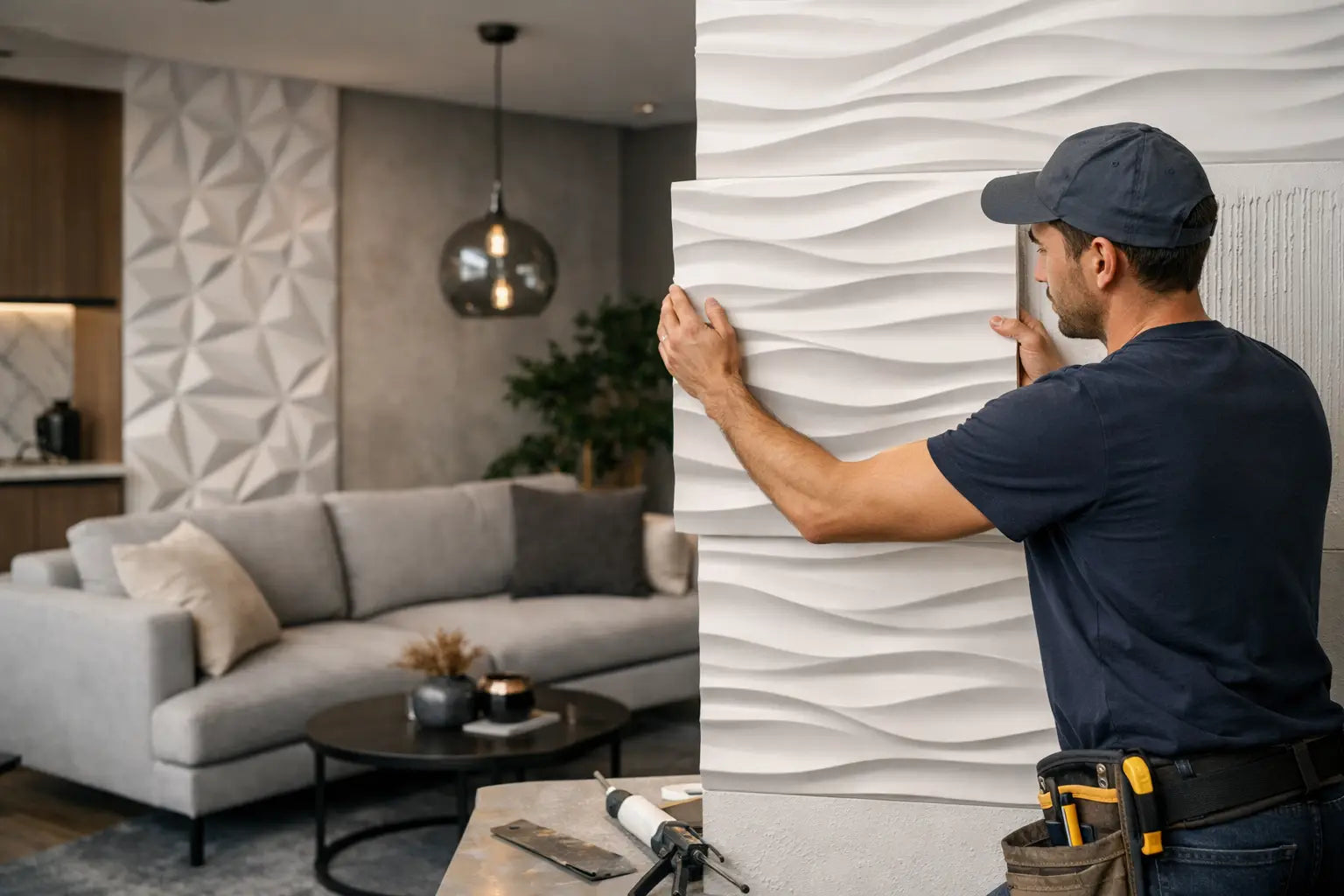
A flat wall rarely changes a room. Well-chosen relief, by contrast, catches the light, structures the space and immediately gives an interior more character. Before starting, the real question is simple: are decorative panels easy to install? In practice, yes, decorative panels can be easy to install, provided you choose the right material, prepare the substrate properly and follow a few essential steps.
Does the material affect how easy decorative panels are to install?
Not all wall panels are equally straightforward to install. This is often where confusion begins. When discussing ease of installation, consider the panel's weight, manufacturing accuracy, fixing method and the quality of the installed finish.
3D plaster decorative panels appeal precisely because they deliver a high-end architectural result without requiring major building work. They are designed to transform an interior wall with a real visual presence while keeping installation manageable. Their regular format helps create crisp alignment, and their surface can then be painted to produce a highly consistent finish.
Conversely, some more flexible or lightweight decorative coverings may seem quicker to install but sometimes produce a less refined, durable or precise result at the joins. The easiest installation is therefore not always the best. In a sophisticated interior, the aim is not simply speed. It is an elegant, stable and lasting finish.
What makes installation straightforward?
Ease of installation rarely depends on a single factor. It comes from the combination of a sound substrate, well-designed panels, the right accessories and a methodical approach.
The first point is wall preparation. If the surface is clean, dry, flat and solid, the work runs much more smoothly. On an uneven wall, even the best panels will need adjustments. On a well-prepared substrate, alignment is more natural and the final result immediately gains precision.
The second factor is the product's format. Accurately sized panels allow patterns to join continuously, which is essential for geometric, wave and more strongly sculpted models. The more precise the design, the more rigorous the installation must be, but that does not mean complicated. Above all, it means working carefully.
The third element is the bonding system. For interior decorative panels, adhesive installation often remains the most accessible option. It avoids heavier structural work and keeps the wall visually clean, with no visible fixings. This is one reason many homeowners regard this type of product as suitable for an ambitious but realistic renovation.
Are decorative panels easy for a homeowner to install?
Yes, in many cases, particularly on a simple surface such as a living-room wall, headboard, hallway or TV area. A careful homeowner can achieve a very attractive result, especially on a straight area without too many complex cuts.
Where expectations must be realistic is the required aesthetic standard. A 3D panel is less forgiving than matt paint on an unobtrusive wall. The relief draws the eye. Lines, joins and finishes are naturally visible. This means a non-professional installation can succeed perfectly well, but it demands more attention than a simple flat wall covering.
The work generally remains accessible if you are comfortable with measuring, marking out, cutting and accurate bonding. If you want a very high-end result in a prominent space, employing a professional may be sensible. This is not necessarily because installation is difficult, but because the finish makes all the difference.
The steps that make the difference
Installation always begins before the first adhesive is applied. Measure the wall, establish the starting point and plan cuts around the perimeter. This prevents visual imbalance, particularly with symmetrical panels or repeating patterns.
Next comes a dry layout. Positioning a few panels without fixing them lets you check the joins, understand the pattern's rhythm and adjust the plan if necessary. It is a simple but very useful way to avoid unpleasant surprises.
Adhesive application should be even and appropriate for the material. Controlled pressure, accurate positioning and frequent alignment checks allow steady progress. The aim is not to install quickly, but to install correctly.
After fixing, any joints and finishing work play a major role. With 3D plaster panels, this stage contributes greatly to the desired monolithic effect. Once painted, the relief gains depth and the wall looks like an integrated architectural element rather than a covering applied on top.
Limitations to understand before buying
Saying decorative panels are easy to install does not mean they suit every situation. Some layouts require more time and sometimes more expertise.
Walls with multiple corners, numerous sockets, niches, returns or significant irregularities naturally make the work more complicated. Cuts become more frequent and precision even more important. Similarly, large decorative formats across very large surfaces require a broader view of the pattern to preserve overall harmony.
The material's weight also matters. Higher-quality, denser and more durable panels often provide a better appearance, but require a suitable substrate and careful installation. This is a familiar trade-off in premium finishes: greater visual presence and durability, but also greater attention during installation.
Think about what follows, too. If you want a painted finish, preparation before painting must not be neglected. It is precisely what creates a sculptural, elegant and uniform wall worthy of a thoughtfully designed contemporary interior.
When is installation genuinely easiest?
The smoothest projects are often the most straightforward. A feature wall in a living room, a simple staircase wall, a bedroom headboard wall or a contemporary office are particularly suitable cases. On these surfaces, panels fulfil their purpose: creating relief, adding material presence and changing the perception of the room without major building work.
These are also settings where aesthetic and practical benefits meet. Plaster panels can contribute to a greater sense of comfort through their thermal and acoustic insulation properties. The benefit therefore extends beyond appearance. The wall gains character and improves the experience of the space.
For a clearly defined decorative project, installation may be simpler than it first appears. Often, it is less a matter of outright difficulty than of organisation and finishing.
Should you choose DIY installation or an installer?
Everything depends on the wall, available time and expected standard. If you enjoy renovation projects, the substrate is sound and the composition remains simple, DIY installation can be entirely feasible. It is an attractive way to give an interior a new dimension without turning the project into major building work.
If, however, you are furnishing a reception space, a high-end property, a premium rental apartment or a decorative project with strong visual impact, professional help brings real peace of mind. Wall relief then becomes a defining interior feature, and every detail matters.
In both cases, the right product makes the experience considerably easier. A well-designed panel that combines aesthetics with a coherent installation method remains the best starting point. This is precisely what gives a premium collection such as EFFET MARBELLA's its value: a strong decorative language with an accessible approach to installation.
Decorative panels are therefore not reserved for complex projects or professionals alone. Chosen and installed well, they offer one of the most elegant ways to turn an ordinary wall into a true centrepiece. If you are still unsure, focus less on difficulty alone and more on the result you want to see in your home every day.


