
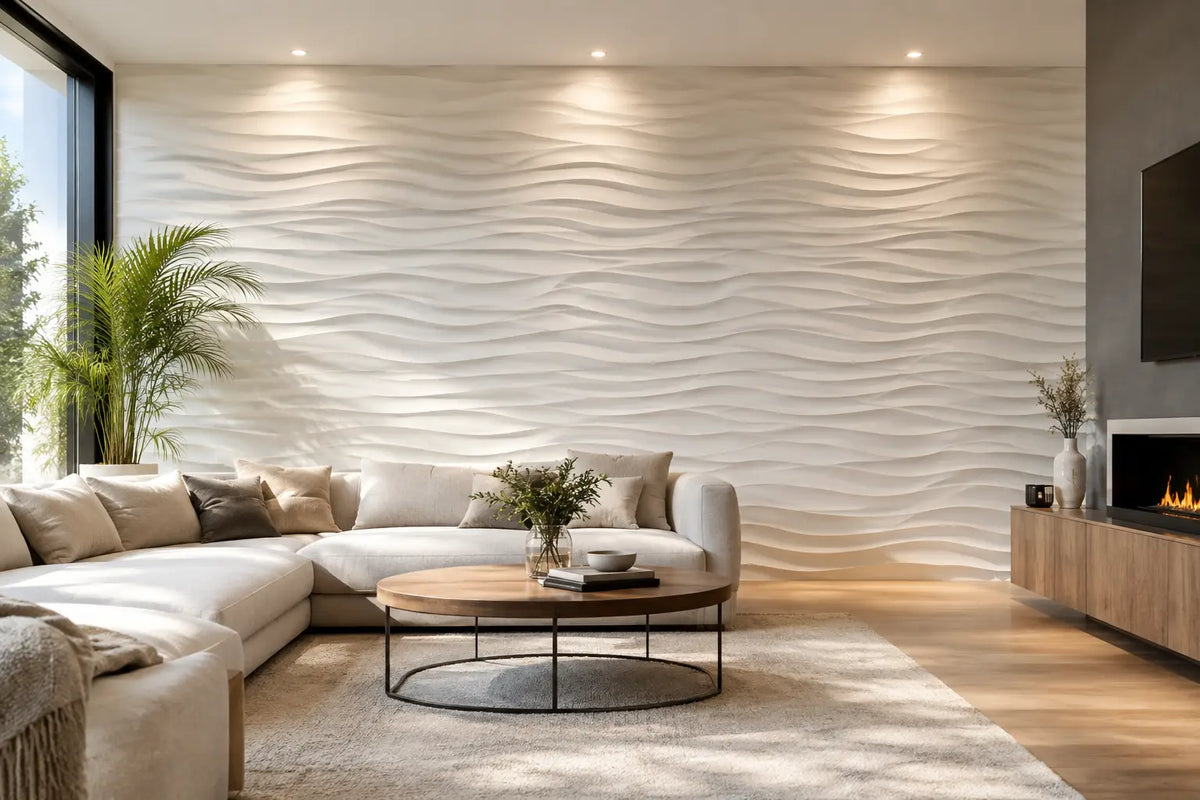
A living room can be impeccably furnished and still lack presence. Often, the issue is not the sofa, lighting or colour, but the surface: a perfectly flat wall lets the eye drift, while well-chosen relief can structure the entire room. This guide to wave panels for living rooms helps you turn an ordinary wall into an architectural element with a result that is contemporary, restful and lasting.
3D wall panels with a wave pattern offer more than a decorative effect. Their movement catches the light, creates shadows that change throughout the day and gives the living room a depth that paint alone cannot offer. Made from plaster, they fit elegantly into modern, minimalist, updated classical and Mediterranean-inspired interiors.
Why wave panels change a living room's atmosphere
The living room is where we entertain, rest and share everyday moments. Its decor therefore needs to be expressive without becoming tiring. Wave lines achieve this balance particularly well: they introduce a gentle visual rhythm, away from the rigidity of strongly geometric patterns.
Unlike busy wallpaper or a highly contrasting covering, a wave panel adds character through its volume. The surface remains restrained, especially when painted a single colour, but comes alive through lighting. Under grazing light, the relief becomes more pronounced. With diffused light, it is more discreet and enveloping.
This versatility is valuable in a living space. A wave wall can become the focal point behind a sofa, complement a TV unit or enhance an open dining area. It avoids a static decorative effect: the wall changes with the time of day, direction of light and desired atmosphere.
Plaster panels also have a functional benefit. Their composition contributes to the room's acoustic and thermal comfort while offering a stable, high-end mineral finish. They are also designed to be painted, allowing the living-room atmosphere to be refreshed without replacing the entire covering.
A guide to wave panels for living rooms: choosing the right wall
A 3D wall panel performs best when treated as an architectural element rather than a simple decorative addition. Choosing the wall matters as much as choosing the model.
Behind the sofa, the relief creates a natural frame around the seating area. This is the most obvious location, but also one of the most effective: the composition remains visible without being constantly in your line of sight while seated. Allow enough viewing distance for the waves to be appreciated as a whole.
The TV wall is another excellent option, provided the installation is planned from the outset. Waves soften the screen's strongly rectangular presence and give this often technical area a more refined dimension. In this case, cables, sockets and any wall bracket need to be planned before the panels are fitted.
In a large, open-plan living room, covering an entire partition can also help define areas without adding a physical divider. The relief visually separates the lounge from the dining area or entrance while preserving movement and light. In a small room, it is often better to focus on one wall section rather than multiply textured surfaces. Relief visually enlarges a space when well lit, but can seem dense when it accumulates in an already heavily furnished room.
Which wave design suits your interior?
Not all waves tell the same story. Some models have broad, continuous curves, ideal for a serene, flowing scheme. Others offer a tighter or deeper relief with a more pronounced sculptural presence. The right choice depends on the living room's scale, lighting and existing furniture.
Large waves are particularly suited to wide walls and uncluttered interiors. They create a generous, almost panoramic sense of movement that works well with a low sofa, stone table or organically shaped furniture. They are also appropriate for projects seeking timeless elegance rather than an overt graphic statement.
Finer patterns can be very attractive in a contemporary apartment or on a smaller wall. Their texture brings precision and a more delicate visual rhythm. They do, however, need more carefully controlled lighting to reveal all their details.
The installation direction also deserves attention. Vertical waves give a sense of height and can enhance a standard ceiling. Horizontal lines visually widen the wall and reinforce a feeling of calm. There is no universal answer: observe the room's proportions before deciding. A tall, narrow living room should not be treated like a low, very open space.
Colour: reveal the relief without making it heavy
Paint completely changes how a wave panel is perceived. Off-white, ivory, mineral beige and greige remain reliable choices for highlighting plaster's natural shadows. These shades have a discreet presence during the day and become particularly elegant under warm evening light.
For a stronger scheme, deep shades create a spectacular effect. Moss green, midnight blue, tobacco brown and charcoal grey accentuate the pattern's recesses and projections. This option best suits a well-lit wall in a reasonably generous living room, or a setting where the rest of the palette remains restrained. A dark shade on deep relief has real decorative strength: it deserves breathing space around it.
Matt finishes are often the most flattering. They retain the panel's mineral softness and allow shadows to define the pattern. A satin finish can work, but it reflects more light and can increase the relief's contrast. If unsure, choose good-quality matt paint suited to a plaster substrate.
Avoid using multiple colours on the same wall. The wave design already provides the ornament. One well-chosen shade gives a more sophisticated result than an overly decorative treatment.
Lighting: the detail that reveals the waves
Without light, a 3D panel remains beautiful. With the right light, it becomes memorable. The aim is to create side or grazing light that highlights the relief rather than flattening it with a very powerful ceiling light directed straight at the wall.
Wall lights on either side create a soft, architectural effect. Adjustable spotlights installed at a reasonable distance allow the beam's intensity and direction to be varied. In more developed schemes, indirect light in a cornice or behind an element of joinery reveals the movement with great subtlety.
Excess should nevertheless be avoided. Too many spotlights create hard shadows and give the wall a theatrical appearance that can become tiring in daily use. A dimmer is an excellent solution: it allows functional light during the day and a more enveloping atmosphere in the evening.
Preparing and installing plaster wall panels
The quality of the result depends first on preparation. The substrate must be clean, dry, sound and as even as possible. A very uneven, crumbling or damp wall needs repair before any installation. Plaster panels are designed to offer a precise finish, but they do not compensate for significant structural defects in the substrate.
Before bonding, mark the starting guides and check the layout. This stage allows cuts to be distributed harmoniously, particularly near corners, switches and skirting boards. Starting with a perfectly aligned panel prevents a small misalignment from growing across the entire composition.
Use an adhesive suitable for plaster panels and observe the recommended setting times. After installation, joints must be carefully finished to preserve the continuity of the movement. This finishing work is what distinguishes a decorated wall from a true architectural covering.
For a simple project, a careful DIY enthusiast can achieve a very satisfactory result. On a large area, around a TV wall, in a living room with niches or where the pattern needs perfect alignment, however, employing a professional may be the most reassuring choice. The additional cost is justified by the quality of the joins, cuts and painted finish.
Create a coherent living room around the textured wall
A wave wall naturally draws the eye. The furniture around it should therefore support the composition without competing with it. Warm materials such as wood, bouclé, linen, wool and stone work particularly well with plaster's softness. They extend its tactile character and give the living room a sense of refined comfort.
Keep other patterns under control. A discreet rug, plain cushions and a few rounded objects are often enough to create a balanced composition. If you choose a strongly coloured sofa or a large artwork, select a calmer panel design and a more restrained wall colour.
At EFFET MARBELLA, wave panels offer precisely this freedom of composition: a sculptural, paintable and durable foundation that can adapt to your style rather than restrict it. The most beautiful result is not one that tries to impress at every centimetre, but one that gives the living room a natural presence, as though the relief had always been part of the architecture.


