
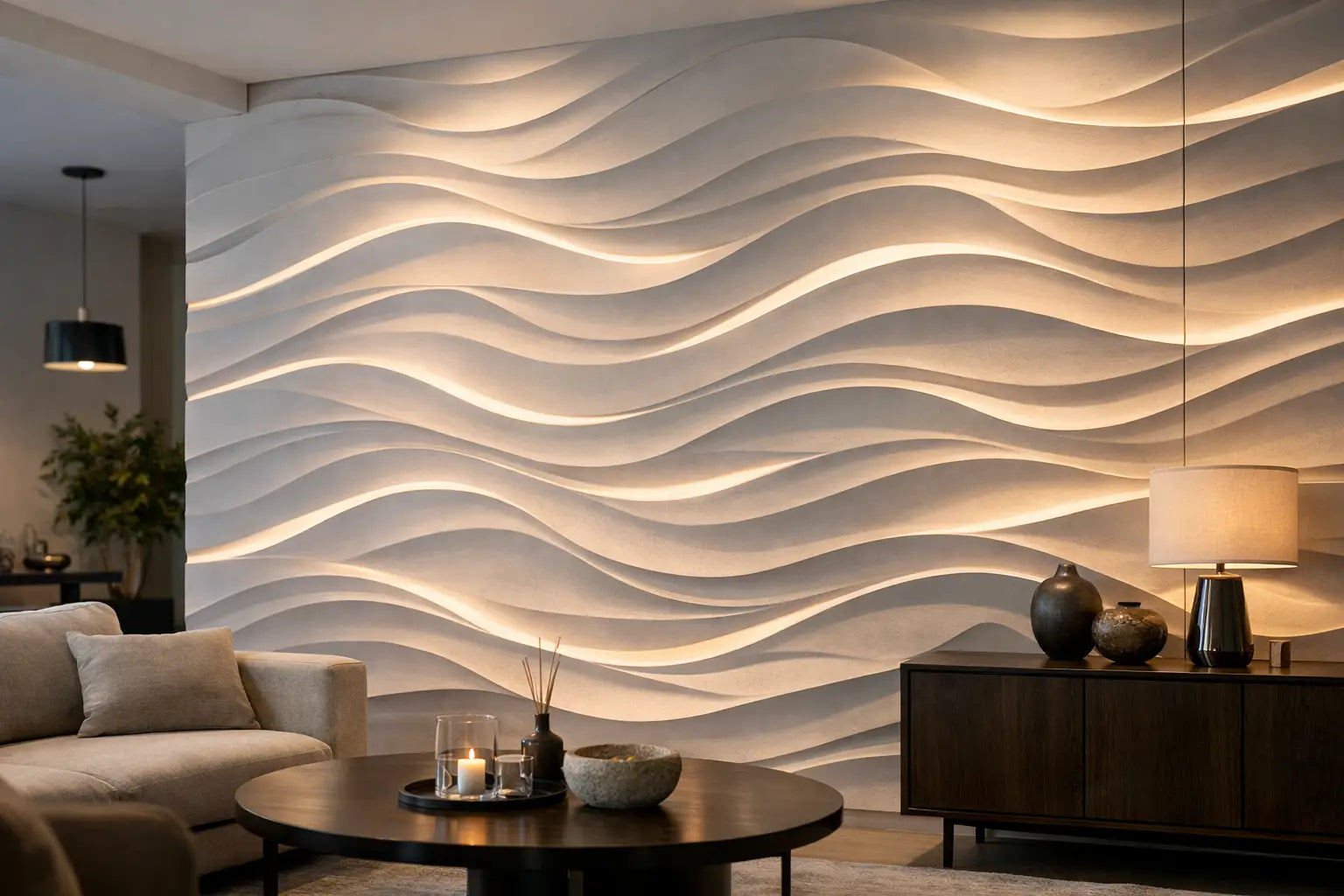
A backlit wall can either give a true architectural presence to a room or look like a simple, hastily placed light fixture. This is precisely what someone typing "LED integrated wall panel review" is often looking for: to find out if an integrated LED wall panel genuinely adds character, comfort, and a high-end finish. When chosen carefully, the 3D gypsum panel transforms light into matter and makes a wall a central element of the interior.
Integrated LED wall panels are not intended to illuminate an entire room. Their role is more subtle: to highlight a relief, create an ambiance, and reveal the lines of a sculpted surface. For a living room, a master suite, an entrance, or a hotel project, this difference changes everything.
LED integrated wall panel review: what truly captivates
The first advantage is visual. Unlike a wall light added as an afterthought, integrated lighting accompanies the panel's design. It can follow a wave, draw a vertical line, or create a soft halo between two volumes. The result is more structured, more coherent, and significantly more elegant than a flat, simply lit wall.
Gypsum reinforces this impression. Its mineral surface captures light with a softness that synthetic materials rarely reproduce. Shadows remain nuanced, reliefs gain depth, and the wall maintains a refined presence even when the LEDs are off. This is essential: a good panel must be decorative both day and night.
This solution also meets a practical expectation. 3D gypsum panels can be painted to match the wall to an existing palette, whether it's architectural white, deep beige, warm gray, or a more assertive shade. The integrated light then becomes a component of the project, not an accessory impossible to adapt during a future renovation.
Finally, the relief of gypsum contributes to the comfort felt in the room. Depending on the wall and project configuration, it can help improve the acoustic and thermal sensation of the space. It does not replace complete technical insulation, but it provides a welcome layer of material in rooms that lack softness or easily echo.
Limitations to be aware of before choosing
An integrated LED panel requires more preparation than a classic wall covering. The composition must be thought out before installation: power supply location, cable routing, transformer choice, and potential access to components. Magnificent light does not compensate for an ill-anticipated electrical connection.
It must also be accepted that ambient lighting is not primary functional lighting. In a hallway, kitchen, or workspace, it must complement appropriate light sources. A too-cold color temperature can also harden the relief and result in a less inviting feel. For a sophisticated residential interior, warm light, around 2700 to 3000 K, generally better highlights the texture of gypsum.
The rendering finally depends on the proportion. An entire wall of luminous panels can be spectacular in a hall, restaurant, or large living room, but become too demonstrative in a compact bedroom. On a smaller surface, a niche, a headboard, or a central panel is often enough to create the desired effect with more restraint.
Where does an LED wall panel make the most impact?
In a living room, it particularly highlights a wall behind a sofa or a media area. Indirect light avoids the dominant black screen effect and gives a calmer identity to the whole. Geometric patterns suit contemporary interiors, while undulating lines bring a more organic feel.
The bedroom is another ideal setting. Installed behind the headboard, the panel creates indirect reading light and an enveloping atmosphere. It reduces the need for multiple bedside lamps, provided that controls accessible from the bed are planned. A dimmer is then highly recommended: the intensity needed for dressing is not what is desired before sleeping.
In an entrance or hallway, integrated LEDs add rhythm to an often-neglected space. The relief guides the eye and the light avoids the impression of a cold passage. For professional projects, this ability to create a strong first impression explains the success of these panels in reception areas, boutiques, wellness spaces, and lounge areas.
Criteria that make a difference
Before ordering, start by observing the wall from a distance. A large pattern requires sufficient setback to be read. In a narrow room, a fine relief or vertical lines visually lengthen the proportions. In a large living room, more generous shapes can assert a sculptural presence without weighing down the space.
The quality of the material is just as decisive. A well-made gypsum panel has clean contours, a surface ready to receive the finish, and a density that gives a feeling of a true decorative element. Panels that are too light or too shiny can appear artificial when lit, as light immediately reveals irregularities and approximate joints.
Then, ask yourself what lighting scenario you desire. A LED line hidden in the relief offers a graphic and contemporary reading. A more indirect, diffuse lighting is more suitable for rest areas. The ability to vary the intensity is a real asset, as it allows the wall to change its role throughout the day, from a discreet accent to evening decor.
Also consider maintenance. Electrical components must remain reasonably accessible, especially the power supply and control system. It is not necessary to make the wall technical or visible, but providing a discreet hatch or access from an adjacent piece of furniture avoids complex interventions later.
Installation: the detail that protects the final result
Surface preparation is non-negotiable. The wall must be clean, dry, flat, and stable enough to receive the panels. Joints must be treated with precision to preserve the continuity of the pattern. After drying, a careful finish and appropriate paint unify the whole and make the module logic disappear.
For a small decorative composition, an experienced DIYer can perform a methodical installation following the product recommendations. However, as soon as the project involves several LED lines, cuts, a high wall, or an embedded power supply, the intervention of a qualified installer and electrician is preferable. This is an investment that protects both aesthetics and safety.
The choice of finish deserves the same attention. A matte paint delicately absorbs light and emphasizes the form. A satin finish reflects more light and may suit certain more graphic decors, but it also more easily highlights preparation flaws. When in doubt, a deep, matte shade remains a safe bet for a LED relief.
Our opinion on integrated LED 3D panels
An integrated LED 3D wall panel is an excellent choice for those who want to evolve their interior beyond conventional decoration. Its appeal is not solely due to the lighting effect: it lies in the meeting of volume, material, color, and ambiance. Well-designed, it brings a lasting signature to a room rather than an ephemeral trend.
It is particularly suitable for projects where the wall deserves to be looked at: a living room renovation, a bedroom designed as a refuge, a reception area, or a residence intended to make an impression. EFFET MARBELLA offers this decorative approach with gypsum panels designed to combine relief, personalization, and contemporary elegance.
The most beautiful result rarely comes from accumulation. Choose a pattern that dialogues with the existing architecture, light that respects the uses of the room, and an installation that lives up to the material. The wall will no longer merely close off the space: it will give it its depth.


