
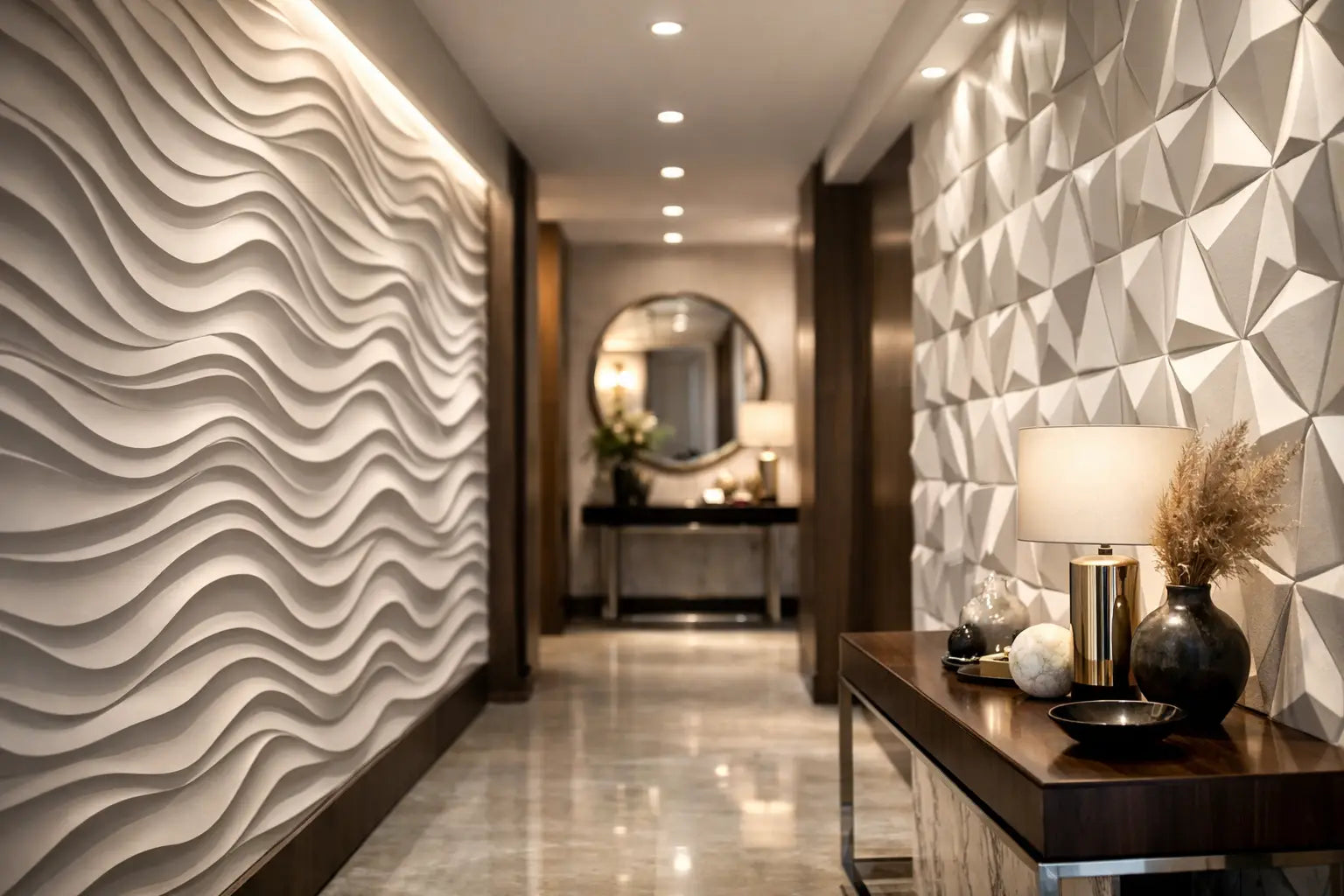
A poorly designed hallway is immediately noticeable. Too narrow, too dark, too empty, or conversely too cluttered, it often gives the impression of a space that is endured rather than enjoyed. However, successfully creating a decorative hallway wall changes how the entire circulation is perceived. This simple linear space becomes a visual signature, adds rhythm, and can even enhance the feeling of comfort through texture, materials, and better light management.
The real challenge isn't just about adding decoration. It's about giving an architectural presence to a passageway without making it feel heavy. In a contemporary interior, the hallway deserves the same level of attention as a living room or an entrance, as it connects volumes and sets the tone for the rest of the house.
Achieving a decorative hallway wall starts with a good understanding of the space
Before choosing a finish, three very practical points need to be considered: width, length, and available light. A long, narrow hallway is not treated the same way as a short passage between two rooms. In the first case, the decorative wall must create rhythm without emphasizing the tunnel effect. In the second, it can become a more prominent focal point.
Light also changes everything. A dark hallway does not fare well with overly matte and uniform finishes if they visually absorb the space. Conversely, a well-designed relief captures shadows and enhances every variation of light, natural or artificial. This is where 3D wall panels become truly relevant: they add character without requiring an accumulation of objects or frames.
Finally, the ceiling height must be taken into account. Very horizontal patterns can visually widen a hallway, while more vertical lines lengthen the perception of height. There is no universal solution. Everything depends on the effect you want to correct or reinforce.
What style to choose for a successful decorative hallway wall
The best choice is often one that remains consistent with the overall interior. A hallway doesn't need to be neutral, but it should converse with the rooms it serves. If your decor is minimalist, a textured wall with geometric lines creates a strong presence while remaining controlled. If the atmosphere is more enveloping, undulating or organic shapes soften the passage and introduce a more fluid elegance.
Relief works particularly well in circulation areas because it animates the wall even without accessories. This is a real advantage in a hallway where every centimeter counts. Where a console, shelves, or a series of frames can clutter, a sculptural covering alone creates an impression of high-end finish.
For a timeless look, it's best to avoid overly decorative or narrative effects. Sober, regular, architectural patterns stand the test of time better. They also allow more freedom to change the color, lighting, or surrounding furniture.
Subtle relief or signature wall
If the hallway is visible from the entrance, a signature wall can have a lot of impact. In this case, the relief becomes a staging element. In a more intimate passage, a more discreet pattern is often preferable, especially if several doors interrupt the surface.
The right question is not just "is it beautiful?" but "is it proportionate?" A spectacular decor in a small hallway can quickly appear forced. Conversely, too timid a relief over a long length risks getting lost.
Materials and finishes that truly add value
In a hallway, the material must be elegant, but also practical for everyday life. This is why 3D plaster wall panels are of particular interest. They offer clear visual depth, a paintable surface, and a real sense of quality. Their relief captures light more refinedly than a simple textured paint, while maintaining a contemporary feel.
There's also an often underestimated functional benefit. In a passageway, a well-designed covering can contribute to acoustic comfort and the thermal perception of the interior. This dimension is particularly important in apartments or houses where the hallway concentrates circulation between living areas and sleeping spaces.
Regarding finish, mineral tones—sand, off-white, greige, light taupe, or warm gray—remain safe bets. They reinforce the sculptural effect without saturating the space. A deep tone can be superb, but only if the hallway benefits from precise lighting. Otherwise, the relief loses readability.
Should the decorative wall be painted the same color as the rest of the hallway?
Often, yes, especially if the goal is a sophisticated and architectural look. A tone-on-tone 3D wall plays with shadows rather than contrast. The result is more high-end, calmer, and visually more enduring.
However, if you want to create a clear break, a slightly richer color can work very well. In this case, you need to be mindful of the overall balance. The hallway should not steal all attention from the rest of the interior.
Light makes half the result
A decorative hallway wall without proper lighting often remains underutilized. Relief needs to be revealed. Even a beautiful material loses its impact if the lighting is flat. Directed wall lights, a well-integrated LED strip, or a series of light points can highlight volumes and transform a simple passage into a decorative sequence.
The ideal is to create light that glides across the surface. This accentuates hollows, lines, and shadows. Relief panels then take on an almost architectural dimension. The hallway appears more refined, but also more vibrant.
However, a light touch is needed. Too many lighting effects can give a demonstrative result. In an elegant interior, light should complement the decor, not overplay it.
The most common mistakes
The first mistake is choosing the decor before considering the proportions. A beautiful panel can be unsuitable for a hallway cluttered with doors, corner returns, or wall breaks. The second is to multiply intentions: textured wall, gallery of frames, imposing mirror, console, original pendant lights. The hallway doesn't need everything. It needs one right gesture.
Another common pitfall: neglecting visual continuity. A successful decorative hallway wall must seem integrated into the project, not added at the last minute. This involves the choice of color, the finish of the corners, alignment with baseboards, and consistency with the flooring.
Finally, real usage must be considered. In a frequently used passage, a stable, durable, and easy-to-maintain solution is better. Refinement is only worthwhile if it remains practical daily.
How to achieve a decorative hallway wall in a small space
In a small hallway, restraint is often style's best ally. One wall is enough. The relief must be legible without being overwhelming, and the color must maintain a certain brightness. Overly complex shapes or very harsh contrasts visually reduce the space.
A regular pattern, a light shade, and side lighting generally yield the best results. If the hallway truly lacks width, it might be wise to treat only a portion of the wall, for example, between the entrance and the first door, to create a signature effect without confining the gaze.
It is also in this type of project that a solution like the one offered by EFFET MARBELLA makes perfect sense: the relief brings real decorative value to a space where every intervention must be both elegant and effective.
When to call a professional installer, and when to do it yourself
It all depends on the regularity of the walls, the expected level of finish, and the chosen pattern. On a simple, well-prepared surface, some projects are accessible to a careful individual. But in a hallway, details matter more than one might think: cuts around outlets, panel alignment, visual connections along the length, transitions with doors and corners.
If you are aiming for a premium finish, installation deserves real attention. A successful decorative wall depends not only on the product but on the precision of its execution. It is often this quality of execution that gives the result its custom look.
The hallway is rarely the largest room in the house, but it can become one of the most striking. When it gains in relief, light, and coherence, it ceases to be a simple passage. It gives rhythm to the interior and, from the first steps, instills an impression of refined comfort that changes everything.


