
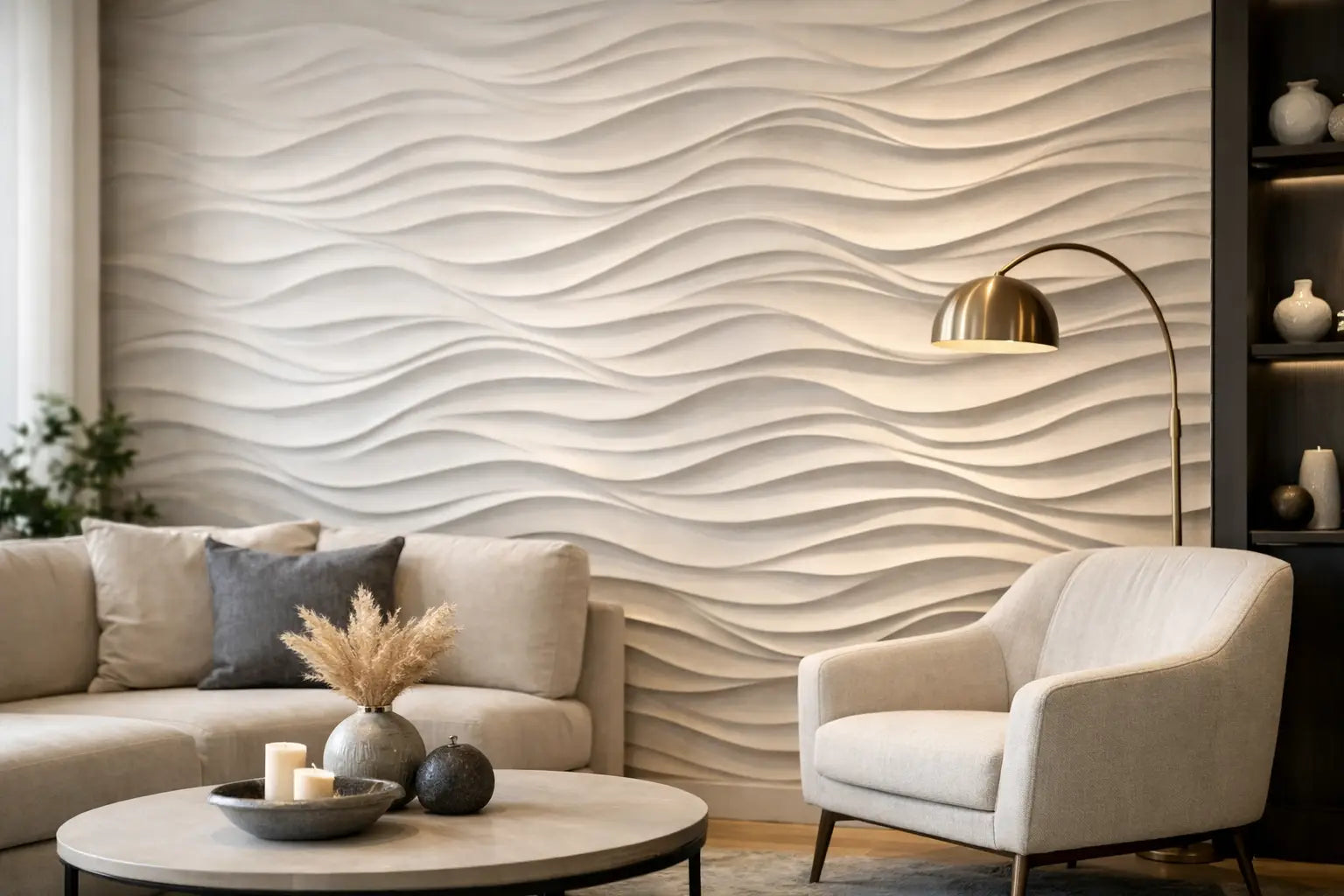
A living room can be perfectly furnished, well-lit, even generously sized, yet still feel flat. This lack doesn't always come from the furniture or colors. Very often, it comes from the walls. Choosing a textured living room wall can transform the atmosphere without weighing down the space, by adding what classic finishes don't provide: rhythm, depth, and a true architectural presence.
In a living space, the wall is not just a backdrop. It structures the gaze, highlights volumes, and sets the overall tone. When it remains smooth and neutral, even a well-appointed interior can seem unfinished. Conversely, a textured wall covering immediately creates a sense of character. The living room gains sophistication, without requiring extensive renovation.
Why a textured living room wall changes the perception of space
Texture first acts on light. A textured surface captures, diffuses, and nuances both natural and artificial lighting. Depending on the angle of the sun, the intensity of the wall lights, or the temperature of an LED light, the wall evolves throughout the day. It is this variation that gives an impression of living material and a high-end finish.
It also affects the reading of proportions. In a compact living room, a well-chosen 3D panel adds character without overwhelming the room, provided the treated area remains measured. In a large living room, it avoids the empty effect and introduces a visual tension more refined than a simple accent wall. The result is more architectural, more enveloping, and often more timeless than very marked decorative trends.
One should also not neglect the feeling of comfort. Certain plaster wall panels provide a discreet but real benefit in terms of acoustics and thermal insulation. In a living room, where one entertains, watches a movie, or seeks a peaceful atmosphere, this quality is as important as the aesthetics.
What style of textured wall for an elegant living room
Everything depends on the role you want to give the wall. If the goal is to create a strong focal point, geometric patterns offer a clean and contemporary presence. They are particularly suitable behind a sofa, around a television, or on a wall section visible upon entering the room. Their design provides structure and a sense of precision highly valued in modern interiors.
If you are looking for a more fluid, softer ambiance, undulating textures are often more enveloping. They soften the lines of furniture and introduce movement without rigidity. This is a wise choice in a living room where one wants to prioritize a sense of calm and comfort while maintaining a sophisticated decorative language.
Panels with integrated lighting follow another logic. They not only decorate the wall, they participate in the staging of the room. This solution works very well in a contemporary living room, especially with ambient lighting. However, it requires a little more thought regarding installation and the final rendering. The result can be spectacular, but it must remain consistent with the furniture, finishes, and desired level of sophistication.
Where to place a textured living room wall for the right effect
The best location is not necessarily the largest wall. It's the one that deserves to be highlighted. In many interiors, the wall behind the sofa remains the most obvious solution. It naturally accommodates a decorative treatment and helps structure the reception area without disrupting circulation.
The TV wall is also an excellent candidate. Texture gives substance to this often difficult-to-balance space, especially when the screen appears visually too dominant. A 3D covering creates a more elaborate frame and better integrates equipment into a global composition.
In a living room open to the dining room or kitchen, a single textured wall can also serve to delineate functions without compartmentalizing. This is particularly interesting in contemporary layouts where one seeks to maintain the fluidity of volumes while giving a clear identity to each zone.
On the other hand, covering all walls is not always the best idea. Texture needs to breathe. A targeted application often produces a more elegant, more legible, and more premium effect than a full treatment.
The right balance between texture, color, and light
A textured wall doesn't need a complex color to exist. On the contrary, sober shades often better reveal the quality of the pattern. Warm whites, mineral beiges, soft grays, or stone tones highlight shadows and depth with great subtlety. This palette easily fits into a timeless living room.
More sustained colors can be very successful, but they require more skill. A deep green, a dense greige, or a matte anthracite reinforces the sculptural effect, provided the room benefits from sufficient light. In a dimly lit living room, a too dark shade can reduce the readability of the texture instead of highlighting it.
Lighting plays a decisive role here. Frontal light tends to flatten shapes, while grazing light reveals volumes. Wall sconces, oriented spots, or indirect lighting significantly change the rendering. A beautiful panel poorly lit loses part of its potential. Conversely, a simple composition well staged immediately appears more luxurious.
Textured living room wall: aesthetics, but also daily use
In a living space, beauty must remain compatible with reality. The living room is a frequented, lived-in, sometimes lively space. Therefore, it is necessary to choose a solution that is not only attractive in photos, but adapted to daily use.
Plaster wall panels have a clear advantage here. They offer an elegant finish, can be painted according to the project, and contribute to a more qualitative perception of the wall. They are suitable for both residential renovation and a more ambitious project led by an architect, decorator, or developer.
Ease of installation also matters. For an individual, a well-designed system reduces the complexity of the work. For a professional, it improves the consistency of the result and the control of deadlines. This does not mean that all walls are equal. An uneven support, a technical cut, or an integration of lighting require precision. But when the product is clearly thought out, the final effect becomes much more accessible.
How to avoid an overly busy look
The main risk with a decorative wall is not a lack of effect. It's excess. A strong texture combined with too many materials, too many contrasts, or too many objects can quickly make the living room feel cluttered. Elegance comes from moderation.
If the wall is graphic, the furniture can remain simpler in its lines. If the texture is fluid and organic, you can allow for more texture in fabrics or rugs. The idea is not to neutralize everything, but to prioritize. The gaze should immediately understand what defines the room's signature.
Accessories must also follow this logic. A large artwork, a well-proportioned mirror, or a few chosen decorative elements can dialogue with the wall. An accumulation of shelves, frames, and small objects often breaks the readability of the texture. In a premium environment, every element must have a reason for being.
A lasting decorative investment
A well-chosen textured wall is not a fleeting trend. It brings an architectural quality that weathers decorative seasons better than a simple trendy color or a very marked wallpaper. This is what makes it an interesting investment for a living room, especially when seeking a visible, durable, and value-adding transformation for the entire property.
This durability lies as much in style as in the ability to evolve. A paintable panel allows the room to be updated without redoing the entire project. You keep the depth of the wall while adapting the shade to new furniture, a change of ambiance, or a partial renovation. This flexibility is precious for individuals as well as for professionals in interior design.
For those who desire an interior with a strong identity, but without falling into ostentation, this is often the right compromise. Texture brings prestige without coldness, character without overload, and an impression of a truly accomplished finish.
At a specialized brand like EFFET MARBELLA, this approach makes perfect sense: offering decorative surfaces that visually elevate the living room while meeting concrete expectations of comfort, personalization, and ease of installation.
The most beautiful choice is not necessarily the most spectacular. It is the one that gives the living room a calm, controlled, and lasting presence, as if the room had finally found its true dimension.


