
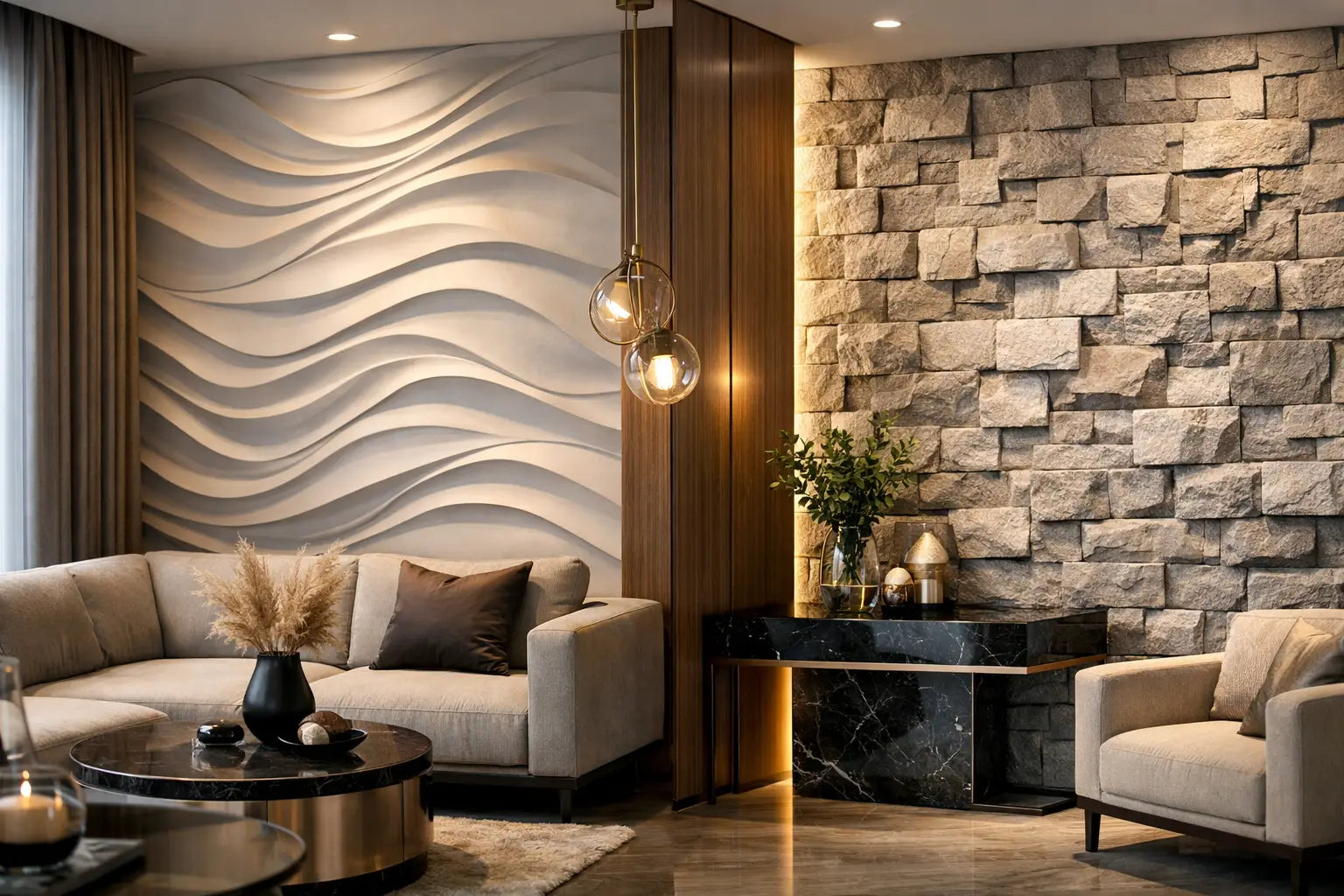
Between a flat wall that goes unnoticed and a surface that catches the light, creates relief, and immediately changes the atmosphere of a room, the choice is not insignificant. If you're hesitating between a wall panel or an interior cladding, you're already in the right place: this type of decision isn't just about taste, but also about the desired effect, installation time, overall budget, and expected level of finish.
In a living room, bedroom, entrance hall, or professional space, wall coverings set the tone even before the furniture. Some projects demand a strong architectural presence. Others require a more discreet, more textured, or more mineral solution. The right option is therefore not universal. It depends on what you want to evoke in the space.
Wall panel or interior cladding: what's the real difference?
These two families are often grouped under the same idea of wall decoration, but their logic is not the same. A wall panel is part of a structured surface approach. It covers the wall with a continuous design, often intended to create a regular, graphic, or sculptural relief. The effect is more architectural, more assertive, sometimes almost custom-made in its visual rendering.
Interior cladding, on the other hand, evokes material more. It seeks to reproduce or recall stone, brick, concrete, or other raw textures. It brings character, but with a more fragmented interpretation. Where the panel creates a coherent scene, cladding plays more on authenticity and material effect.
This nuance changes a lot of things. If you want to give a wall a central role in the room, the wall panel often has more impact. If you're looking for a decorative covering that evokes a workshop, mineral, or revisited traditional atmosphere, cladding may be more suitable.
The visual impact is not the same
A 3D wall panel transforms the perception of volume. It captures shadows, complements natural light, enhances ambient lighting, and adds depth to a simple wall. In a contemporary interior, this effect is particularly sought after because it allows for the addition of character without overloading the decoration.
Interior cladding, on the other hand, tells a different story. It creates a more tactile, more organic, sometimes more rustic look depending on the chosen finish. It works very well on a section of wall, around a fireplace, in an entrance, or to warm up a slightly too smooth space. But its rendering can quickly dictate the style of the room. A very pronounced stone imitation, for example, imposes its personality more than a geometric relief painted in the wall's shade.
This is where a simple question comes in: do you want a wall that structures the space or a wall that evokes a material? The first choice often leans towards the panel. The second towards cladding.
Installation: an often underestimated criterion
On paper, everything seems decorative. In reality, ease of installation can sway the decision. Decorative wall panels, especially plaster ones, are appealing due to their relatively straightforward installation on a prepared surface. The principle is clear, the result can be precise, and the whole gains in elegance when the joints are well treated and then painted to achieve a continuous effect.
Interior cladding sometimes requires more time. Depending on the format, modular aspect, or cuts, installation can become more meticulous. It's necessary to manage alignment, joints, visual balance, and sometimes the desired irregularities of the material. It's not necessarily more complicated, but it's often less linear.
For an individual who wants a sophisticated result with a clean and contemporary look, the wall panel offers a real advantage. For a professional, the choice will mainly depend on the aesthetic specifications and the pace of the project.
The substrate and preparation matter as much as the covering
A sound, clean, and stable wall is essential in both cases. However, wall panels particularly support a high-end finish ambition when the substrate is properly prepared. This is what allows for a homogeneous, clean, and durable rendering.
Cladding, on the other hand, sometimes tolerates certain small visual discrepancies better thanks to its texture, but this never exempts a serious base. A beautiful decorative wall always starts before installation.
Comfort, maintenance, and daily use
A covering is rarely chosen just for the final photo. Daily life must also be considered. From this perspective, the decorative wall panel has a strong argument: it combines design effect with a real functional dimension. Some plaster models provide an interesting complement in acoustic and thermal comfort, which can make a difference in a bedroom, TV lounge, or office.
Interior cladding can also reinforce the impression of visual warmth, but its technical benefits vary greatly depending on the material. Not all claddings are equal in terms of comfort. Some focus almost exclusively on appearance.
In terms of maintenance, everything depends on the relief and the finish. A panel painted in a matte or satin shade generally remains simple to integrate into a light maintenance routine. Highly textured cladding, on the other hand, can retain more dust, especially in pronounced hollows. This is not a prohibitive defect, but it should be anticipated in high-traffic areas.
Which choice for a contemporary interior?
In current projects, wall panels are often chosen when seeking a clean, fluid, and durable elegance. They blend particularly well with clean lines, noble materials, mineral palettes, light wood, deep black, or indirect lighting. They have the ability to enrich the space without making it look too busy.
Interior cladding remains relevant, but it needs to be dosed more precisely in contemporary settings. Well chosen, it creates an attractive contrast. Poorly calibrated, it can confine the room to an overly thematic aesthetic. Everything is therefore a matter of balance.
In which rooms do wall panels excel?
The living room is undoubtedly its most obvious domain, especially behind a sofa or TV unit. The bedroom also works very well, particularly as a headboard, where the relief brings an enveloping and more refined sensation than simple paint. In an entrance, it immediately creates a visual signature. In a professional project, it gives presence to a reception, waiting room, or reception area.
Cladding, on the other hand, retains real strength in areas where one wants to introduce a more raw material feel, such as around a dining area or on an accent wall that supports a more contrasting aesthetic.
Budget: don't just look at the price per square meter
The comparison between wall panels and interior cladding quickly becomes misleading if one limits oneself to the purchase price. Installation time, finishes, maintenance, visual durability, and the final effect achieved must be considered. A cheaper covering may require more adjustments and produce a less coherent result in a highly visible room.
Wall panels can represent a more design-oriented investment, but they often offer a more premium look from the first glance. This is particularly true when the goal is not merely to cover a wall, but to enhance the entire interior.
A careful buyer doesn't just pay for a material. They choose a presence, an atmosphere, a quality of transformation. This is why the most successful projects rarely stem from a purely accounting logic.
How to choose between wall panel or interior cladding
If your priority is to create a contemporary, sculptural, and elegant decor, with a controlled finish and a true sense of luxury, the wall panel is generally the best choice. It is particularly suitable for interiors that want to assert their style while remaining sober and timeless.
If you are primarily looking for an expression of material, a more rustic chic, industrial, or mineral atmosphere, interior cladding may better meet this intention. It has charm, but it requires stronger coherence with the rest of the decoration.
For lovers of refined interiors as well as for those undertaking more ambitious projects, the right criterion is not just what you like today. It's what you will still enjoy seeing every day in two, five, or ten years. Well-designed reliefs, paintable surfaces, and finishes designed to last meet this requirement with particular accuracy, as demonstrated by the solutions offered by EFFET MARBELLA.
The most beautiful wall is not the one that overdoes it. It's the one that clearly transforms the room, without ever tiring the eye.


