
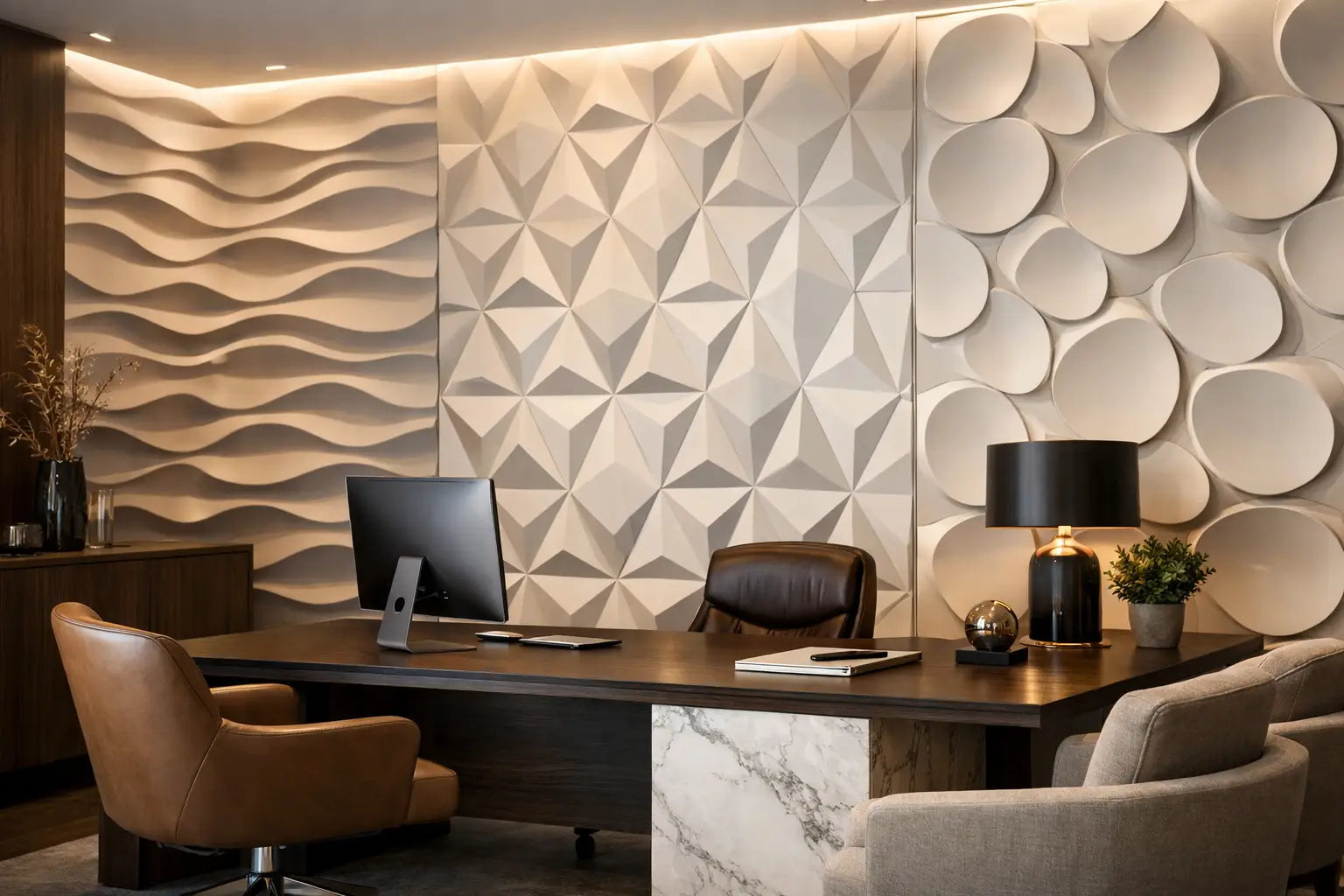
In an office, noise doesn't just come from conversations. It bounces off windows, smooth ceilings, hard floors, and bare partitions, making a meeting more tiring than it should be. An acoustic office wall covering can restore comfort to the space while transforming an ordinary wall into a true interior architectural element.
For a law firm, an open-plan office, a meeting room, or an executive office, the challenge is not to mask the walls with an impersonal technical solution. It's about creating a calmer, more focused, and visually more distinctive atmosphere. 3D plaster wall panels meet this ambition with sculptural reliefs, a paintable surface, and lasting elegance.
Why acoustics change the perception of an office
A workspace with poor sound management is immediately noticeable. Voices seem louder, phone calls carry far, and conversations overlap. Even when the sound level remains moderate, reverberation can create a feeling of constant agitation. It hinders concentration, confidentiality, and the comfort of both teams and visitors.
Perfectly flat and mineral surfaces reflect sound directly. Conversely, a wall with relief breaks this visual uniformity and contributes to a more subdued atmosphere. Wall coverings don't always replace a complete acoustic treatment, especially in a large, highly glazed open-plan office or a room with high ceilings. But they are a valuable component of a global project, particularly when combined with absorbent ceilings, textiles, curtains, or upholstered furniture.
The right choice therefore depends on the objective. Do you want to limit echo in a meeting room, make a reception area more welcoming, or create a visual separation in a shared space? The answer will determine the type of relief, the surface to be covered, and the complementary materials to consider.
Acoustic office wall covering: aesthetics serving comfort
A professional office reflects a way of working. White, smooth walls may seem functional, but they rarely convey an impression of care or singularity. A 3D wall panel adds depth, plays with light, and establishes an architectural presence without extensive carpentry work.
Geometric patterns are suitable for contemporary spaces seeking a precise and structured identity. They perfectly complement a meeting table, a company logo, or furniture with clean lines. Panels with undulating shapes create a more fluid expression, particularly suited to a lobby, waiting area, or executive office. Their relief captures shadows throughout the day and gives the wall a lively dimension, without decorative overload.
Lighting also plays a crucial role. Grazing light highlights volumes and emphasizes the quality of the design. In a premium space, panels integrating LED lighting can form a signature wall behind a reception desk or in a presentation room. The effect remains controlled when light is conceived as an accent, not a demonstration.
What a plaster panel truly brings
Plaster seduces with its mineral appearance, its finesse, and its ability to produce precise reliefs. It allows for a continuous finish, closer to an architectural work than a simple decorative covering. Once the joints are prepared and the surface painted, the wall gains coherence and refinement.
3D plaster panels also contribute to indoor comfort through their mass and relief. They can improve the acoustic sensation of a room by reducing the visual and sonic harshness of large flat surfaces. However, two often-confused concepts must be distinguished: acoustic insulation and acoustic correction.
Insulation aims to limit the transmission of noise from one room to another. It generally requires a complete composition with framework, insulation, plasterboard, peripheral sealing, and treatment of weak points, such as doors or outlets. Acoustic correction, on the other hand, seeks to improve the sound atmosphere within the same room by reducing reverberation. For measurable and high performance, a dedicated absorbent material or a suitable underlay may be necessary behind or around the decorative covering.
This nuance is essential for designing a fair project. A 3D plaster wall brings strong aesthetic value and can contribute to overall comfort, but it should not be solely entrusted with the mission of soundproofing an entire open-plan office. An approach combining decoration, absorption, and layout yields the most convincing results.
Where to install wall panels in workspaces
The wall behind the meeting table is often the first location to consider. It creates an elegant backdrop for meetings, video conferences, and presentations, while avoiding the cold effect of a white wall. A discreet pattern, painted in a deep or mineral shade, enhances the space without distracting participants.
In a reception area, the wall covering becomes a brand statement. It accompanies a logo, structures the visitor's journey, and gives an impression of quality from the entrance. In this case, a composition of panels over the entire height or on a targeted wall section can be enough to establish a strong identity.
Executive offices and consulting spaces lend themselves to more enveloping finishes. An undulating relief in a sand, greige, deep green, or midnight blue hue brings a calm sophistication. For corridors and circulation areas, it is often preferable to choose a visually resistant, uncluttered pattern to maintain fluid readability despite traffic.
In an open-plan office, the covering can mark quiet zones or delineate an informal meeting alcove. It will benefit from being combined with acoustic dividers, textile seating, and suspended elements if the volume is large. The goal is not to cover every wall, but to place interventions where they have the most effect on use and perception.
Choosing the right pattern, color, and surface to cover
A generous relief offers an immediate visual impact, but it must remain proportionate to the room. In a small office, fine patterns or gentle waves avoid visually shrinking the space. In a spacious lobby or meeting room, more assertive geometric shapes can give rhythm and establish a stately presence.
Paint is one of plaster's great assets. It allows the covering to be adapted to a graphic charter, to create a subtle tone-on-tone, or, conversely, to make the wall a focal point. A matte finish generally reveals the relief better than a glossy paint, which can produce overly bright reflections under office lighting.
The amount of wall covered also deserves consideration. A complete section is relevant when it serves as a main decor or when it needs to correct the monotony of a large volume. A partial composition works very well for framing an area, highlighting a niche, or creating a perspective head. The choice depends on the light, ceiling height, furniture, and the desired level of expression.
Preparing the installation for a durable finish
The quality of a wall covering relies as much on the installation as on the panel's design. The substrate must be clean, stable, dry, and sufficiently flat. Careful preparation facilitates the alignment of modules and reduces finishing work at the joints.
For a professional project, it is useful to plan the layout before installation. This step allows anticipating cuts around outlets, switches, fixed furniture, or signage. It also helps position the pattern in a balanced way, especially when it extends from one panel to another.
Plaster panels require careful handling, but their installation remains accessible with the right accessories and a rigorous method. On a highly trafficked wall or as part of a large-scale project, professional intervention ensures a neat, continuous, and durable finish. For a simpler project, a diligent DIY enthusiast can achieve remarkable results by respecting drying times, jointing, and preparation before painting.
Designing an office you want to inhabit
A high-performing workspace is not just about its furniture or surface area. It relies on an ambient quality: pleasant light, controlled sound levels, chosen materials, and walls that give the place an identity. 3D wall covering brings these dimensions together in a single decorative gesture.
At EFFET MARBELLA, plaster panels are designed to create expressive, customizable, and timeless interiors. For an office, the most beautiful result often comes from a simple decision: choosing a strategic wall, a suitable relief, and a color that allows the material to dialogue with light. Comfort sometimes begins with what you decide not to leave flat anymore.


