
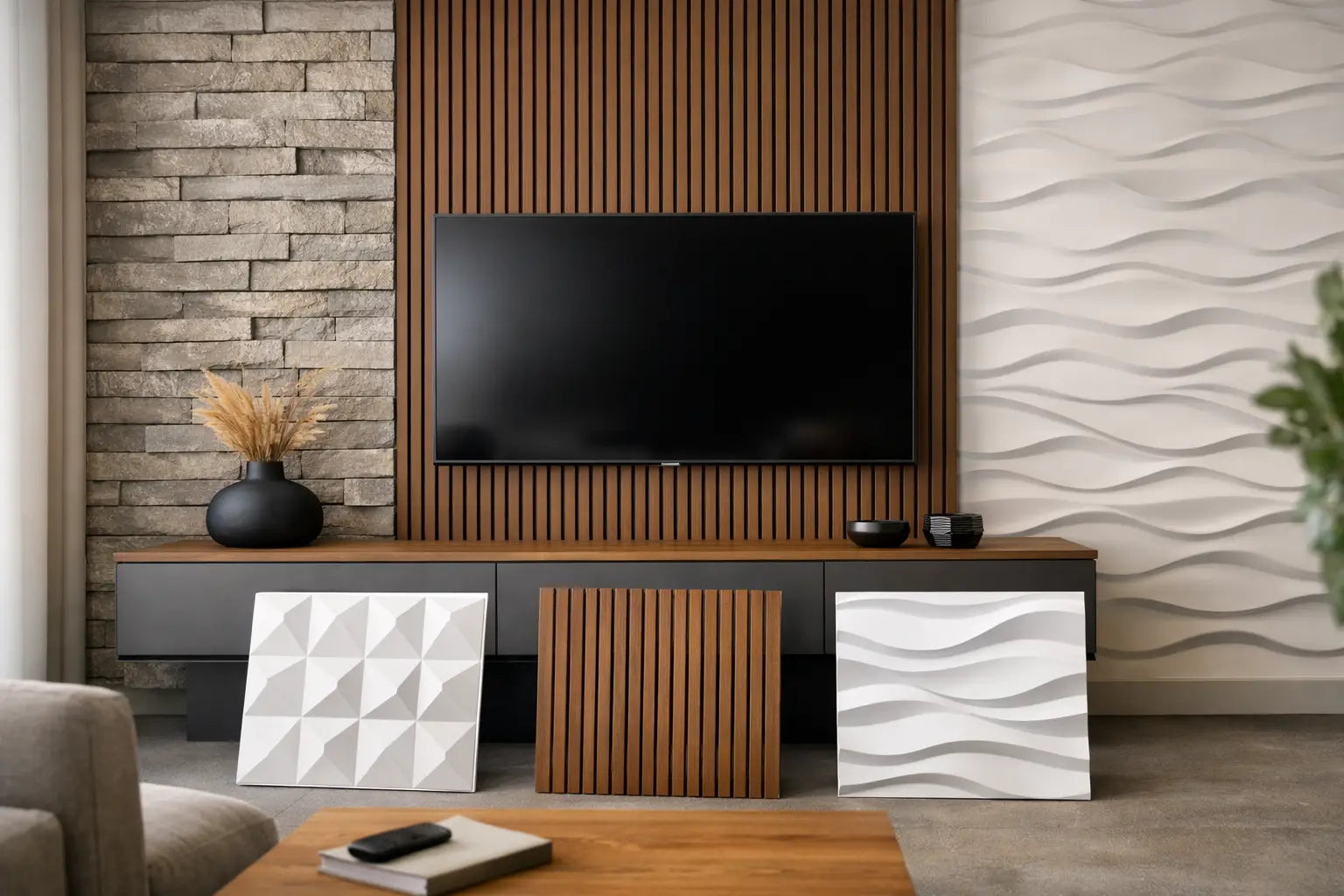
A poorly executed TV wall is immediately noticeable. Even with a beautiful screen, neat furniture, and well-thought-out lighting, the overall effect can remain flat, cold, or visually cluttered. The real question is therefore not just what TV wall panel to install, but which panel will give the living room an architectural presence, without weighing down the space or complicating installation.
In a contemporary interior, the TV wall is no longer just a backdrop. It structures the room, frames the gaze, and gives rhythm to the volume. Well-chosen, it transforms a functional corner into a decorative composition in its own right. Poorly chosen, it creates the opposite effect – visual overload, non-durable material, demanding maintenance, or an outdated look after a few months.
Which TV wall panel for the desired effect
The right choice depends first and foremost on the desired ambiance. Not all decorative panels tell the same story. Some establish a very clean graphic line, others bring softness through movement, while still others rely on light to create a sophisticated focal point.
If you are looking for a sleek and architectural finish, geometric panels are often the most appropriate. They are particularly suitable for modern living rooms, apartments with sober lines, or projects where the TV unit is minimalist. Their strength lies in their visual structure – they decorate without dispersing.
For a more enveloping space, wave or curved panels create a more fluid sensation. They soften the very rectangular presence of the screen and add relief without rigidity. This is a very relevant choice in rooms where you want to introduce visual texture while maintaining a calm atmosphere.
Panels with integrated LED lighting respond to a different logic. Here, the wall does not just serve as decor; it participates in the staging of light. The result can be spectacular, provided it remains measured. In a living room, indirect lighting works better than an overly dramatic effect. Visual luxury often comes from restraint.
Relief, a central asset
On a TV wall, relief does almost everything. It breaks the monotony of a large vertical surface and adds depth around a naturally black and smooth screen. It is precisely this contrast that creates a high-end finish.
That said, the more pronounced the relief, the more it requires a balanced composition. In a small room, a very strong pattern can visually reduce the space. Conversely, subtle relief is often enough to add character without saturating the visual perception of the room. Elegance rarely comes from excess.
Which material to favor for a TV wall
The material influences both style and use. On this point, you need to look beyond appearance. A TV wall is exposed to light, ambient variations, sometimes frequent passages, and must remain clean over time.
3D plaster panels are particularly suitable for this use when combining visual refinement and finishing quality. They offer precise relief, an elegant mineral presence, and a surface that can be painted to match the decorative project. Their rendering is nobler than visually similar solutions in lighter or shinier materials.
Another significant advantage is that plaster also contributes to indoor comfort. Depending on the configuration of the wall and the room, it can contribute to a better acoustic sensation and a more subdued environment. In a living room, where the screen, speakers, and sound reverberation play an important role, this detail matters more than one might imagine.
PVC or certain synthetic panels may be appealing due to their price or apparent ease. But for a central TV wall in a living room, their finish can quickly appear less sophisticated. The surface appearance, the depth of the pattern, and the overall perception of quality make the difference. If the goal is to sustainably enhance the interior, it is better to think in terms of the final result, not just immediate cost.
Which TV wall panel for a small living room
In a compact space, the priority is not to fill the wall, but to structure it intelligently. An overly busy panel or one installed across the entire width without visual breathing room can overwhelm the room. Conversely, a well-proportioned panel adds verticality and draws the eye where it needs to be.
Most often, a regular pattern, with moderate relief and a light shade, works very well. Off-whites, greiges, stone beiges, or sand tones keep the overall look bright while highlighting the volumes. A panel painted in a too dark shade can be superb, but it generally requires more space or very well-controlled lighting.
In a small room, it is also wise to limit the number of competing materials. If the TV wall already has textured furniture, a strong-presence floor, and thick curtains, a sober panel will have more impact than a very dramatic design. The right wall is not the one that draws all the attention, but the one that makes the whole more coherent.
Should the entire wall be covered or just a zone?
It all depends on the room's format and the desired composition. A full covering creates a true architectural scene. This is often the best choice in a spacious living room, with a centered screen and well-aligned furniture.
On a narrower wall, it may be more elegant to treat only the area behind the television and the low unit. This approach frames the installation, reduces the budget, and maintains a beautiful visual lightness. It works very well in contemporary interiors where every element needs to breathe.
Practical criteria not to neglect
Aesthetics are the first attraction, but the success of the project often lies in technical details. A TV wall panel must be easy to integrate, durable, and consistent with the daily use of the living room.
Paintability is a real advantage. It allows the panel to be adjusted to the room's palette, to match it with the joinery, or to create a very sophisticated tone-on-tone effect. It is also a safeguard for the future – if the ambiance evolves, the wall can follow suit without being replaced.
Ease of installation also matters. Some panels are designed to offer a premium finish without requiring a complex construction site. For a careful individual as well as for a professional, this dimension is far from secondary. A beautiful product loses its value if its implementation becomes a source of irregularities or delays.
It is also necessary to anticipate cable routing. On a TV wall, visual purity often relies on this point. The chosen panel must allow for a clean integration of the screen, sockets, an eventual light strip, or audio equipment. Nothing breaks the high-end effect faster than a visible wire on a carefully crafted decor.
Matching the panel to the living room style
The TV wall should not exist in isolation. It must dialogue with the furniture, lighting, flooring, and general palette. This is what creates a truly accomplished result.
In a minimalist interior, linear or geometric reliefs are particularly convincing. They extend the spirit of the place and reinforce the feeling of precision. In a warmer decor, with light wood, textured fabrics, and natural shades, panels with fluid shapes create a softer balance.
For a more scenographic ambiance, the addition of indirect LED lighting can sublimate the volumes. One simply needs to avoid the light overshadowing the material. The panel remains the main element. The light should reveal its design, not hide it.
In this logic, the decorative solutions offered by specialized brands like Effet Marbella effectively meet the expectations of current projects – creating a strong, elegant, and durable wall, without sacrificing ease of installation or daily visual comfort.
The best choice is not always the most spectacular
When wondering which TV wall panel to choose, the temptation is often to go for the most impressive pattern. However, over time, it is the best-balanced compositions that remain the most beautiful. A good TV wall should accompany the living room, not dominate it.
The ideal panel is therefore one that assumes a true decorative presence while respecting the scale of the room, the available light, and the style of the furniture. Controlled relief, quality material, paintable finish, clean integration of the screen, and eventual acoustic dimension – these are the criteria that truly matter.
If your living room lacks character, the TV wall is one of the most effective ways to transform the space with elegance. You just need to choose a panel that does not just seek to fill a wall, but to give it a reason to exist.


