
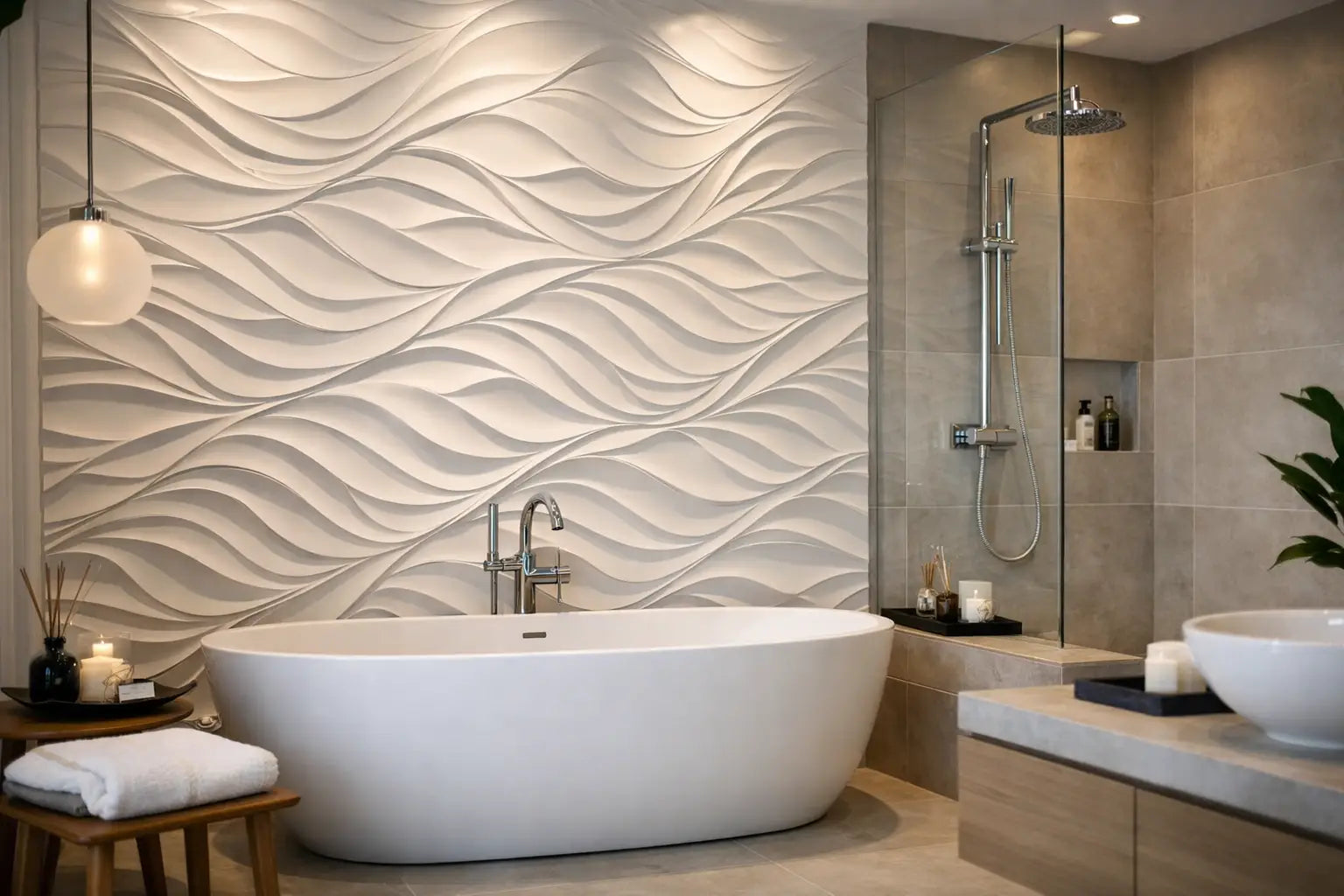
A successful bathroom isn't just about the taps or the choice of tiles. It's felt in the light, the volumes, and the details that give the space a unique presence. 3D wall panels for bathrooms allow for the introduction of this architectural relief, transforming a plain wall into a refined decor without heavy renovation.
Their strength lies in their ability to evolve the space according to the time of day. A grazing light highlights a soft wave, a geometric line, or a sculpted pattern. The wall comes alive, while maintaining lasting elegance. In a contemporary bathroom, this effect provides the visual warmth that is sometimes lacking in smooth, cold, or very mineral surfaces.
Why relief changes the bathroom's atmosphere
The bathroom is often treated as a strictly functional room. Yet, it's also the first preparation space in the morning and where one seeks to unwind in the evening. Relief adds a subtle sensory dimension. It creates shadows, structures proportions, and draws the eye without imposing a strong color or busy pattern.
A 3D panel can, for example, frame a suspended basin, extend the line of a mirror, or add depth to the wall opposite the bathtub. In a small bathroom, the goal is not to cover all walls. A single accent wall, or even a vertical composition behind the vanity unit, is often enough to establish a decorative signature.
Geometric patterns suit graphic and contemporary interiors. Wavy patterns provide a more soothing movement, particularly harmonious near a bathtub. Panels incorporating LED lighting, meanwhile, offer a more scenographic interpretation of the volume, provided that the lighting is adapted to the room's requirements.
Where to install 3D wall panels in the bathroom?
The right location depends primarily on water exposure. Decorative plaster panels are particularly relevant in dry areas or those not directly exposed to splashes: the wall behind a vanity unit, toilet area, entrance wall, decorative niche, wall section opposite the shower, or the outer contour of a freestanding bathtub.
They should not be considered a substitute for a waterproofing system in an open shower, on a wall directly splashed by a bathtub, or inside a shower cabin. In these areas, the substrate, waterproofing under the covering, and the finishing covering must meet the constraints of humidity and splashes. Tiles, stone, or a surface specifically designed for a wet area generally remain more appropriate.
This distinction does not diminish the interest of relief. On the contrary, it allows for the creation of a more sophisticated bathroom by associating materials appropriately: a protected technical zone near the water, then a sculptural wall in the dry part. The result appears more architectural, and the finish maintains all its beauty over time.
The wall behind the basin
This is the most natural location for a 3D panel. It creates an immediate focal point, enhances the mirror, and gives more presence to an often very minimalist piece of furniture. A satin paint or a finish compatible with humid rooms facilitates maintenance while revealing the shadows of the pattern.
The wall opposite the bathtub
When sufficiently far from splashes, this wall is ideal for a more expressive composition. A wave pattern, painted in a warm white, a mineral beige, or a very soft grey, enhances a spa ambiance without making it excessively decorative.
A niche or a transition zone
In a bathroom open to a bedroom, a dressing room, or a hallway, the 3D panel can mark the transition between spaces. A vertical strip of relief then adds character without visually cluttering the room.
Choosing the right pattern, scale, and color
The choice of a panel should not be based solely on a photograph. A spectacular pattern in a large hotel can become too dominant in a room of a few square meters. You need to consider the size of the wall, the ceiling height, the available lighting, and the existing materials.
Large, fluid reliefs enhance generous walls and calm volumes. Fine or geometric patterns find their place more easily in a compact bathroom, where they add rhythm without reducing the feeling of space. If the wall is narrow, a vertical design can also give an impression of height.
The possibility of painting the panels is a major advantage. A tone-on-tone finish creates a subtle, almost monolithic decor. Conversely, a deeper shade can accentuate the hollows and protrusions of the pattern. In a bathroom, off-whites, sand shades, clay greys, and muted greens offer a more lasting elegance than overly sharp contrasts.
The level of sheen also matters. A matte paint gives a muted and very contemporary look but may be less easy to clean depending on its quality. A velvety or satin finish, chosen for humid rooms, often represents the best balance between visual depth and ease of maintenance.
Plaster material in a humid room: the right conditions
Decorative plaster panels offer precise relief, a mineral presence, and a high-end finish. However, their use in a bathroom requires careful installation. The room's ventilation, the quality of the substrate, and the choice of finishing products play a decisive role in their durability.
Before installation, the wall must be clean, sound, dry, stable, and flat. Persistent humidity, infiltration, or a crumbling substrate must be treated before any installation. After gluing and joint treatment, applying an appropriate primer and then paint designed for humid environments helps protect the surface and standardize the finish.
Joints deserve special attention. Well-made, they give the impression of a single sculpted wall. Poorly prepared, they break the continuity of the pattern and become more visible under side lighting. For a large area, the intervention of an installer accustomed to decorative panels can make a real difference in the final quality.
Panels can also contribute to the room's comfort thanks to their thickness and structure, especially acoustically. However, this contribution depends on the entire wall, the existing insulation, the substrate, and the configuration of the dwelling. It does not replace technical insulation when necessary but adds a valuable layer of comfort in a renovation project.
Installation: prepare the decor before fitting
Successful installation begins with a layout plan. Before gluing the first panel, it's useful to mark the axes of the vanity unit, mirror, wall lights, sockets, and any cutouts. This work avoids ending up with a too narrow section of pattern on a wall edge or an awkward junction around equipment.
Lighting should be considered from this stage. A wall light placed near the wall or an indirect light strip can magnify the relief, but a source that is too powerful and too low will accentuate every imperfection. In a bathroom, all electrical equipment must naturally be chosen and installed according to the applicable safety volumes.
For careful individuals, panels designed for simplified installation make the project accessible over a reasonable surface. For a highly visible wall, a large composition, or a bathroom with technical constraints, a professional remains a reassuring choice. The challenge is not just to fix the elements: it's about achieving clear, durable, and perfectly aligned visual continuity.
Daily maintenance of a 3D wall
A well-protected decorative wall requires little effort. Gentle, regular dusting is usually enough to preserve the relief. In case of marks, use a soft, slightly damp cloth, without abrasives or aggressive products. Rough sponges and very alkaline cleaners risk dulling the paint or altering the finish.
Effective ventilation remains essential after showers and baths. It limits condensation on all surfaces of the room, including decorative walls. If the paint shows signs of wear after several years, the advantage of a painted panel is that it can be refreshed without replacing the entire decor.
Choosing 3D panels for a bathroom means giving this room a more personal ambition. By respecting water zones and taking care of the finish, the relief is not just a visual effect: it becomes a matter of comfort, light, and character, designed to accompany daily gestures for the long term.


