
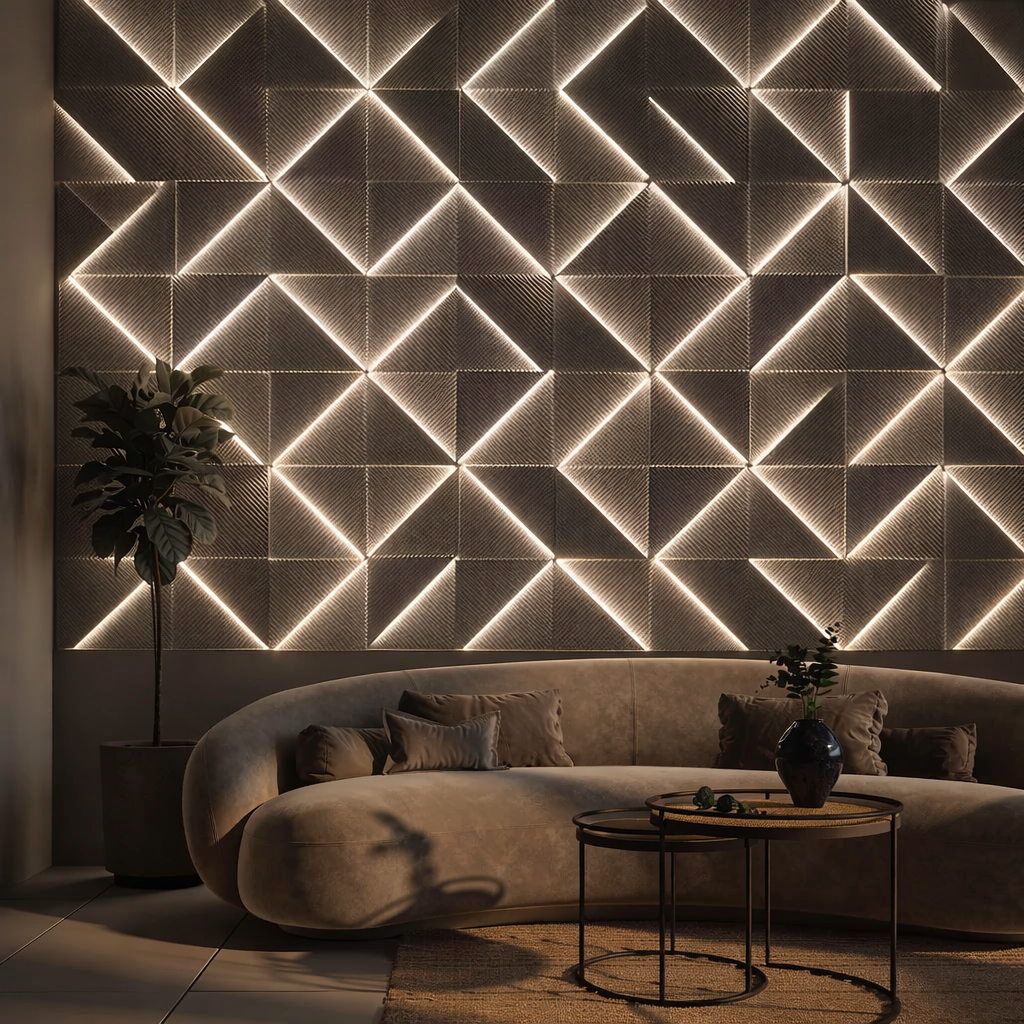
A living room can be perfectly furnished and yet lack presence. Often, the problem lies not with the sofa or the color of the walls, but with the relief and the light. This is precisely where a LED wall panel for living room ambiance changes the perception of the room. It doesn't just decorate a wall. It creates visual depth, emphasizes volumes, and establishes a more refined, calmer, more architectural atmosphere.
In a contemporary interior, indirect light has a rare quality. It enhances without being aggressive, complements materials without overpowering them, and transforms a simple wall into a true compositional element. When combined with a 3D panel, the effect becomes even more convincing. The relief captures the light, creates subtle shadows, and gives the living room that high-end finish feel that is immediately noticeable.
Why choose an LED wall panel for your living room's ambiance
The living room is a hybrid room. We entertain there, we relax there, we read there, we watch movies there. A single central light is rarely enough to accommodate all these uses. An LED wall panel allows for the introduction of softer ambient light, while also giving the wall a strong decorative dimension.
The benefit is twofold. On one hand, the relief dresses the space and replaces the monotony of a flat surface. On the other hand, integrated or backlit lighting adds a warmer interpretation of the volume. The result looks elaborate but remains very visually clear. It is a decorative choice that adds character without cluttering the room.
For a living room, this balance is essential. An overly demonstrative composition can quickly become tiring. Conversely, a well-designed wall with controlled lighting creates a durable, elegant decor that is easy to evolve with furniture, textiles, or color.
What to expect from a living room LED wall panel
The desired effect depends on the style of the room, but certain results almost always occur. The first is the feeling of depth. Even in a medium-sized living room, a textured wall appears more lively than a smooth wall. It draws the eye and gives an impression of a more refined interior architecture.
The second effect is related to the light itself. A well-integrated LED does not aim to light up the entire room like a ceiling light. It accompanies the moment. In the evening, it softens the atmosphere. During the day, it extends the elegance of the relief without taking over. This restraint makes all the difference in a meticulously designed interior.
Finally, there's the signature effect. A living room LED wall panel often becomes the focal point of the room – behind the sofa, on the TV wall, or in a transition area open to the dining room. It structures the decor without multiplying decorative objects.
Relief, shadow and indirect light
A 3D panel works particularly well with an LED source because indirect light reveals shapes instead of flattening them. Geometric lines gain precision, wavy patterns become more enveloping, and more sober compositions take on a sculptural dimension.
It is also a more timeless choice than some very colorful or overly technological lighting effects. In a living room designed to last, warm light and a well-defined relief are better than an overly demonstrative device. Visual luxury often comes from mastery, not excess.
Where to install an LED wall panel in the living room
Location matters as much as the panel itself. The wall behind the sofa is the most natural choice, as it allows for the creation of an elegant and immediately visible backdrop. This is often the best option if you want to add character to the living room without altering the entire room.
The TV wall also works very well, provided a balanced composition is maintained. The panel should not compete with the screen. Overly complex shapes or excessively strong lighting can impair visual comfort. In this case, a regular pattern and soft light are generally more suitable.
In an open-plan living room, an LED panel can also be used to delineate a zone. It helps to distinguish the lounge area from the dining room or an entrance, without creating partitions. This is particularly interesting in contemporary apartments where circulation remains fluid, but where one still wishes to prioritize volumes.
Placement mistakes to avoid
A wall already cluttered with frames, shelves, and decorative objects is not always the best support. Relief needs space to breathe. The stronger the panel's design, the more controlled the environment must remain.
One must also consider reflections and color temperature. A LED that is too cool can harden the living room ambiance, especially with mineral finishes or neutral tones. A warm or warm white light enhances the material more and reinforces visual comfort.
What style of LED wall panel for which decor
Not all living rooms require the same design. In a minimalist interior, geometric panels with clean lines create a precise, very contemporary architectural effect. They are well suited to uncluttered spaces, with low furniture, natural tones, and a few noble materials like dark wood, black metal, or discreet brass.
In a more enveloping living room, panels with wavy shapes soften the overall look. They introduce movement without rigidity and interact very well with generous textiles, heavy curtains, textured carpets, or more organic seating.
The right choice also depends on the size of the wall. A very striking pattern on a small surface can quickly appear dense. Conversely, on a large wall, a too discreet relief risks losing its impact. Therefore, one must consider the overall scale of the room, not just the isolated panel design.
A decorative choice that remains practical
The appeal of a decorative wall panel is not limited to aesthetics. In a living room, it can also contribute to perceived comfort. 3D plaster panels offer a richer material presence than a simple painted coating, and certain systems contribute to better acoustic and thermal insulation. This is important in a living space where one seeks tranquility as much as elegance.
Another significant advantage is that the surface can be painted. This allows the panel to be adapted to the exact desired ambiance, whether it's a luminous white, a mineral beige, a sophisticated greige, or a deeper shade for a living room with strong character. Paint not only personalizes but also helps integrate the panel into the overall decorative project.
For both individuals and professionals, ease of installation also plays a role. A beautiful product must remain compatible with clear implementation. This is one of the points that make this type of solution particularly interesting in current renovations.
How to successfully create an LED wall panel living room ambiance project
The simplest approach is to start with the desired atmosphere before thinking about the pattern. If the goal is a cozy living room, the priority will be warm light, soft relief, and a calming color palette. If a more graphic look is desired, one can opt for sharper lines and a slightly more pronounced contrast.
Next, you need to look at the room as it is actually used. A family living room does not have the same needs as a reception lounge or a show home in a real estate project. The right panel is one that remains beautiful long-term, with the right light intensity and the right level of visual presence.
Finally, it's better to avoid treating all the walls. A single well-thought-out wall often has more impact than an entire room overloaded with relief. Refinement comes from measure. On https://effetmarbella.fr/, this approach makes perfect sense through collections designed to give character to the space while maintaining true decorative legibility.
What an interior truly gains
When the choice is right, the living room appears more accomplished without seeming forced. The light becomes softer, the volumes more interesting, and the overall impression gains in perceived value. It's a visible transformation, but also a tangible one. We notice less a simple decorated wall than an ambiance that seems naturally better designed.
An LED wall panel is therefore not just another passing trend. It's a precise way to introduce relief, light, and visual comfort into the most watched room in the house. Well-chosen, it gives the living room that calm and elegant presence that depends neither on accumulation nor exaggeration, but on a true sense of composition.
The most beautiful result is not the one that attracts all the attention, but the one that makes the living room more harmonious as soon as you enter the room.


