
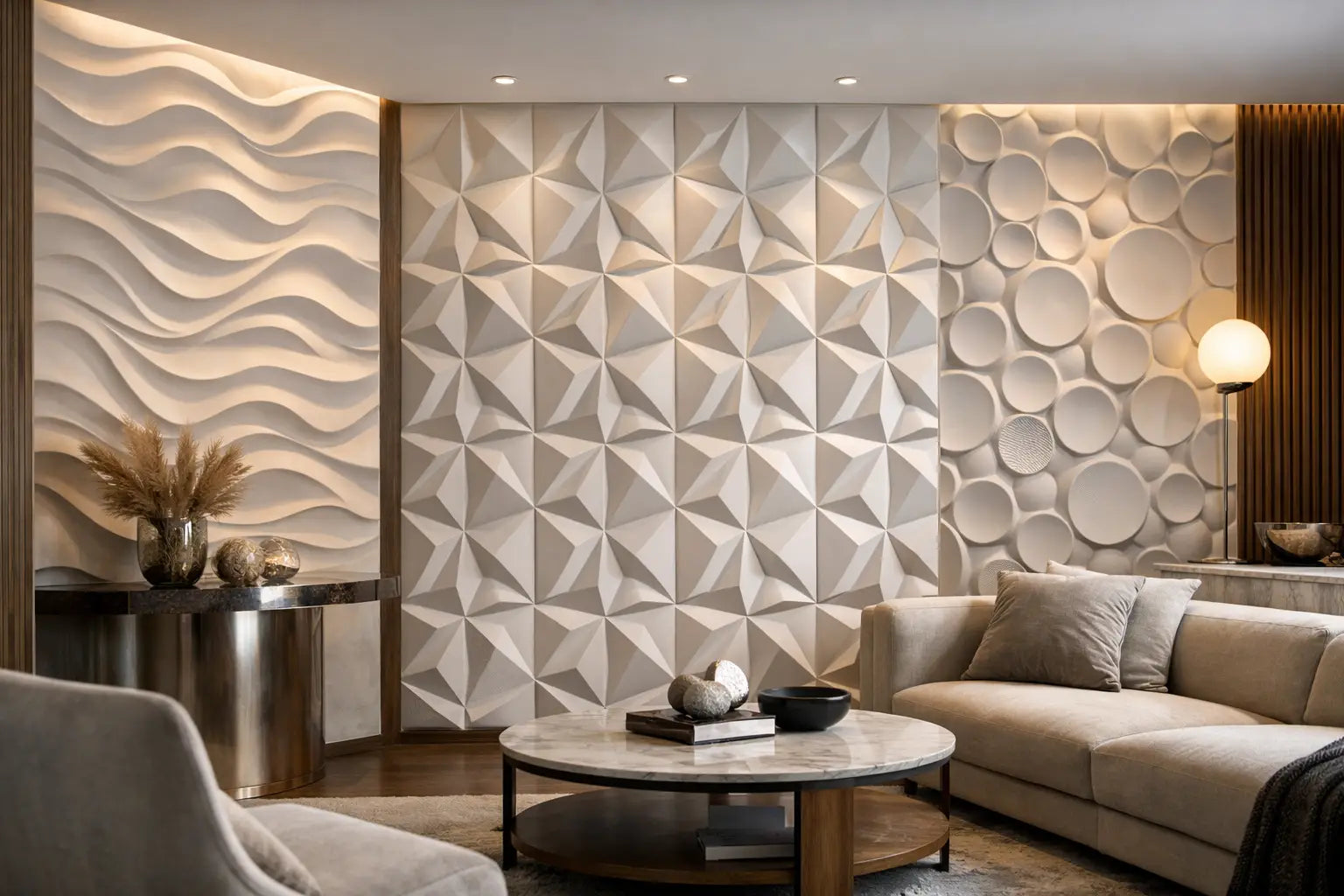
A flat wall can leave a perfectly furnished room without real presence. Conversely, a textured covering immediately changes the perception of space, captures light, and provides that extra architectural element that paint alone cannot create. If you are wondering how to choose 3D wall panels, the right approach is not to start with a favorite design, but to look at the whole picture – room volume, light, use, finish, and aesthetic requirements.
How to choose 3D wall panels based on the room
The first criterion is always the location where the panel will be installed. A decorative wall in a living room does not have the same expectations as a headboard, a hallway, or a reception area. In a living room, a strong visual effect is often sought, capable of structuring the room without making it feel heavy. Geometric patterns work very well for this, as they provide a clear and contemporary rhythm.
In a bedroom, the choice is often more subtle. Fluid lines, waves, or softer reliefs create an enveloping and calmer atmosphere. The panel should not only look good from the front. It must also remain pleasant in dim light, in the morning as well as in the evening.
In a hallway or entrance, caution is advisable. A relief that is too deep can visually reduce the space, especially if the width is limited. In this case, it is better to opt for a delicate, elegant design that adds texture without creating a cluttered feeling.
For a professional project, such as a lobby, an office, or a reception area, the logic changes again. The panel must make an impression, but also last over time and maintain an impeccable appearance. This is where the choice of material and finish becomes decisive.
The style of the pattern must harmonize with the architecture
A good 3D panel is never chosen in isolation. It must extend the spirit of the place. In a very contemporary interior, graphic, repetitive, and sharp forms reinforce the rigor of the lines. In a warmer decor, curves or organic reliefs avoid too cold a result.
One must also consider the scale of the pattern. This is an often underestimated point. A large, spectacular design can be magnificent on a wide, clear wall section, but lose its impact on a small surface cut by doors, furniture, or outlets. Conversely, a pattern that is too small can appear busy over a large length.
The most accurate approach is to seek a balance between presence and breathing room. A 3D wall panel should create a focal point, not visual overload. The stronger the furniture, the more restrained the wall should remain. The more minimalist the arrangement, the more prominent the relief can be in the composition.
Geometric, wave, or integrated LED
Geometric panels are suitable for structured interiors, modern living rooms, offices, and projects where a distinct identity is desired. Wave panels soften the ambiance and are well-suited for bedrooms, lounge areas, or rooms where natural light plays on the reliefs.
Panels with integrated LED lighting add a more scenic dimension. They are particularly interesting for headboards, TV walls, or high-end commercial spaces. However, they require more precise planning regarding electrical installation and the desired effect. They are not suitable for all projects, but when used well, they truly transform the wall into an element of interior architecture.
The material makes all the difference
When looking for how to choose 3D wall panels, aesthetics first catch the eye, but the material determines the actual quality of the project. Plaster panels stand out for their premium look, visual density, and elegant finish. They offer a clear relief, good durability, and a surface that can be painted to perfectly integrate into the chosen decorative universe.
Plaster also offers a practical advantage. It contributes to acoustic comfort and thermal insulation, which is important in a living room as well as in a bedroom or a professional space. This advantage is particularly valuable when you want to enhance a wall while improving the overall feel of the room.
However, one must accept a certain level of requirement. A premium panel should not be treated as a simple surface covering. It deserves careful installation, a prepared substrate, and precise finishes. This is what allows for that monolithic, elegant, and high-end effect, highly sought after in contemporary interiors.
Light is as important as the panel itself
A 3D panel never exists without light. It is light that reveals shadows, emphasizes recesses, and brings the pattern to life throughout the day. In a well-exposed room, even a subtle relief can become spectacular. In a darker space, a too subtle pattern risks fading away.
Before choosing, observe the orientation of the room, the presence of windows, the color of adjacent walls, and the type of artificial lighting planned. Grazing light enhances volumes. Too frontal light flattens them. This is why a 3D wall placed behind lighting specifically designed for it produces a much superior result to a wall chosen solely based on a photo.
Should 3D wall panels be painted?
Yes, and this is often one of their great assets. Paint allows you to unify the wall, adapt the rendering to your palette, and enhance the elegance of the relief. Light colors visually enlarge the space and give a sophisticated, very architectural look. Deeper colors create a more theatrical and enveloping effect.
The choice of finish also matters. A too glossy paint can disrupt the perception of the relief, while a matte or velvety finish better enhances the forms. It all depends on the desired style, but in a refined interior, sobriety often works better than a demonstrative effect.
Easy installation does not mean improvised installation
Many buyers are looking for a product that is easy to install, and that is legitimate. But the real question is not just about ease of installation. It is about the quality of the final result. A 3D wall panel can be accessible to a skilled DIYer, provided the substrate is prepared, the modules are perfectly aligned, and the joints are carefully finished.
If the wall has imperfections, if the project covers a large area, or if the pattern requires impeccable continuity, hiring a professional is often a wise choice. The difference is immediately noticeable. In a high-end decorative project, installation details are not secondary – they are part of the result.
It is also necessary to check the necessary accessories, including suitable adhesives, jointing compounds, cutting tools, and finishing solutions. A beautiful wall effect depends as much on the chosen panel as on the consistency of the installation.
How to choose your 3D wall panels without making a mistake
To choose your 3D wall panels well, you must resist two common mistakes. The first is to choose solely according to trends. A very fashionable pattern can be appealing today and tire faster than a more timeless design. The second is to underestimate the role of context. The most beautiful panel in the catalog will not necessarily be the best for your room.
A successful choice generally relies on four simple questions. What effect do you want to create – structure, soften, impress, or visually enlarge? What place will the wall hold in the room? What level of finish do you expect? And finally, do you want a purely decorative rendering or a covering that also provides acoustic and thermal comfort?
It is precisely this global perspective that makes it possible to distinguish a decorated wall from a truly transformed interior. With a brand like EFFET MARBELLA, this requirement is expressed in panels designed as much for the beauty of the relief as for the quality of use.
The right choice is the one that remains relevant over time
A successful 3D wall panel does not just seek to attract attention at the time of installation. It must remain consistent with your interior over time, accompany the evolution of furniture, tolerate color changes, and retain its strength without becoming tiresome. This is why balanced lines, noble materials, and careful finishes stand the test of time better than overly demonstrative effects.
If you are still hesitating, look at your room as a whole and not as a simple wall to cover. When relief, light, material, and style work together, the panel no longer just decorates the space – it gives it a true signature.


