
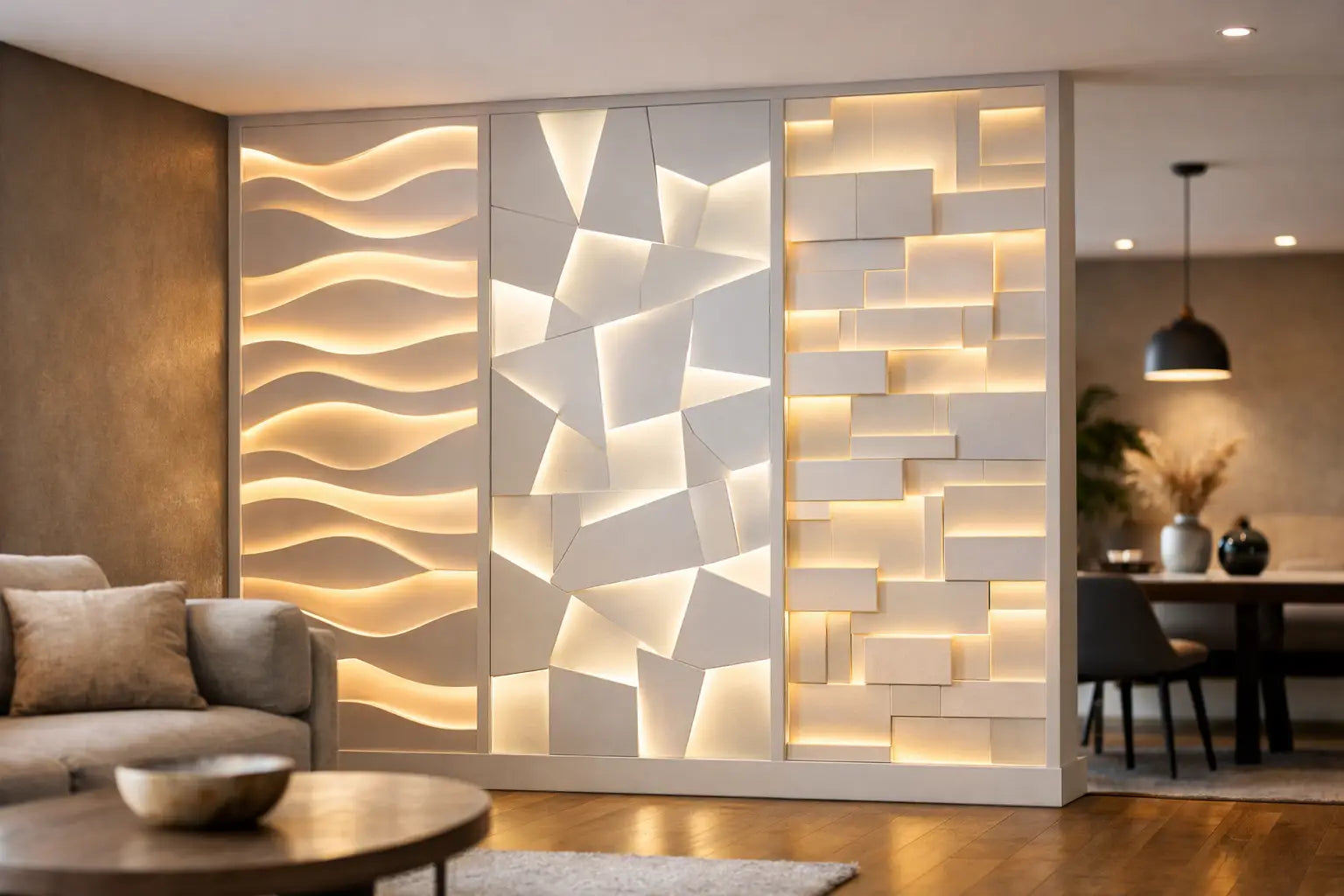
A luminous decorative partition immediately changes the perception of a room. It doesn't just separate two areas. It creates rhythm, draws the eye, and establishes a more architectural, more refined ambiance. When well thought out, it brings both relief, visual comfort, and true decorative value.
The decisive factor is not just the light. It's the balance between material, design, diffusion, and proportions. An overly busy partition fatigues the eye. A too discreet partition loses its impact. Therefore, successfully creating this element requires a precise approach, especially if one desires a durable and elegant result rather than a simple trendy effect.
Achieving a Luminous Decorative Partition Starts with the Right Intention
Before choosing a pattern, a shade, or LED lighting, it's essential to clarify the role of the partition. In a living room, it can structure the transition between the living and dining areas without closing off the space. In an entryway, it immediately adds character. In a master suite, it can filter volumes with more softness than a solid separation.
This intention changes everything. A partition designed to visually delimit will not have the same presence as a partition conceived as a centerpiece. In the first case, lightness prevails. In the second, one can assume more relief and a more pronounced luminous signature.
Circulation must also be considered. A beautiful composition loses its strength if it obstructs a passage, reduces the feeling of space, or blocks natural light. A good project is not about adding a decorative object. It's about integrating a new architectural line that serves the room.
The Choice of Design Sets the Tone
The surface design is the first strong aesthetic decision. Geometric 3D panels offer a very contemporary and structured interpretation. Waves, curves, or more fluid reliefs create a softer, more enveloping ambiance. Between the two, the choice must be made according to the overall interior style, but also according to the size of the wall and the viewing distance.
In a compact space, an overly complex relief can appear visually dense. Conversely, in a large volume, a too discreet pattern risks dissolving. There is therefore a real question of scale. The more visible the partition is from afar, the more legible the design must remain. The closer it is, the more one can opt for fine and sophisticated relief.
The material is just as important. Decorative 3D plaster wall panels bring a mineral, clean, and high-end presence. Their surface can be painted, allowing the finish to be adjusted to the project rather than imposing a fixed color. This is a significant advantage when seeking a coherent rendering with an already defined interior palette.
Light Should Not Dazzle; It Should Reveal
This is where many projects lose elegance. A luminous partition is successful neither because it shines brightly nor because it multiplies light points. It works when the light subtly highlights the reliefs without aggression.
Indirect lighting often remains the most sophisticated choice. It outlines volumes, accentuates shadows, and adds depth. Conversely, overly frontal light flattens the relief and reduces the sculptural effect. The goal is not to flood the partition, but to reveal its lines.
Color temperature also deserves real attention. A warm white creates a more residential, cozy atmosphere, particularly suitable for a living room, bedroom, or elegant reception hall. A more neutral white can suit a very contemporary interior, but it requires great skill to avoid hardening the overall look.
Intensity, too, must be controlled. If the partition becomes the dominant light source, it risks unbalancing the room. It almost always benefits from working in conjunction with main lighting and accent lighting. It is this layering that creates a refined interior.
Proportions, Height, and Visual Rhythm
A successful luminous decorative partition respects the proportions of the room. This seems obvious, but it is often where the difference between a convincing project and an artificial result lies.
A full-height partition accentuates the architectural effect and gives an impression of custom construction. It is very well suited for contemporary interiors, open living rooms, or spaces with high ceilings. A lighter, mid-height version can be ideal when one wants to structure without enclosing.
Width requires the same care. Too narrow, the partition looks like a simple added panel. Too wide, it can make the room feel heavy. A natural rhythm must be sought in relation to openings, furniture, and circulation axes. A luminous partition is not an isolated element. It dialogues with the sofa, table, bed, millwork, and the empty spaces around it.
Emptiness, precisely, is essential. Allowing the composition to breathe gives it more strength. In interior design, not everything needs to be filled to appear luxurious. Often, elegance comes from what is restrained.
Achieving a Luminous Decorative Partition with a Coherent Finish
The final color influences the rendering as much as the relief itself. Light tones emphasize plays of shadow and maintain a feeling of lightness. Off-whites, greiges, sands, and luminous taupes work particularly well in a timeless approach. They allow the material to express itself without making the partition overwhelming.
Deeper shades can be superb, provided the room has a good light balance. A mineral gray, a rich beige, or a very soft brown create a more enveloping and high-end presence. However, on a surface that is too dark and poorly lit, the relief can lose legibility.
The paint finish must remain meticulous. Overly glossy paint draws attention to imperfections and can interfere with lighting effects. A matte or velvety finish generally better highlights the design of the panels and the elegance of the partition.
Installation: A Beautiful Result Also Depends on Precision
Even the most beautiful panel loses its impact if the installation lacks rigor. Alignments must be clean, joints discreet, and surface preparation impeccable. A luminous decorative partition naturally draws the eye. Therefore, it does not forgive approximations.
It is necessary to anticipate cable routing, reservation for LED sources, possible ventilation depending on the chosen system, as well as technical accessibility. A luminous installation must remain beautiful, but also reliable over time. This is particularly true in high-end residential projects and public spaces.
For a careful individual, some systems remain accessible. For a more ambitious project or a large surface, calling on an experienced installer often leads to a more fluid and enhancing finish. The right trade-off depends on the level of visual requirement, budget, and design complexity.
Errors That Make the Result Less High-End
The first mistake is trying to do too much. Marked relief, strong color, and intense light combined on the same partition rarely yield a subtle result. It is better to prioritize the effects.
The second mistake is ignoring the immediate environment. A sculptural partition needs a readable decor around it. If floors, textiles, furniture, and lighting are already very expressive, the pattern or lighting should be tempered.
The third mistake concerns light quality. Poorly integrated, visible, or too cold LEDs immediately break the impression of sophistication. In an elegant interior, technology must fade behind the final effect.
Finally, user comfort should not be forgotten. A luminous partition in a bedroom does not have the same requirements as a separation in a living room or a reception area. The ideal project is one that remains beautiful at all times, without becoming overwhelming in everyday life.
For Which Spaces Is This Choice Most Relevant?
The living room is often the most natural location, as it allows for the creation of a strong focal point while structuring volumes. The entryway is also an excellent area for expression, especially when one wishes to give an immediate visual signature. In an office, the luminous partition adds character without sacrificing the feeling of openness.
In more premium projects, it works very well behind a headboard, as a dressing room separation, or in a reception area. This is where the mix of decorative relief, integrated light, and meticulous finish takes on its full value. A brand like EFFET MARBELLA is precisely in line with this logic: transforming a wall or separation into an interior architectural element, with lasting aesthetics and clear implementability.
A beautiful luminous partition does not seek to impress at all costs. It brings presence, rhythm, and just the right light. When every choice is mastered, it elevates the interior with an elegance that is immediately apparent and remains relevant long after trends have passed.


