
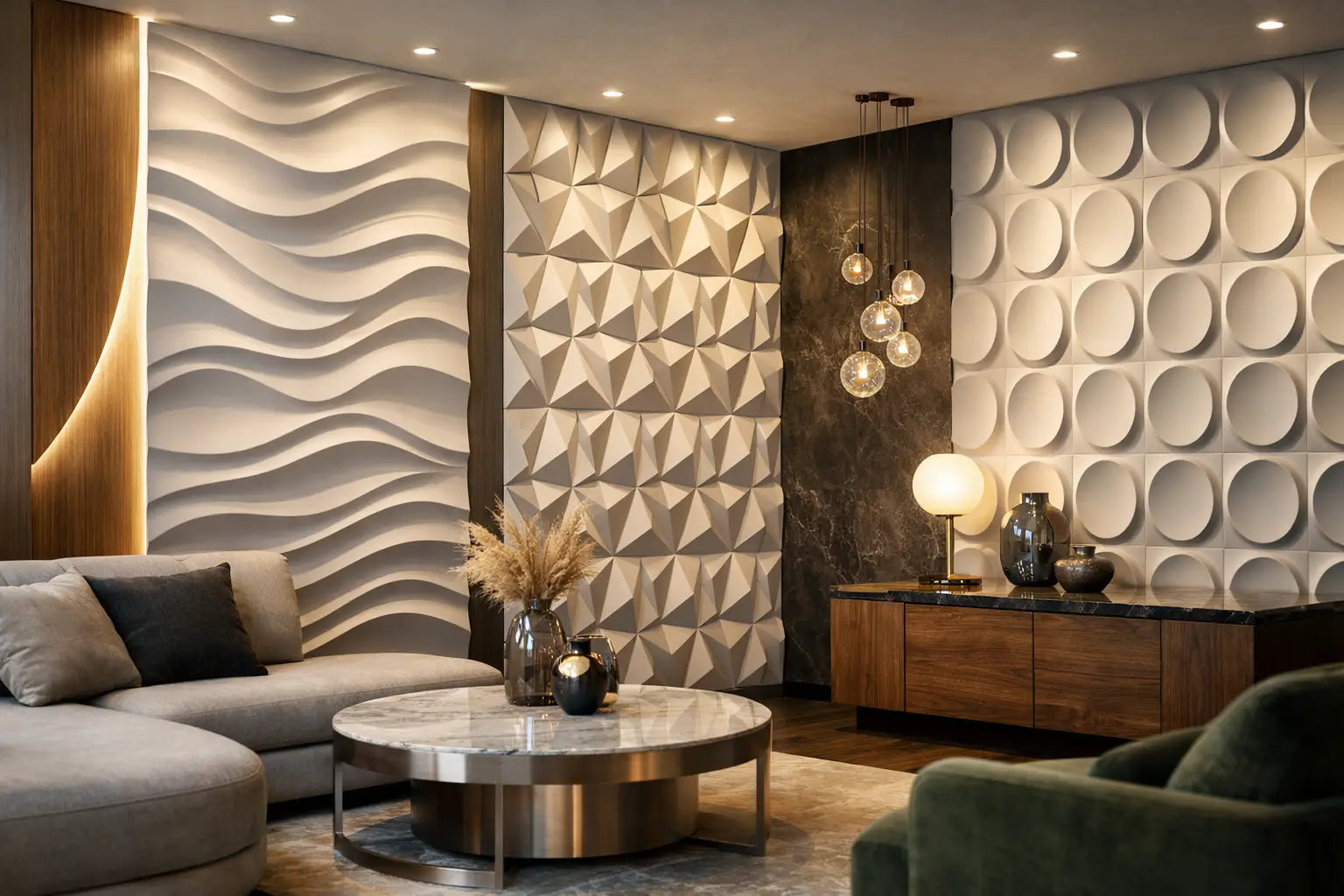
A white wall can be perfectly clean and yet leave a room without character. The 3D wall panel addresses this lack of personality by providing what paint and wallpaper alone cannot create: real depth, an evolving play of shadows, and an architectural presence. In a contemporary living room, a refined bedroom, or the lobby of a hotel project, it transforms a forgotten surface into a focal point.
Choosing a textured wall covering is not just about selecting an attractive pattern. The design, material, light, and proportion of the wall together determine the result. When well-thought-out, a 3D panel gives the impression of a more elaborate, enveloping, and durably elegant space.
Why 3D wall panels change the perception of a room
A flat decorative panel adds color or print. A three-dimensional covering changes how the eye moves through the room. Its reliefs capture natural light in the morning, deepen at dusk, and take on a new dimension under indirect lighting. It is this subtle variation that gives it its high-end character.
Gypsum panels offer a particularly mineral and architectural finish. Their surface can be painted, allowing for a bright white, a deep black wall, or a shade coordinated with the furniture. This flexibility is valuable during a renovation: the decor can evolve without having to replace the entire covering.
The relief also provides a sense of comfort. Depending on the wall's composition, the installation system, and the room's environment, gypsum panels can contribute to thermal and acoustic comfort. However, they should not be confused with a complete technical insulation solution. In a very noisy room or on a wall facing outside, a suitable study of insulation layers is still necessary.
Which 3D wall panel to choose according to your style
The right model does not seek to draw attention everywhere. It creates a balance between the existing architecture and the ambiance you wish to create. An old molding, an oak floor, or large bay windows do not require the same relief.
Geometric patterns for asserted architecture
Lines, facets, diamonds, and repetitive compositions provide a clean and contemporary look. They are particularly suitable for a wall behind a sofa, an entrance, or an office space. In a room with simple volumes, a geometric pattern brings immediate structure.
The more pronounced the design, the more it needs space to breathe. It is generally preferable to reserve this type of panel for a main wall rather than covering the entire room. Combined with furniture with clean lines, it creates a precise decor without appearing cluttered.
Wavy panels for a softer ambiance
Waves and fluid reliefs introduce movement without rigidity. They naturally complement a bedroom, living room, or wellness area, especially when lit by wall lights or a discreet LED strip. Their rhythm softens angles and gives the wall an almost hand-sculpted dimension.
These models are particularly interesting in interiors dominated by warm materials: light wood, boucle, stone, linen, or brushed brass. A matte monochrome paint then enhances the elegance of the relief without making it ostentatious.
Panels with integrated lighting to create a scene
A panel designed to receive LED lighting offers a more theatrical, yet highly controlled, effect. Light emphasizes hollows and edges, which can transform a dark corridor, a TV wall, or a headboard into a true decorative element.
The quality of the project here depends on the dosage. Warm light is often better suited for a bedroom or living room, while more neutral light can serve a reception area or a very contemporary interior. Plan the electrical supply before installation and consider future access to technical elements.
Assessing the wall before installing 3D panels
The beauty of the result primarily depends on preparation. A dry, clean, stable, and sufficiently flat wall allows the panels to align correctly. Active cracks, moisture traces, and friable supports must be treated before any installation. Placing a decorative covering over an unresolved problem only temporarily hides it.
Measure the useful width and height, then draw the panel layout. This step helps anticipate cuts around outlets, switches, corners, doors, or baseboards. For a repetitive pattern, start by determining where the cuts will be: a symmetrical finish on both sides of the wall often gives a neater result.
Lighting deserves the same attention. A deep relief placed opposite a window will be more discreet during the day and more expressive in the evening. Conversely, grazing light reveals every detail of the panel. Before choosing a model, observe the wall at different times and imagine the desired effect, subtle or spectacular.
Installation: accessible, but never improvised
Gypsum panels are designed for straightforward installation, especially with an adhesive suitable for the substrate. For a reasonably sized accent wall, a meticulous DIYer can achieve a beautiful finish. However, projects involving many cuts, complex angles, integrated lighting, or great height benefit from being entrusted to an experienced installer.
Installation begins with a precise tracing of reference lines. Each panel must be carefully positioned from the start, as a slight misalignment can become visible over several rows. After bonding, the joints are worked to form a continuous composition. It is often this finish that distinguishes a merely clad wall from a wall that appears to have been designed with the room's architecture.
Once dry, the surface can receive appropriate paint. Matte or velvet finishes generally reveal the relief with great elegance. Overly glossy paint can accentuate reflections and small irregularities, which is not always desirable. For an intense shade, preparation and several thin coats will yield a more homogeneous result.
Where to install a 3D wall panel?
The living room remains a natural choice, especially behind the sofa or around a TV unit. The panel creates a visual frame that enhances the layout without requiring multiple decorative objects. In a bedroom, it advantageously replaces a classic headboard and creates a more intimate atmosphere.
The entrance is also a strategic location. Even on a limited surface, an elegant relief sets the tone from the first glance. In a corridor, favor a design that complements the length of the wall and sufficiently soft lighting so as not to overload the space.
For professionals, possibilities extend to reception areas, shops, restaurants, offices, and premium rental projects. In these environments, the 3D panel becomes a visual identity tool. It helps make a place memorable while maintaining a durable finish that is easy to customize with paint.
Details that preserve the elegance of the decor
A textured wall does not need much competition. Avoid covering it with frames, shelves, and objects that would disrupt the pattern's readability. A few well-placed elements are sufficient: a wall light, a mirror, a thin console, or a carefully chosen artwork.
Maintenance remains simple. Regular dusting with a soft duster or the brush attachment of a vacuum cleaner helps preserve the hollows of the relief. In case of a small mark on a painted surface, a localized touch-up is often possible. This is one of the advantages of a painted gypsum panel: the decor can be maintained and renewed over the years.
At EFFET MARBELLA, gypsum panel collections allow each wall to be envisioned as a surface of expression, combining contemporary geometry, organic movement, and integrated lighting. The most successful choice is rarely the most imposing: it is the one whose relief, color, and light give your interior an obvious presence, without ever detracting from its serenity.


