
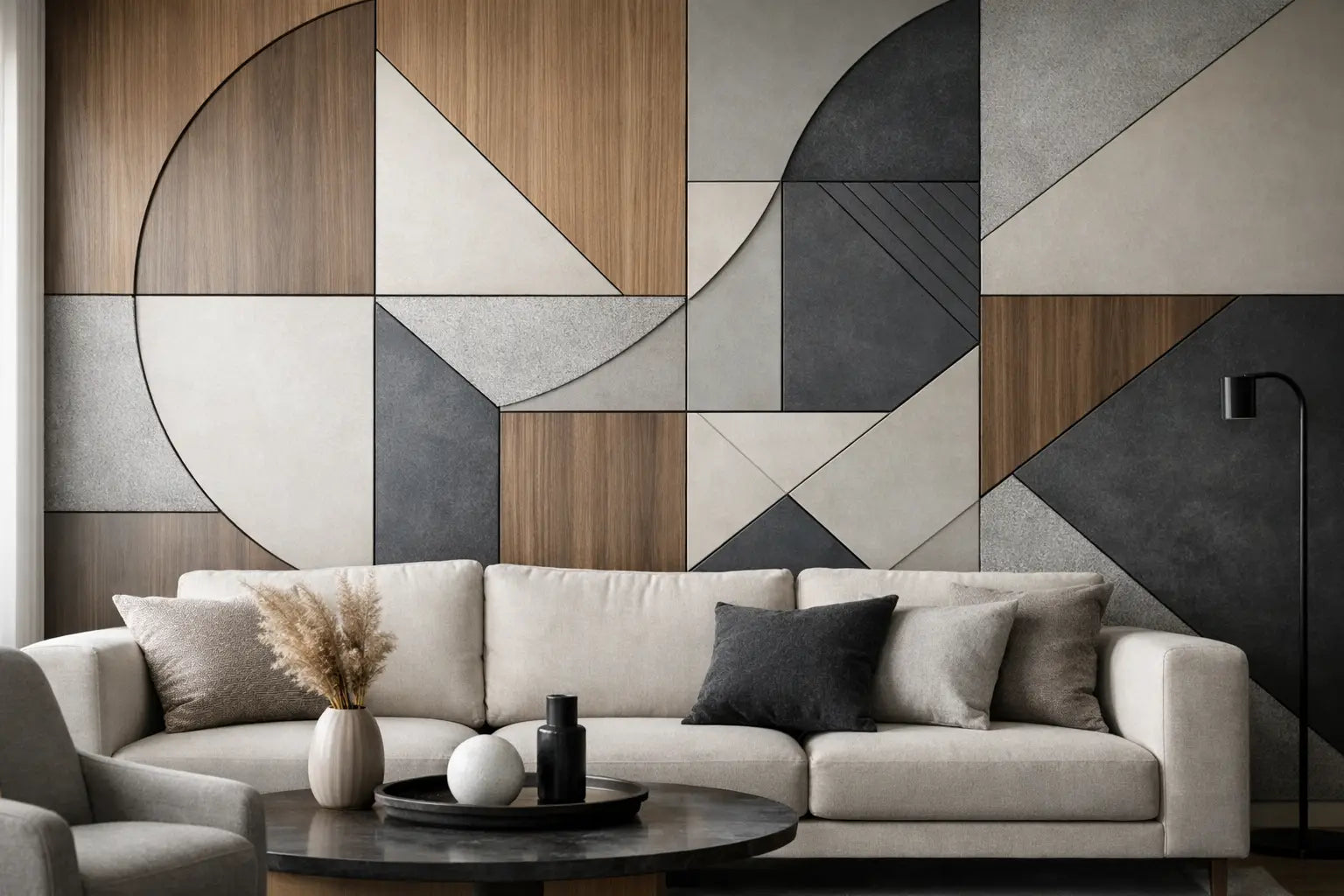
A modern living room can be perfectly furnished, well-lit, and yet lack presence. Often, it's the main wall that falls short. The modern living room geometric wall panel addresses precisely this need: it adds rhythm, creates visual architecture, and transforms a neutral surface into a strong element, without weighing down the overall space.
The appeal of a geometric wall panel isn't solely aesthetic. In a contemporary interior, every choice must strike the right balance between visual impact, daily comfort, and coherence with the furniture. This is where this type of covering truly comes into its own. It dresses the living room with controlled depth, while remaining versatile enough to integrate into very different projects, from minimalist living spaces to more sophisticated reception areas.
Why choose a modern living room geometric wall panel
In a living room, the wall is not just a backdrop. It frames the sofa, highlights a television, complements a bookshelf, or emphasizes a high ceiling. A geometric decor immediately adds a more architectural interpretation to the room. The lines catch the light, create subtle shadows, and add character without resorting to overly ornate decorative patterns.
The main advantage is this elegant sense of relief. Unlike a matte paint or a graphic wallpaper, a 3D panel acts on both visual perception and the overall ambiance. The living room appears more refined, more upscale, more intentional. This impression is particularly interesting in newer spaces that sometimes lack architectural details.
There's also a practical dimension that attentive buyers quickly appreciate. 3D plaster panels can contribute to acoustic and thermal comfort, while offering a surface that can be painted to adapt to evolving decor. It's not merely an aesthetic choice. It's a decorative solution that adds texture, comfort, and real perceived value.
What visual effect to expect in a modern living room
It all depends on the chosen design. A soft geometry, with wide and regular lines, is well suited to a calm living room, with mineral or natural tones. The result is contemporary, but never cold. Conversely, a more pronounced pattern, with sharp facets or a more sustained repetitive rhythm, creates a more sculptural effect. It attracts more attention and works well on a focal wall.
Lighting plays a decisive role. A geometric panel reveals its full quality when it receives grazing light, natural during the day or indirect in the evening. The reliefs effortlessly come to life. This is a simple reason to avoid installing this type of covering on all walls of the same living room. In most cases, a single section is enough to establish a strong visual signature.
The right choice therefore depends less on current trends than on the desired atmosphere. A modern living room is not always strict or monochrome. It can be warm, textured, cozy, or even very decorative. The geometric panel adapts to these nuances, provided there is consistency between relief, color palette, and furniture.
Where to install a geometric wall panel in the living room
The wall behind the sofa remains the most obvious, and often the most effective, location. It structures the reception area, creates a visual anchor, and immediately gives more presence to the ensemble. In a living room open to a dining room, this placement also helps to delineate the space without partitioning.
The TV wall is another relevant option. A geometric relief provides a more elegant frame for the screen and avoids the somewhat empty effect of large smooth surfaces. One simply needs to measure the pattern intelligently. If the television is imposing and the furniture already very graphic, it's better to choose a regular design and a sober shade to maintain a fluid visual.
In living rooms with high ceilings, a partial installation can be more refined than a complete covering. A panel on the upper half of the wall, or in a carefully framed central composition, yields a very decorative result. This type of choice works particularly well in projects where a premium effect is sought without overloading the room.
Colors, materials, and combinations that really work
White remains a classic for good reasons. It highlights shadows, emphasizes the purity of lines, and integrates easily into a contemporary living room. But a geometric wall panel doesn't have to be white to remain elegant. Sand tones, greige, light taupe, mineral gray, or warm beige often offer a more sophisticated result, especially in interiors where a enveloping atmosphere is desired.
Deep hues can be superb, but they require more mastery. A navy blue, a smoky green, or a matte charcoal reinforce the sculptural aspect of the relief. On the other hand, they absorb more light. In a dimly lit living room, this can compress the perception of space instead of elevating it.
In terms of combinations, geometric panels interact particularly well with grained wood, matte black metal, brushed brass, smoked glass, and thick textiles. The secret is not to multiply the effects, but to compose a clear hierarchy. If the wall already has a strong identity, the rest of the decor should complement rather than compete.
A design choice, but also functional
The success of this type of covering lies precisely in its dual promise. On one hand, it immediately transforms the living room. On the other, it improves the usability of the space. In a living area, this dimension is more important than one might imagine. A reverberant living room, with overly bare walls, often appears less warm even when well-decorated.
3D plaster panels provide a subtle correction to this sensation. They break the visual flatness, but also some of the acoustic harshness. Perceived comfort improves, especially in open spaces, recent apartments, or living rooms with very smooth materials. It's not a technical solution in the strict sense of specialized acoustic treatment, but it's a real plus for residential use.
The possibility of painting the panels is another important asset. It allows the final rendering to be adjusted to the project, creating a subtle tone-on-tone or, conversely, a deliberate contrast. For individuals as well as professionals, this flexibility makes the product much more durable over time.
What to look for before buying
The first criterion is the quality of the relief. A good panel is not content with having an interesting pattern. It must have clean lines, regular repetition, and a finish capable of producing a homogeneous result once installed. On an entire wall, alignment or manufacturing defects are quickly noticeable.
The second point concerns the proportion of the pattern. A large living room better accommodates ample and assertive designs. In a more compact space, an overly massive relief can appear overwhelming. One must consider the actual viewing distance. A wall seen from three or four meters does not require the same design as a sofa back perceived close up.
Ease of installation also deserves particular attention. Some clients wish to install their covering themselves, others prefer to entrust the work to a craftsman. In both cases, panels designed for clear installation and careful finishing make a real difference. At EFFET MARBELLA, this logic of design and practicality is reflected in an offer designed for both residential projects and more ambitious realizations.
Common mistakes to avoid with a modern living room geometric wall panel
The first mistake is to choose the panel as a simple decorative motif, without considering the entire room. A strong relief needs a dialogue with the furnishings, lighting, and volumes. If it is added too late, without an overall vision, the result may seem tacked on.
The second mistake is to overdo it. In a modern living room, elegance often comes from restraint. A single well-treated wall has more impact than several competing surfaces. It is better to create a precise focal point than to disperse attention.
Finally, many underestimate the importance of the paint finish. A poorly chosen shade or an approximate application can flatten the relief instead of revealing it. The panel deserves a coherent color scheme with the light of the place and the other materials present.
An investment that truly changes the perception of the living room
This type of covering appeals to both decoration enthusiasts and professionals for a simple reason: it creates a visible transformation without undertaking major renovation. Where some decorative elements merely add style, the geometric wall panel modifies the very interpretation of the space. The living room appears more structured, more refined, more memorable.
It is also a choice that stands the test of time better than many highly distinctive trends. Geometry, when well designed, retains a timeless strength. It can complement a minimalist, chic contemporary, or more textured interior, without losing its relevance.
If your living room lacks relief, it doesn't necessarily need more furniture or objects. It may simply need a wall that finally sets the tone.


