
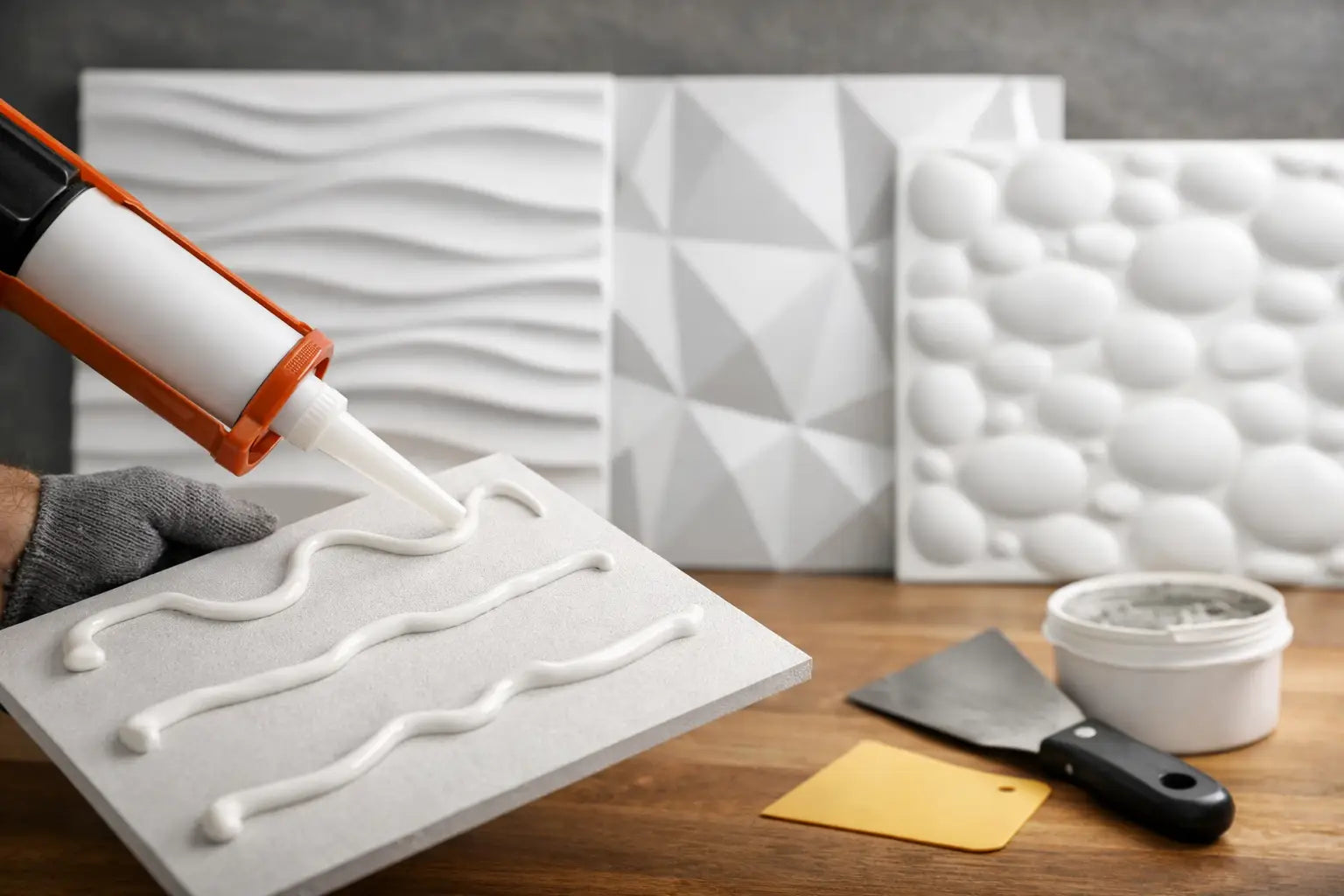
A poorly glued decorative panel is unforgiving. Even the most beautiful relief loses its elegance if the joints shift, if a corner peels off, or if the installation lacks precision. The real question is not just which adhesive to choose for decorative panels, but which adhesive is suitable for the substrate, the panel material, and the expected level of finish.
To achieve a clean, durable result worthy of a well-maintained interior, one must think like an installer as much as a decorator. The right adhesive ensures not only adhesion but also the visual stability of the wall over time.
Which adhesive for decorative panels depending on the material?
Not all decorative panels are installed in the same way. This is the first point to clarify before buying an adhesive. A 3D plaster panel, a PVC panel, a composite wood wall covering, or a lightweight foam panel do not exert the same weight or the same stress on the wall.
For decorative plaster panels, the most consistent choice is generally a construction adhesive suitable for mineral materials, or a specific adhesive recommended for plaster wall panels. It must offer strong adhesion, good vertical hold, and sufficient working time to adjust alignments. This is particularly important with geometric or wavy reliefs, where the slightest misalignment is immediately visible.
For very lightweight panels, certain polymer adhesives or fixing mastics may be suitable, provided the substrate is sound, dry, and well prepared. However, the denser and more architecturally prominent the panel, the more one should prioritize a formula capable of supporting real weight without slipping.
The useful reflex is simple: first, choose the adhesive based on the panel, and only then based on price or ease of application. For a high-end decorative wall, performance takes precedence over saving a few euros.
The substrate changes everything
Two identical panels may require a different approach depending on the wall they are installed on. A painted plasterboard substrate, a raw plaster wall, slightly porous masonry, or an already old surface do not react in the same way.
On an absorbent substrate, the adhesive may dry faster. This can be an advantage for initial grab, but it also reduces adjustment time. On a closed or less porous substrate, adhesion depends more on surface preparation. In both cases, a dusty, greasy, friable, or uneven wall compromises installation, even with a very good adhesive.
Before bonding, the substrate must be clean, stable, dry, and as flat as possible. If it has significant deviations, the adhesive should not be used as a massive patching solution. It is designed to fix, not to correct a structurally imperfect wall.
For premium decorative panels, the level of substrate preparation directly influences the final result. Precise installation always begins with a wall ready to receive a finishing element, not an approximate construction site.
The most suitable adhesives in practice
In the majority of interior projects, three product families often come up: construction adhesive, polymer mastic adhesive, and specific adhesive for plaster panels.
Construction adhesive is often chosen for its powerful adhesion. It is well suited for decorative panels when the manufacturer recommends it for vertical wall installation. It is appreciated for its fast curing, but some versions have a fairly short adjustment time. This can be less comfortable if you are installing a repetitive pattern that requires a very neat joint.
Polymer mastic adhesive is interesting for its versatility. It adheres to many substrates, resists aging well, and often remains more flexible than a rigid adhesive. This flexibility can be useful on certain walls that may experience slight movement. However, its compatibility with the panel material and the actual load to be supported must be checked.
Specific adhesive for plaster panels often remains the most reassuring solution for high-end 3D decorative panels. It better meets the constraints of weight, installation precision, and material compatibility. For a product designed to provide relief, depth, and an elegant finish, this technical consistency makes the difference.
Which adhesive for decorative panels in a humid room?
A bathroom, kitchen, or space subject to temperature variations requires more attention. This does not mean giving up decorative panels, but simply avoiding generic choices.
In a humid room, the adhesive must maintain its adhesion despite the ambient humidity. It is also necessary to ensure that the panel itself is suitable for this use, as well as the finish applied afterward. A high-performance adhesive will never compensate for a material unsuitable for the environment.
If the wall receives direct splashes or is in a highly exposed area, it is better to validate the entire installation system: possible primer, adhesive, joint treatment, paint, or surface protection. In this context, durability depends on a whole system, not a single product.
For a durable and refined result, the best approach is to think of the wall as a complete wall covering. This logic makes it possible to maintain the sculptural effect of the panel without aesthetic compromise after a few months.
The most common mistakes to avoid
The first mistake is to choose a "universal" adhesive without checking its actual compatibility. Universal often means convenient, not necessarily ideal. For decorative panels, especially those with relief, bonding precision matters as much as adhesive strength.
The second mistake is to overload with adhesive. Many imagine that by using more product, they secure the installation. In reality, excess can create thickness, hinder alignment, and complicate joints between panels.
The third mistake is to neglect setting time. Some products allow repositioning for a few minutes, others almost none. If your wall composition requires continuous lines, precise layout, or clean cuts around a switch, this detail becomes essential.
Finally, one must not forget the logic of finishing. If the panels are to be painted after installation, the joints and the adhesive used must allow for a homogeneous result. A solid but visible fixation is not a success.
How to install well to enhance the relief
Bonding is not just about fixing the panel to the wall. It's about preserving the design, the continuity of volumes, and the elegance of the final surface. Regular application of adhesive, methodical positioning, and light, even pressure are often preferable to overly rapid installation.
It is advisable to work panel by panel, with constant visual control of the joints. On contemporary reliefs, the eye immediately catches breaks in the line. The perceived quality of a decorative wall therefore depends as much on the chosen adhesive as on the care taken in assembly.
For a meticulous residential project or a more ambitious realization, it may be wise to use a solution designed for this type of covering, as installers do who seek a regular and durable finish. It is in this spirit that a brand like EFFET MARBELLA integrates its panels into a logic that is both decorative and functional: visual impact, interior comfort, and controlled installation.
The right choice depends on the result you expect
If you want to dress an accent wall in a living room, create an architectural headboard, or give character to a hall, the adhesive should never be a secondary purchase. It contributes to the quality of the rendering as much as the panel itself.
For 3D plaster decorative panels, the best choice generally remains an adhesive suitable for mineral materials and designed for vertical wall installation. For lighter panels, a high-performance polymer mastic adhesive may suffice, provided the substrate is impeccable and the use of the room is well taken into account. In all cases, the correct answer to the question of which adhesive for decorative panels always depends on three elements: the weight of the panel, the nature of the wall, and the desired level of finish.
A beautiful decorative wall effortlessly draws the eye. To maintain this presence over time, it must be given an installation base worthy of its design.


