
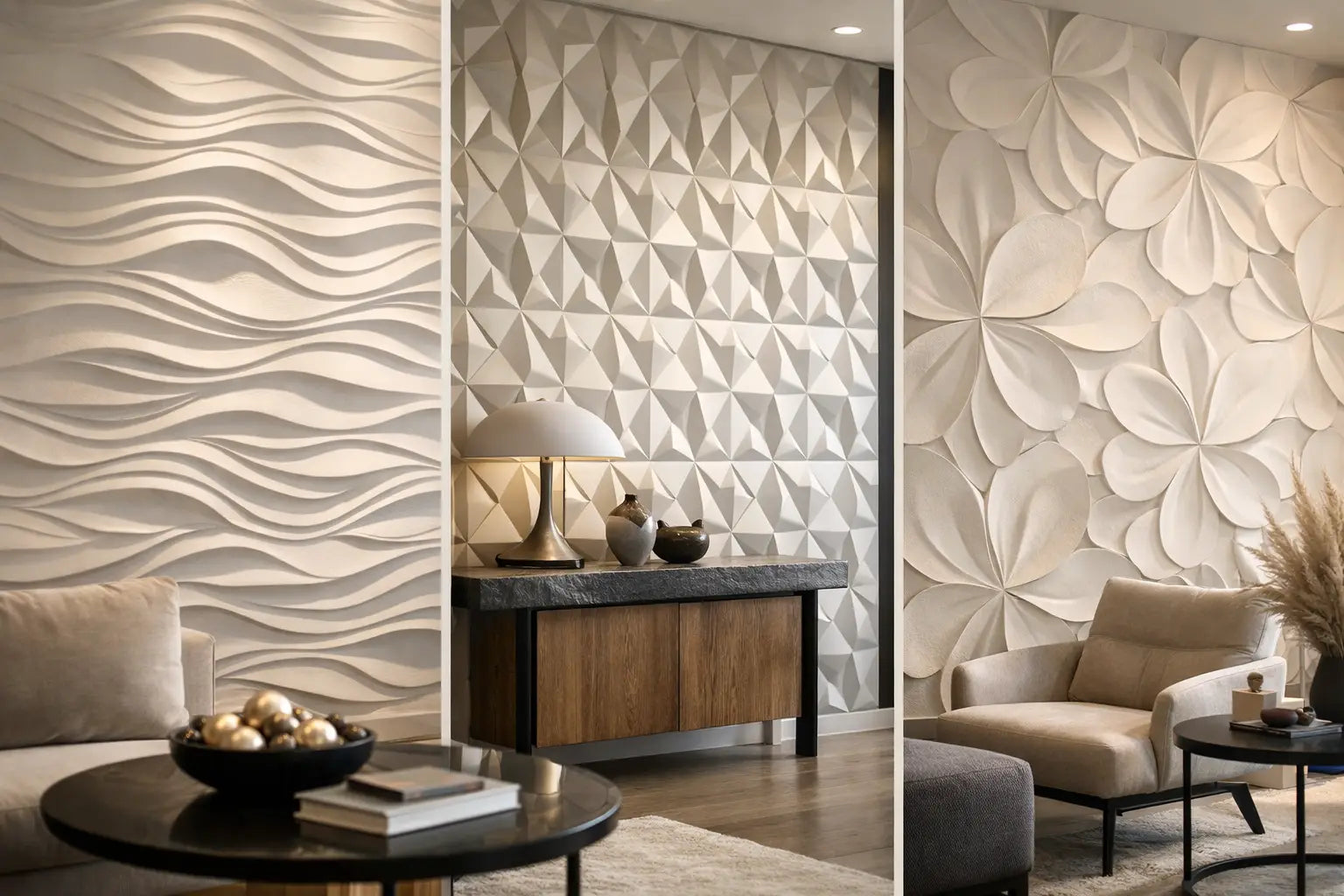
A perfectly smooth wall can make a room look tidy, but rarely memorable. When a living room lacks character, a headboard seems unfinished, or a reception area needs to assert its identity, relief immediately transforms the perception of volumes. This decorative wall panels comparison helps to understand what distinguishes the main decorative solutions and to choose a finish that is as beautiful to look at as it is pleasant to live with.
Decorative Wall Panels Comparison: Relief Above All Else
The first criterion is not just color or pattern. It's how the panel catches the light. A decorative relief wall covering changes throughout the day: shadows shift, lines gain depth, and the wall becomes an architectural element in its own right.
Geometric panels are suitable for structured and contemporary interiors. Their facets, grooves, or repeated compositions bring a precise rhythm, particularly elegant in an entrance, an office, or behind a sofa. The wave models offer a more fluid rendering. They soften the lines of a bedroom, a hallway, or a wellness area, with a strong visual presence without rigidity.
Panels incorporating LED lighting go further: light is part of the decor. This option is particularly suitable for a central partition, a reception, a restaurant, or a headboard designed as a focal point. However, it requires careful preparation of the electrical supply and the positioning of the lighting elements before installation.
Materials: Appearance is Not Enough
Not all decorative wall panels meet the same expectations. The choice of material influences touch, finish, durability, comfort, and installation conditions. A very light solution may seem practical, but offer less depth or fewer finishing possibilities. Conversely, a mineral material provides a visual quality and stability that justify more careful installation.
PVC Panels: Simple, But More Limited
PVC is often chosen for its low weight and moisture resistance. It can be suitable for certain technical areas or projects where budget is paramount. However, its relief generally remains less sculptural, and its appearance can reveal its synthetic nature more, especially under side lighting.
It is also less suitable when looking for a wall painted in a very precise and durable shade. Some PVC panels accept paint, but their final appearance depends heavily on the preparation and quality of the product used. For a high-end interior, the result may lack the expected depth.
Wood or MDF Panels: Warm, with Constraints
Wood and MDF create a warm sensation, particularly in organic décors or hotel-inspired projects. Battens, slats, and machined patterns bring a natural presence that works very well with textiles, brass, or stone.
However, wood requires special attention to variations in humidity and temperature. MDF must be properly protected in rooms exposed to moisture. These solutions are also less free when it comes to creating large, continuous, and perfectly paintable reliefs, without visually marked joints.
3D Gypsum Panels: Depth, Finish, and Comfort
3D gypsum panels are distinguished by their mineral appearance, their precise relief, and their ability to become a true architectural surface. They are designed to be painted, which allows the wall to be matched to an existing palette or to create a sophisticated contrast. Matte white, warm beige, deep gray, mineral green, or custom shade: the color highlights every detail of the design.
Gypsum also brings practical benefits. Its mass and composition contribute to the acoustic and thermal comfort of an interior. It does not replace complete insulation, but it can help make a room feel cozier and more pleasant, especially on a living room, bedroom, or office wall.
This choice requires a sound, flat, and prepared surface. The panels must be installed methodically to achieve the alignment and continuity that a premium decor deserves. For a large-scale project or a complex pattern, professional intervention remains a wise decision.
