
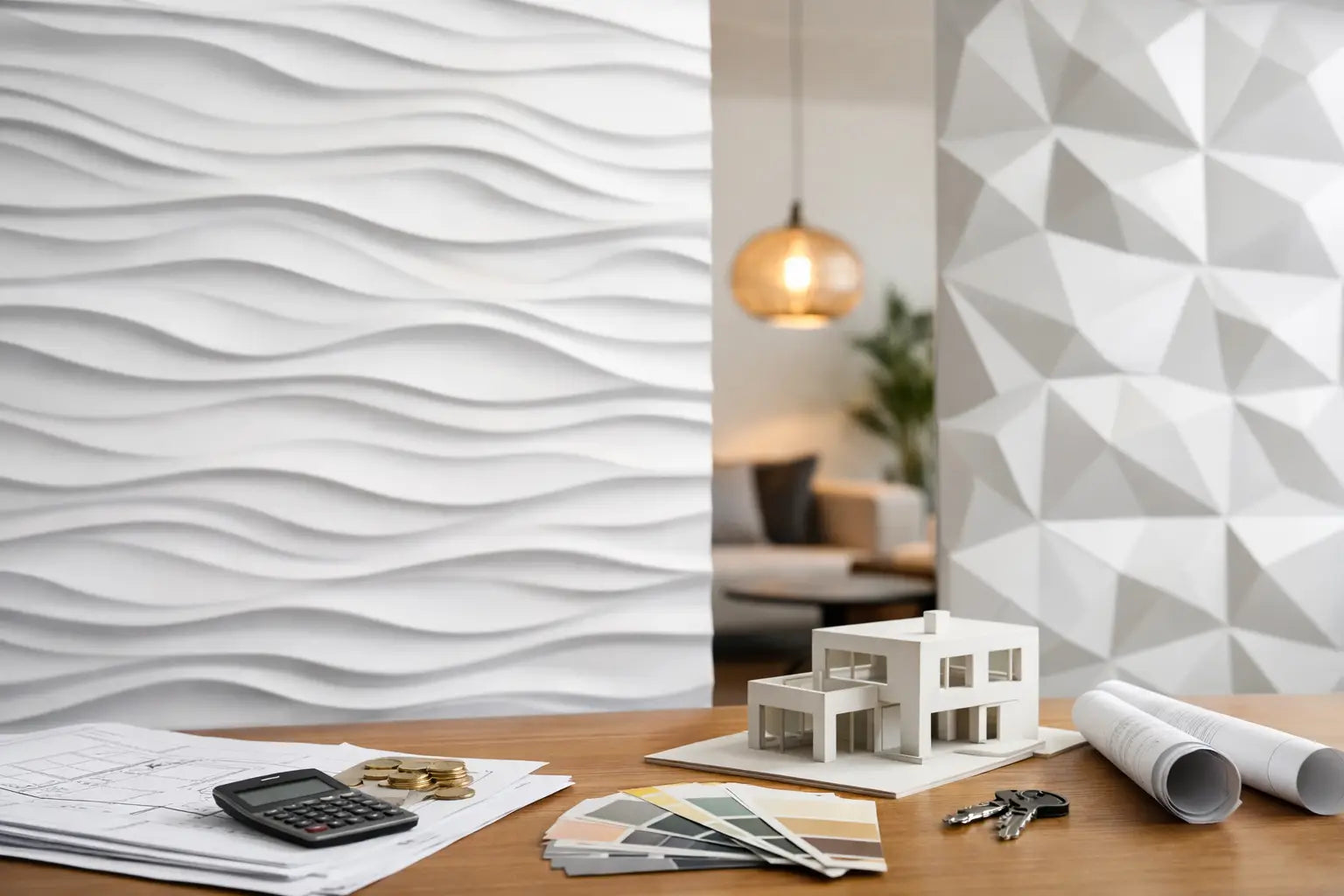
An empty wall can leave a perfectly furnished room without real character. Conversely, a well-chosen wall panel immediately changes the perception of space. If you're wondering how much a 3D wall costs, the true answer isn't a single figure, but a range that depends on the material, design, surface area to cover, and desired level of finish.
For an interior decorative project, the price of a 3D wall is generally calculated per square meter, then adjusted for installation, preparation, and finishing costs. In practice, a 3D wall with decorative panels can start around 30 to 50 euros per square meter for a simple solution, and go up to between 70 and 150 euros per square meter, or even more, for a more high-end finish with sophisticated patterns, paint, precise cuts, or integrated lighting.
How much does a 3D wall cost depending on the type of panel?
The primary price factor is the material. Not all 3D walls offer the same rendering or the same durability over time.
PVC or synthetic material panels often remain the most accessible. They are suitable for tight budgets or quick projects, but their visual appearance may seem less refined depending on the models. In this category, entry-level prices often range from 20 to 40 euros per square meter, excluding installation.
Panels made of plant fibers or composites fall into an intermediate range. They are appealing due to their lightness and relatively simple installation, but their resistance, regularity, and the final result after painting must be carefully considered. The budget is often between 30 and 60 euros per square meter, excluding installation.
Plaster or gypsum 3D panels are clearly part of a more architectural approach. The relief is sharper, the surface more elegant, the paint more homogeneous, and the final effect more premium. For this type of wall, you generally need to budget between 45 and 90 euros per square meter for the panels alone, depending on the design, thickness, and collection. More elaborate models or those intended for very refined interiors may exceed this range.
This is often where the difference lies between a temporary decoration and a true signature wall. A discreet geometric pattern will not have the same impact or price as a spectacular wavy composition or a panel compatible with indirect LED lighting.
The price per m² doesn't tell the whole story
When talking about how much a 3D wall costs, many stop at the displayed price of the panel. However, the real cost depends on the complete project.
A small section of wall behind a headboard or in an entryway often costs more per square meter than a large, simple rectangular wall. The reason is quite logical: waste, cuts, and preparation time weigh more heavily on a small surface. Conversely, a large, regular partition allows for smoother implementation and a better optimized overall cost.
The support must also be taken into account. If the existing wall is sound, dry, and reasonably straight, installation remains simple. If the surface has irregularities, cracks, or flatness defects, preparation will be necessary before installation. This step can significantly vary the budget.
Cost of installing a 3D wall
Installation can be done by a careful individual or entrusted to a professional. In both cases, the budget will not be the same.
For professional installation, you should often expect to pay between 25 and 60 euros per square meter for the installation alone. This range varies depending on the complexity of the pattern, the height of the wall, angles, cuts around outlets and switches, as well as the level of requirement for seamless joints. If the project requires invisible joints, a very smooth finish, or an impeccable paint-ready result, the cost naturally increases.
For a more technical composition, especially with lighting effects or very precise graphic alignment, the price can exceed this range. This is particularly true in high-end projects, reception halls, master suites, or living rooms where the wall becomes a central element of the interior architecture.
Self-installation certainly reduces the bill, but it requires rigor. A 3D wall rarely succeeds halfway. The slightest misalignment is visible, especially with grazing light.
Finishes that vary the budget
A raw 3D wall is not always a finished wall. The finish therefore plays a part in the calculation.
Paint is the first item to consider. Some panels can be easily painted, which allows the wall to harmonize with the room's color palette. Depending on whether you do this step yourself or not, you need to add a material budget and possibly labor. On average, painting can represent an additional 10 to 30 euros per square meter.
Accessories also count. Adapted glue, primer, joint filler, cutting tools, finishing profiles, or accent lighting complete the project. Taken separately, these elements seem secondary. Added together, they concretely influence the final cost.
Finally, there's the desired level of detail. A matte white 3D wall with a minimalist design doesn't require the same investment as a wall painted in a deep hue, perfectly jointed, and enhanced by indirect lighting. The latter creates a spectacular presence, but it requires more precision and budget.
What budget to plan according to your project?
To give a simple benchmark, a small decorative wall of 4 to 6 m² can cost between 250 and 900 euros depending on the material, finish, and installation method. This is often the format chosen for a bedroom, a dining nook, or an entryway, with a strong visual impact without undertaking major work.
For a living room wall of 8 to 12 m², you should more often consider an overall budget between 700 and 2,000 euros. This range is explained by the differences in quality, but also by the desired rendering. A living room can easily accommodate a more ambitious treatment, as the 3D wall becomes a lasting focal point there.
For larger surfaces or in a professional setting, pricing is almost always custom-made. Volume can lower some unit costs, but technical constraints can also increase them.
What justifies a higher-end 3D wall?
Not all decorative walls offer the same value over time. A higher price can be justified if the panel presents a more precise relief, better density, a more noble surface, and true stability once installed.
Gypsum, for example, attracts enthusiasts of refined interiors because it gives a sculptural presence without an artificial effect. It also offers appreciable qualities in terms of comfort, particularly acoustically and thermally depending on the wall configuration. It's not just an aesthetic choice; it's also a way to add texture and calm to a room.
For an owner who wants to sustainably enhance their interior, or for a professional who designs a space with a true visual signature, the initial cost must be weighed against the final result. A well-integrated 3D wall transforms more than a surface—it redefines the entire ambiance.
How to estimate the cost of a 3D wall in your home
The most accurate method is to start with the exact surface area, then add four variables: the type of panel, the complexity of the pattern, the level of wall preparation, and the desired finish.
If your project involves a simple, regular-shaped wall, with paintable gypsum panels and careful installation, you can aim for a realistic overall budget of between 80 and 160 euros per square meter, supplied and installed. For a simpler version with self-installation, the budget can be significantly lower. For a premium composition with technical details, it may exceed this estimate.
The classic mistake is to underestimate the finish. Yet it is the finish that gives the wall its truly high-end look. A beautiful panel poorly installed remains a visible compromise. A well-chosen, well-jointed, and well-painted panel becomes an interior signature.
For a brand like EFFET MARBELLA, this logic is central: the 3D wall is not just a covering, but a decorative solution designed to add relief, elegance, and true coherence to the space.
Should you choose the cheapest option?
Not necessarily. If your goal is to create a quick effect in a secondary room, an economical solution may suffice. But for a living room, a suite, a reception hallway, or a professional space, the perceived result matters as much as the purchase price.
A successful 3D wall must remain beautiful every day, withstand light, enhance furniture, and retain its character over time. This is where a better-designed, more stable, and more elegant product makes perfect sense. The right budget is therefore not the lowest, but the one that corresponds to the level of effect you want to achieve.
Before comparing prices, ask yourself a simple question: do you want to decorate a wall, or transform a room? The answer often changes everything.


