
A plain white painted wall may be immaculate, but it doesn't really transform a room. As soon as an interior lacks presence, the question quickly arises: should you opt for a decorative wall or a textured coating? Both solutions add depth, character, and a true visual signature, but they don't meet the same expectations or pose the same installation constraints.
The right choice depends less on fashion than on the desired result. Some finishes appeal with their artisanal and mineral look. Others create a clearer, more sculptural interior architecture, with immediate visual readability. Between appearance, durability, maintenance, and ease of installation, there are real differences to consider before transforming a living room, bedroom, or professional space.
Decorative wall or textured coating: the real difference
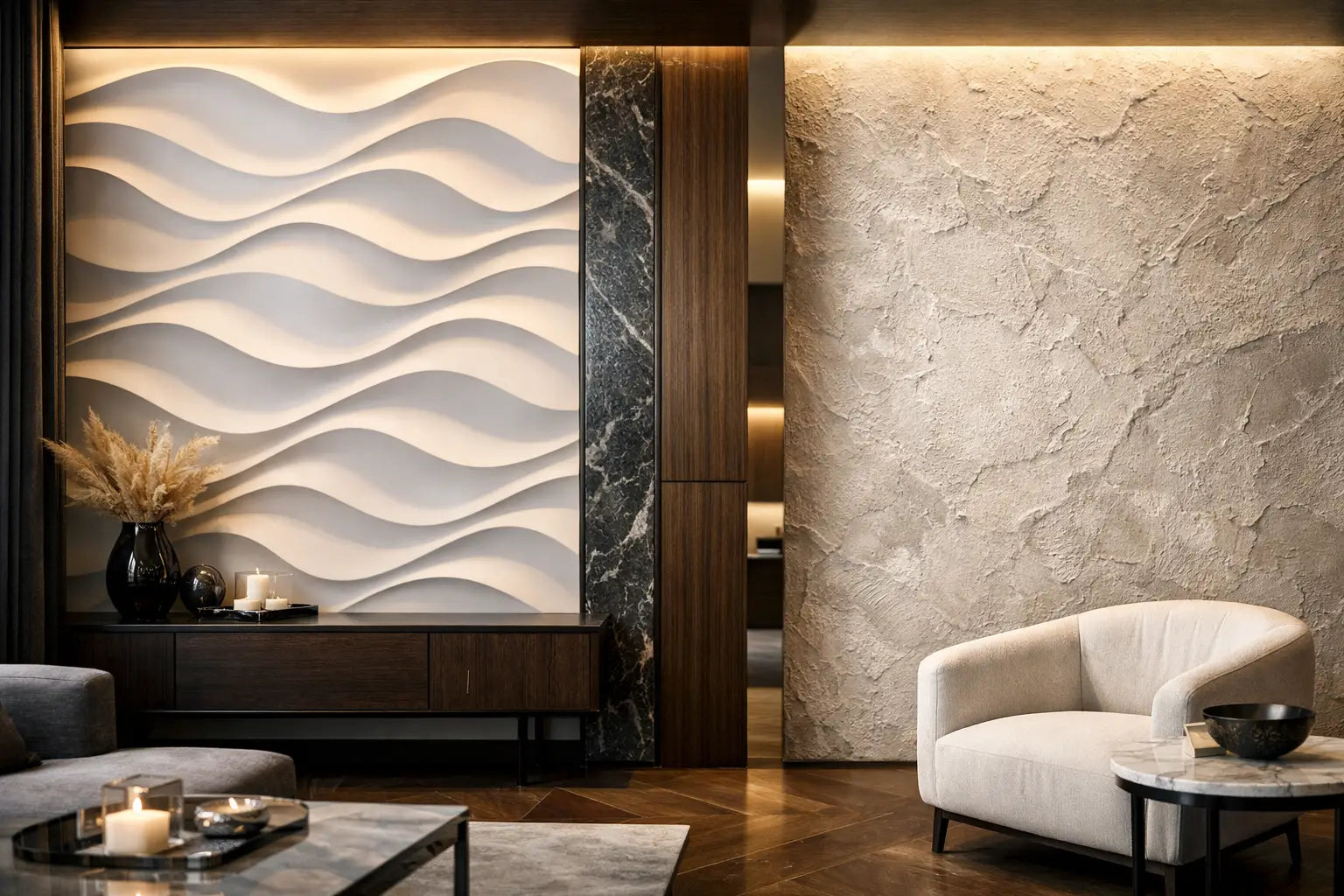
Textured coating is a material applied directly to the wall. Its interest lies in the gesture, the hand, the texture created on the surface. Depending on the chosen technique, it can offer a cloudy, troweled, raw, sanded, or more contemporary effect. It provides a discreet or expressive depth but remains linked to the existing support and the applicator's know-how.
The decorative wall, in a more architectural approach, is not limited to a finish. It becomes a compositional element. This can involve embossed wall panels, geometric shapes, waves, shadow plays, and sometimes even integrated lighting. Here, the decor doesn't just adorn the wall: it structures the space.
This nuance matters. A textured coating often gives a material feel. A decorative wall more readily creates a volume effect. One works the skin of the wall, the other its expression.
When textured coating is the right choice
Textured coating works very well in interiors where a soft, sophisticated, and slightly artisanal atmosphere is desired. In a bedroom, office, or living room with a mineral palette, it can produce an enveloping effect, without drawing too much attention to a single wall. It's often the right option if you want to avoid too graphic an effect.
It is also suitable when the project relies on visual continuity. On large surfaces, it can create a calm elegance, especially with stone, greige, sand, or ivory shades. Its charm comes from its controlled irregularities. No wall section is exactly identical, and that's precisely what appeals.
However, the coating requires real execution precision. The final result strongly depends on the preparation of the support, the tool used, the gesture, and the drying. Two applicators will not obtain exactly the same effect. For an amateur, the risk is not just aesthetic. A poorly dosed or poorly stretched texture can quickly appear dated or approximate.
You also need to think about touch-ups. On some textured finishes, repairing a damaged area without visible traces is difficult. This does not make the solution less interesting, but it is better suited to those who accept the artisanal dimension, even in its small variations.
Why the decorative wall is so appealing today
If the decorative wall plays such a significant role in current projects, it's because it responds to a very clear desire: to add style without undertaking heavy renovation. An embossed wall immediately transforms the perception of a room. It captures light, creates rhythm, and gives an impression of high-end finish, even in a sober space.
In a living room, behind a headboard, in an entrance, or in an office, the effect is more pronounced than with a simple coating. The relief provides a sculptural presence that enhances furniture and creates a natural focal point. This is particularly interesting in contemporary interiors where every element must count.
Another advantage is that the result is more predictable. With well-designed decorative panels, the pattern, depth, and alignment are planned upstream. You don't solely rely on artisanal skill to achieve an elegant look. This reassures both individuals and decorators or professionals working on a project with an expected result from the design stage.
Visual relief, comfort, and daily use
Aesthetically, textured coating and decorative wall don't send the same message. The former evokes more raw material, mineral softness, sometimes the spirit of a Mediterranean house or refined workshop. The latter falls into a more drawn, more contemporary, sometimes more luxurious style depending on the pattern and painting.
But appearance is not the only criterion. In living spaces, comfort also matters. Some decorative walls made of 3D plaster panels offer an additional benefit in terms of acoustic insulation and thermal comfort. This is not a detail in an apartment, a bedroom, or a reception room where a more hushed feeling is sought.
Textured coating, on the other hand, mainly plays on the surface effect. It can contribute to the ambiance, but it does not provide the same level of physical presence or the same functional performance. If your priority is purely decorative with a subtle rendering, that may be enough. If you want to combine visual impact and use, the decorative wall often takes precedence.
Installation, project time, and margin of error
This is often where the decision is made.
A textured coating requires rigorous surface preparation, several steps, drying time, and good technical mastery. On paper, it seems simple. In reality, achieving an elegant and regular texture over a large area is much more demanding than it appears. The site can also be messier and less clear in terms of the final result before the last coat.
A decorative wall made of panels has a different logic. Installation requires precision, but it is more structured. The relief is already designed, which reduces aesthetic uncertainty. For a careful individual as well as for an installer, this clarity changes a lot of things. Once the panels are installed, joints prepared, and surface painted if desired, the whole quickly takes on a finished look.
This is one of the reasons why ready-to-install decorative solutions appeal so much to residential projects and larger operations. They allow for a strong effect without entirely depending on manual decorative execution over the entire surface.
Which rendering ages best?
The question is essential, especially for an interior that you want to keep for several years.
A textured coating can age very well when its color, texture, and environment are coherent. The risk appears when the effect is too pronounced or too trendy. Some very pronounced textures can be visually tiring or date a space faster than expected.
The decorative wall ages well when it is based on a balanced and timeless design. Sober geometric reliefs, elegant waves, or linear compositions have this advantage: they add character without depending on an overly obvious fashion effect. The possibility of repainting the surface is also a real asset. You can change the ambiance without replacing the entire decor.
For a premium project, the best approach is often to choose a strong but controlled relief. A wall should define the space, not clutter it.
In which rooms to choose one or the other?
In a bedroom, textured coating is suitable if you are looking for a calm and enveloping atmosphere. A decorative wall behind the bed also works very well, with a more spectacular and refined result.
In a living room, everything depends on the role of the wall. If it is to remain discreet and chic, coating is a credible option. If it is to become the center of the composition, particularly behind a sofa or a TV unit, architectural relief provides more presence.
In an entrance or a professional space, the decorative wall often has more impact. It immediately asserts an identity. For a high-end rental project or a layout designed to impress visitors, this visual strength is extremely important.
In a small room, one should not think that a relief is automatically excessive. On the contrary, a well-chosen panel can add depth without being heavy, provided that the color and furniture remain sober.
So, decorative wall or textured coating?
If you like sensitive, mineral finishes with an artisanal charm, textured coating can be the right choice. It provides a discreet, almost tactile elegance, but it requires impeccable execution and accepts approximation less well.
If you are looking for a clearer, more contemporary, and more enhancing transformation for the entire room, the decorative wall is often the most convincing solution. It immediately creates relief, structures the eye, and combines aesthetics and functionality with great clarity of result. This is precisely what explains the growing interest in premium 3D panels offered by brands like EFFET MARBELLA.
The fairest thing is not to follow a trend, but to choose the finish that truly serves your space. A beautiful wall does not just fill a surface. It gives the interior a presence that is felt from the first glance.


