
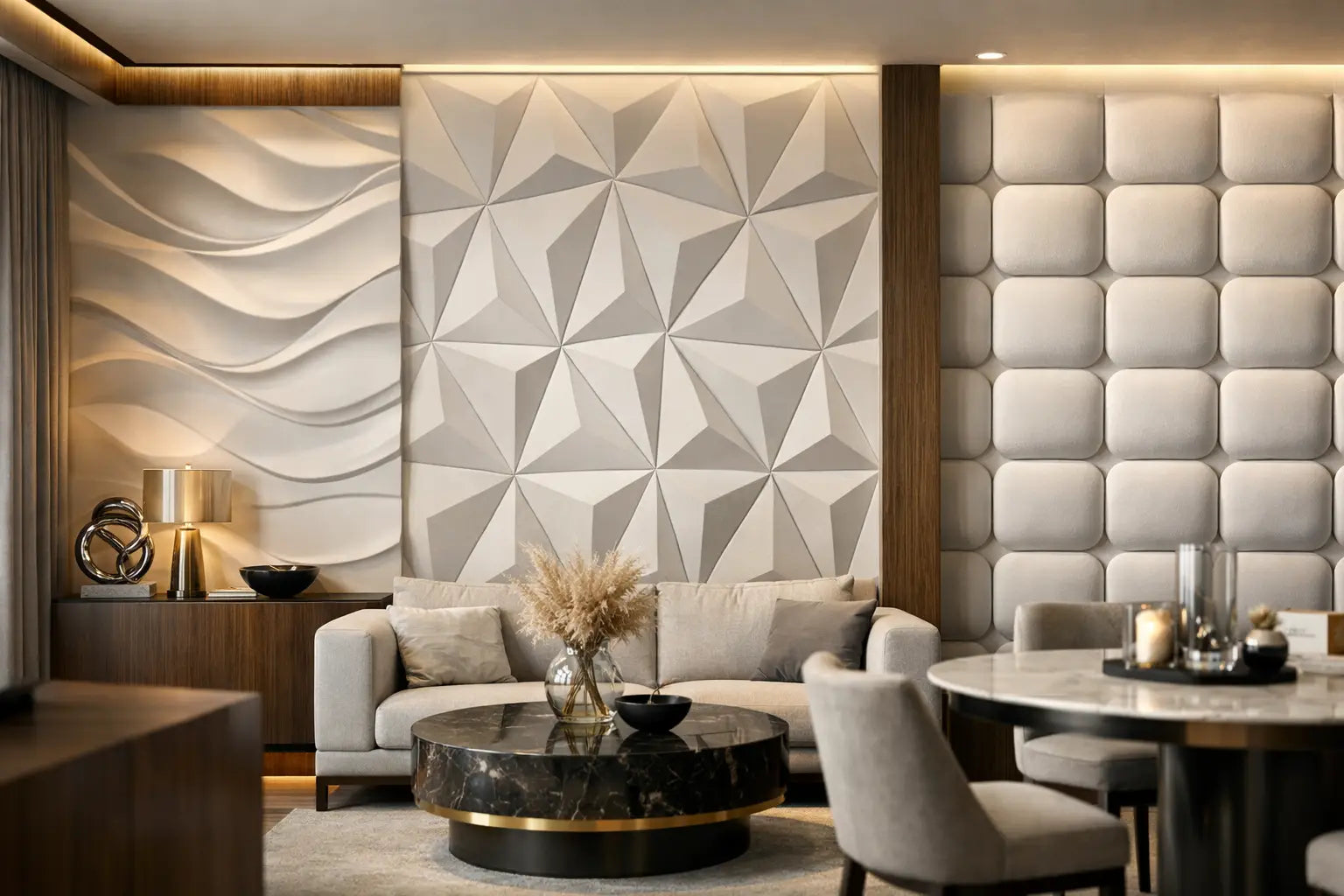
A flat wall can be clean. It rarely makes an impression. This is precisely where a geometric wall panel buying guide comes in handy: when you're looking for more than just a covering, and you want to give rhythm, relief, and a true architectural presence to a room.
The geometric wall panel is not a well-chosen passing trend. It's a decorative solution that transforms the perception of space, captures light differently throughout the day, and brings immediate sophistication, without requiring major construction. But you still need to choose the right model, the right material, and the right level of relief. Between aesthetics, comfort, and installation constraints, everything comes down to the details.
Geometric wall panel buying guide: start with the right room
The first criterion is not the pattern. It's the use of the room. In a living room, a geometric panel can become the focal point of the decor, behind a sofa, a low cabinet, or a television. In a bedroom, it works particularly well as a wall headboard, with a soft enough relief to maintain a calm and refined atmosphere. In an entryway, it immediately gives a more high-end character to an often neglected space.
The size of the wall matters as much as the function. On a large surface, a pattern that is too small can get visually lost. Conversely, in a narrow hallway or a compact office, a very prominent design can quickly overwhelm the space. The smaller the room, the more essential the balance between relief and visual breathing room becomes.
You also need to think about the light. A geometric wall panel reveals its full value when shadows highlight its lines. Grazing light, whether natural or indirect, accentuates the volumes. In a dimly lit room, it's best to avoid excessive relief or too dark a shade if the goal is to maintain a feeling of space.
Which style of geometric panel to choose
Not all geometric patterns tell the same story. Some create a graphic, clean, and contemporary atmosphere. Others, more sculpted, create a more enveloping elegance. The right choice depends on the desired result.
Sharp angular shapes are well suited to modern, minimalist interiors or those inspired by architectural aesthetics. They add character without needing many decorative objects around. If your furniture is already very prominent, a panel that is too complex can visually compete with the rest. In this case, a more repetitive, calmer design that structures the wall without overloading it is better.
More fluid reliefs based on softened diamonds, facets, or regular volumes integrate more easily into elegant and timeless projects. They have the advantage of remaining decorative for a long time, without the very dated effect that some overly demonstrative patterns can produce.
The good reflex is to look at the panel from a distance. A beautiful pattern up close is not necessarily the best on an entire wall. What matters is its overall perception, once repeated over several square meters.
The material changes everything
When purchasing a wall panel, the material is never a detail. It influences the final appearance, durability, perceived quality, and installation. For a premium finish, 3D plaster wall panels remain a serious benchmark.
Plaster offers an elegant, clean, and mineral finish. It gives the wall a more architectural presence than a simple lightweight panel with a purely decorative purpose. Its surface can be painted, allowing the relief to be integrated into your interior palette with precision. This is a decisive point if you want a custom result rather than a fixed product.
Another advantage is that plaster contributes to comfort. Depending on the configurations, it can contribute to a better thermal sensation and better acoustic damping, which interests both individuals and specifiers for residential projects. It is not a complete technical treatment on its own, but it is a real benefit in a functional decoration approach.
However, a higher quality material requires more careful installation. If you are aiming for an impeccable finish, the execution must be up to the standard of the product.
Relief, dimensions, and joints: points to avoid disappointment
A panel that looks good in a photo can be disappointing once installed if its proportions are not suitable for the wall. Therefore, three elements must be considered together: the depth of the relief, the format of the panel, and the quality of the joint between modules.
A very pronounced relief has an immediate impact, but it also draws more attention to the junctions. This requires precise installation and clean finishes. A moderate relief is often easier to integrate and simpler to live with on a daily basis, especially in a furnished or high-traffic room.
The format also plays a role in perception. Large panels reduce the number of visible joints and can provide a more fluid appearance. Smaller formats sometimes allow for better adaptation to wall constraints, but require more attention to alignment.
Joints, in particular, are often underestimated during purchase. A repetitive geometric pattern must maintain its visual continuity from one panel to another. If the logic of the design is broken, the high-end effect immediately disappears. Before choosing, it is therefore necessary to check whether the panel is designed for harmonious repetition over a large area.
Color and finish: elegance lies in restraint
The geometric wall panel can remain white to emphasize its sculptural purity, or be painted to interact with the entire project. Both options work, provided they are coherent.
White highlights shadows and the finesse of lines. It is often the most timeless choice, especially in a contemporary or minimalist interior. A mineral shade, a stone beige, a greige, or a soft taupe bring a more enveloping sophistication, ideal in a living room or a master suite.
Dark colors can be magnificent on a 3D panel, but they require real lighting conditions. In a dark room, they can flatten the volume or make the overall effect heavier. In a well-lit room, on the contrary, they create a very architectural and almost custom effect.
The matte finish generally remains the most elegant. It better enhances the relief than an overly present shine, which risks disturbing the perception of volumes.
Should you install it yourself or hire a professional?
The answer depends less on your motivation than on your finishing requirements. A geometric wall panel is accessible to a good DIYer, especially on a simple, well-prepared wall with not too many cuts. But as soon as the pattern is technical, the surface is large, or the wall has irregularities, professional installation becomes a true choice for peace of mind.
The substrate must be sound, clean, and even. The precision of the alignment is extremely important, as the eye immediately detects any misalignment in a geometric pattern. You also need to anticipate corners, outlets, switches, and peripheral cuts. It is often these details, more than the gluing itself, that determine the quality of the final result.
For a strong decorative project in a main room, paying for a professional installation is often more cost-effective than correcting a poorly executed wall. For a simpler accent wall, DIY can remain relevant if you like to work methodically.
Budget: what you're really buying
The price doesn't just correspond to panels. You're buying a lasting visual effect, material quality, ease of customization, and, in the best ranges, a finish that brings the decorative wall closer to an element of interior architecture.
A tight budget sometimes leads to choosing a lighter or more standard product. This can be suitable for a secondary room or occasional decorative use. However, for a living room, a master bedroom, an entrance hall, or a premium rental project, it is often better to invest in a higher quality solution, paintable and designed to last.
You need to include installation accessories, substrate preparation, eventual painting, and labor if you don't install it yourself in your calculation. The good purchase is not the cheapest per square meter. It is the one that delivers the expected result without visible compromise.
The most common mistakes before buying
The first mistake is to choose solely based on a photo. A panel must be evaluated for its actual rendering in a room, not just for its marketing effect. The second is to underestimate the importance of the support wall. A very beautiful panel installed on an uneven base will never give a premium finish.
Another classic mistake is trying to do too much. A strong geometric wall doesn't need to be repeated everywhere. A single well-treated surface can be enough to transform the entire room. Finally, many customers choose a pattern without thinking about furniture, curtains, lighting, or flooring. However, a 3D wall succeeds when it integrates into a composition, not when it tries to dominate everything else.
How to recognize a good choice
A good geometric wall panel holds three simple promises: it adds relief without tiring the eye, it integrates naturally into your interior, and it maintains its elegance over time. If you hesitate between two models, choose the one that seems most appropriate, not necessarily the most spectacular.
With a specialized brand like EFFET MARBELLA, this logic makes perfect sense: offering 3D panels that transform space with refinement, while remaining paintable, functional, and adapted to real interior living.
If your wall needs to do more than just fill a void, choose a panel that gives it a lasting presence. This is often where a more remarkable interior begins.


