
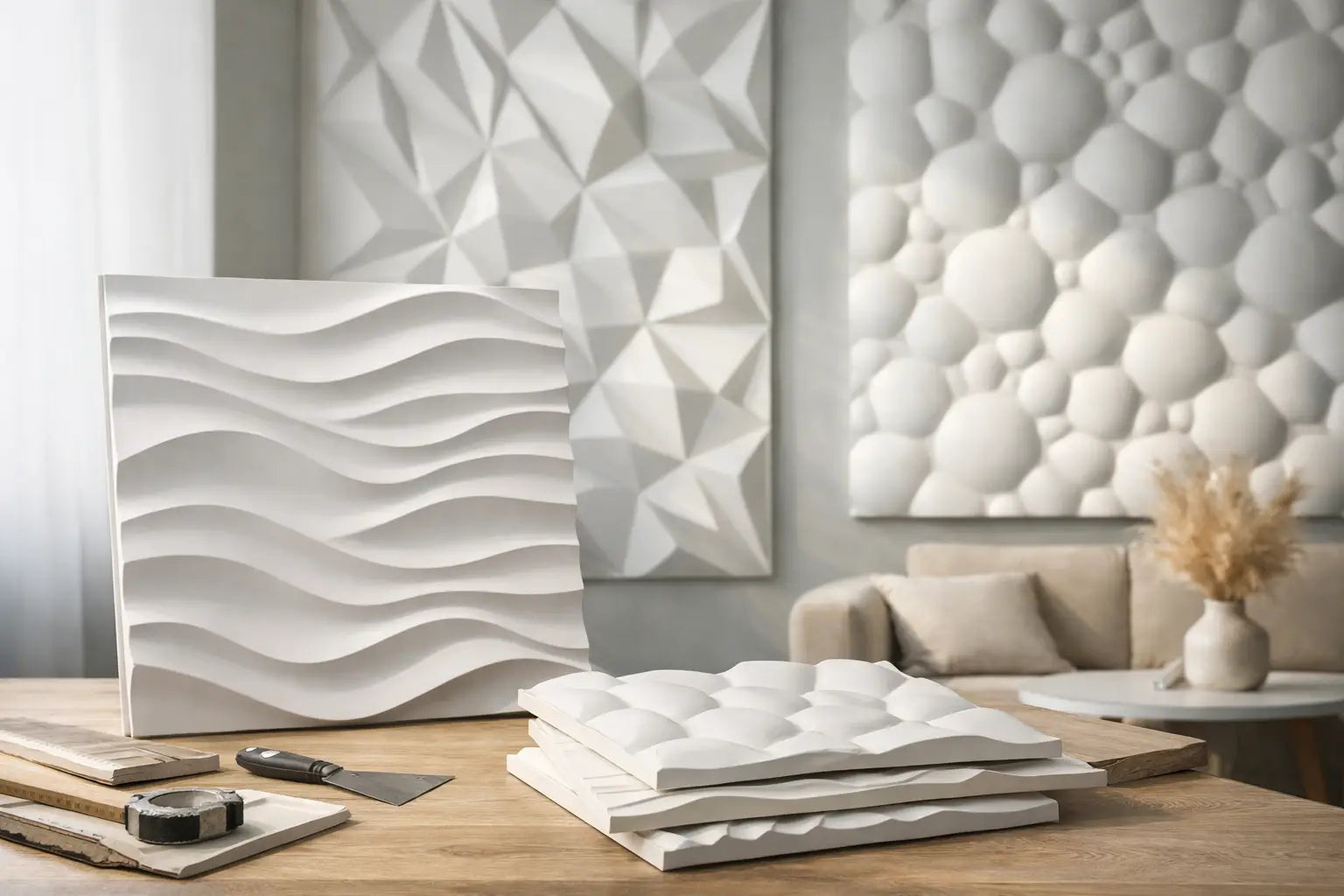
A plain wall can make a room perfectly acceptable – but without character. Conversely, buying 3D plaster wall panels introduces rhythm, light, and a true decorative signature, without requiring heavy renovation. It's often the detail that transforms a subdued living room, an overly simple bedroom, or an impersonal entrance hall into a more architectural interior.
Why buy 3D plaster wall panels
Plaster has a rare advantage in the world of decorative coverings: it combines visual elegance with functional performance. Where some materials focus solely on decorative effect, 3D plaster panels bring tangible depth, a refined mineral surface, and excellent customization capability through paint.
Relief also changes the perception of space. Depending on the chosen pattern, it can lengthen a wall, subtly capture natural light, or create a sophisticated focal point behind a sofa, a headboard, or a reception desk. The result appears more integrated than simple textured wallpaper, and more timeless than a solution overly influenced by trends.
There's also a practical benefit. Plaster contributes to acoustic comfort and thermal sensation, which appeals to both individuals and project developers. In a living room, it can help soften resonance. In an office or reception area, it enhances perceived comfort without compromising aesthetics.
Buying 3D plaster wall panels – the right criteria
Before choosing a model, you need to look beyond the product image. A beautiful panel poorly suited to the room or installation quickly disappoints. The right purchase is based on a balance between style, technical constraints, and daily use.
The style of the relief
Geometric panels are well suited to contemporary interiors, with clean lines and structured compositions. They bring a graphic presence, often more assertive. Wavy panels, on the other hand, create a more fluid and softer ambiance, ideal in a living room, bedroom, or a space where a cozy feeling is desired.
Models compatible with integrated LED lighting offer a more spectacular rendering. They are particularly interesting for accent walls, circulation areas, or hotel and reception projects. However, they require more rigorous anticipation regarding electrical planning and implementation.
The wall's purpose
Not all walls call for the same level of impact. On a large, clear wall section, a grand and sculptural pattern can become the centerpiece of the decor. On a smaller surface, it's sometimes better to choose a finer relief to avoid an overly dense visual effect.
In a living room, the TV wall or the wall behind the sofa are natural locations. In a bedroom, the headboard remains the most elegant use. For a hallway or entrance, the relief can give character to often overlooked areas. In a professional project, it can enhance a reception area or define a more premium visual identity.
The desired finish
The great advantage of plaster is its ability to be painted. This opens the door to very different renderings. In matte white, the relief appears crisp, bright, and very architectural. In a mineral shade, it becomes more subdued. With deep tones, such as dark greige, muted terracotta, or olive green, the panel gains in intensity and sophistication.
You just need to keep in mind that a dark color accentuates the shadows of the relief. This is superb in a well-lit room, but sometimes less suitable for a narrow or poorly lit space.
What plaster really changes compared to other materials
When comparing 3D plaster panels to alternatives made of PVC, foam, or lightweight fibers, the difference is often immediately apparent. Plaster offers a nobler, denser, and more visually credible presence. It gives the wall an architectural quality that better suits sophisticated interiors.
That said, one must be realistic about the compromises. Plaster is more refined, but it requires careful handling and meticulous installation. It is not necessarily the most relevant choice for all contexts, especially if one is looking for an ultra-temporary solution or a very quick covering without minimal preparation.
For a durable project, however, it ticks essential boxes: high-end finish, paintable surface, good longevity, and an authentic material feel. This is precisely what attracts customers who want more than just a decorative effect.
Should you install it yourself or hire a professional?
It all depends on the wall, the pattern, and the expected level of demand. For a careful DIY enthusiast, installation can remain accessible on a simple, well-prepared surface without particular constraints. If the panels are well calibrated and the appropriate accessories are provided, installation can be smooth.
But there are cases where a professional clearly makes a difference: a large, very visible wall, complex joints, LED integration, corners, technical cuts, or a project with high aesthetic requirements. Relief attracts the eye. This means that imprecise alignment or a poorly handled joint is more noticeable than on a flat covering.
The fairest approach is to evaluate the overall cost, not just the purchase price. A controlled installation protects the quality of the final result. On a central wall, it is often a relevant investment.
How to prepare your purchase
Before ordering, you need to precisely measure the surface and anticipate any cuts. Allowing a safety margin is always preferable, especially when the pattern requires proper visual continuity. It's also helpful to consider the room's lighting, as light strongly influences how the relief is perceived.
The quantity choice should not be an approximation. A 3D panel is conceived as a wall composition. The more coherent the overall design, the more elegant the effect. For this reason, it is often wise to define in advance the exact placement, the final color, and the desired finish type.
If the project concerns a primary residence, a rental apartment, or a professional space, priorities may vary. Some primarily seek immediate visual impact. Others prioritize ease of maintenance, simplicity, or adaptability to different decor styles. The right product is one that remains beautiful after the novelty wears off.
Where the effect is most successful
3D plaster wall panels achieve their best results when used intentionally. A full wall can be spectacular, but a well-framed partial covering can appear even more sophisticated. In a contemporary interior, it's not necessary to overdo it. A single strong wall often suffices to elevate the entire room.
Combining them with understated materials works particularly well: light wood, matte lacquer, black metal, stone, thick textiles. Relief needs a balanced environment to express its full value. Too many decorative elements around it can blur its readability.
For lovers of premium ambiances, lighting plays a crucial role. Grazing light reveals volumes with great subtlety. This is where the panel ceases to be a simple covering and becomes a true interior signature.
A decorative, yet strategic purchase
Choosing to buy 3D plaster wall panels isn't just about beautifying a wall. It's about adding an architectural dimension to an interior, with a solution more expressive than paint alone and more refined than a standard covering. The interest is aesthetic, of course, but also sensory, thanks to the comfort the material provides.
For an individual, this enhances the perceived value of their home. For an interior designer, decorator, or developer, it is a strong answer to the search for more memorable spaces. And for those who wish to reconcile visual impact with product clarity, a carefully curated selection like that offered on effetmarbella.fr provides a reassuring framework.
The most beautiful result always comes from a coherent choice: the right pattern, a controlled shade, and an installation that lives up to the project. When these three elements come together, the wall no longer just fulfills a function - it sets the tone for the entire room.


