
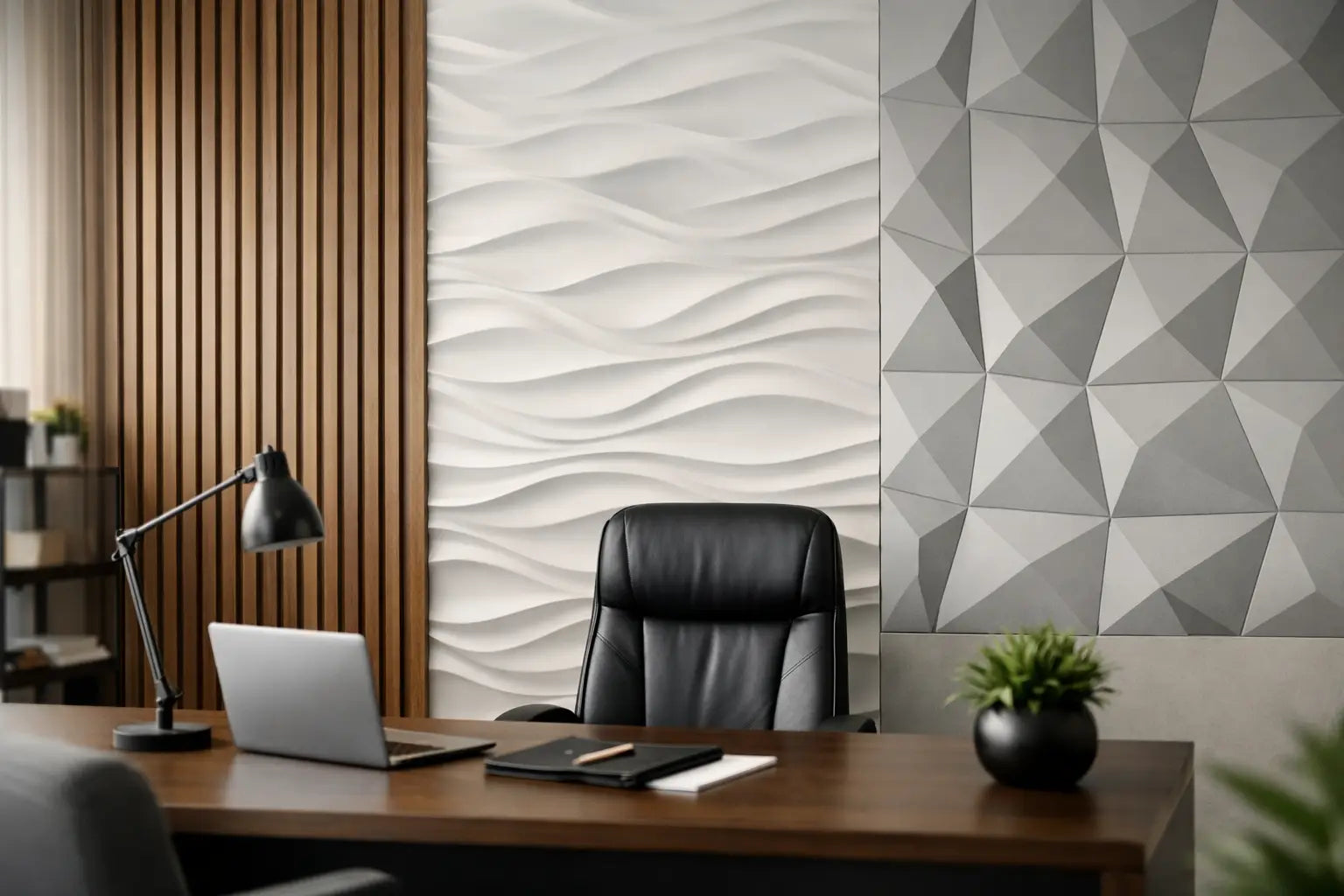
A bare office that feels impersonal or visually tiring always sends a message – to clients, teams, and yourself. The right professional office wall panel doesn't just adorn an empty wall. It structures the space, enhances comfort, and gives the place a more assertive, coherent, high-end presence.
In a work environment, every surface matters. Walls occupy a significant visual space but are often treated minimally, with plain paint or flat partitions. This is precisely where a 3D wall covering changes the perception of a room. It adds rhythm, captures light, introduces texture, and creates a clear aesthetic signature, without resorting to overly dramatic decor.
Why choose a professional office wall panel
In an office, decoration cannot be separated from its use. A wall must be beautiful, of course, but it must also withstand daily use, contribute to overall comfort, and integrate into the identity of the place. This is why choosing a wall panel deserves a more thoughtful approach than a simple style arbitrary decision.
The first benefit is visual. An embossed wall panel immediately transforms a meeting room, a reception area, an executive office, or a waiting room. It adds depth to a room that can sometimes be very rectilinear and technical. In contemporary interiors, this architectural contribution creates an impression of complete finish, as if the space had been designed in detail rather than furnished at the last minute.
The second benefit is related to comfort. Certain panels, particularly those made of 3D plaster, contribute to a better acoustic and thermal sensation. It's not about promising total sound correction as in a recording studio, but about achieving a softer, less harsh, more pleasant environment for daily living. In an open-plan office, a video conferencing room, or a public-facing practice, this nuance matters a lot.
Finally, there's the image. A professional office is not just a place of production. It is also a space for representation. A well-designed wall expresses a level of expectation. It reassures, enhances the brand, and reinforces the impression of seriousness without resorting to expensive artifices.
What type of wall panel for which workspace
Not all offices expect the same effect. The right choice depends on the room's function, its size, its luminosity, and the experience you wish to create.
In a reception area, the wall panel must set the tone from the entrance. Geometric patterns work particularly well when seeking an impression of controlled modernity. They add character while maintaining a clear and professional readability. Placed behind a counter or on a main wall, they allow for signing the space without overcrowding.
In an executive office or a meeting room, more fluid lines, such as wave panels, bring a calmer elegance. The relief subtly catches the light and creates a more enveloping atmosphere. This is often the right choice when the goal is to establish a premium atmosphere, conducive to exchanges, concentration, and visual confidentiality.
For more creative areas or hybrid spaces, panels incorporating LED lighting can also find their place. The effect is more contemporary, sometimes more scenographic. It is well suited for agencies, showrooms, or places that want to make an impression. However, in certain very institutional environments, a too spectacular treatment may seem less appropriate. Everything depends on the company's positioning.
3D plaster, an elegant and functional choice
3D plaster holds a special place in professional wall design because it combines visual refinement with concrete benefits. Its finish has a mineral, clean, and architectural presence that harmonizes very well with the codes of contemporary offices.
One of its great assets is its ability to be painted. This allows the wall to be perfectly aligned with the space's charter, whether it's a luminous white, a muted beige, a deep gray, or a more assertive shade. The relief remains visible, but the color can be adjusted with precision. This freedom is valuable for interior designers, businesses, and project leaders seeking complete visual consistency.
Plaster is also appreciated for its durable rendering. When properly installed and prepared, it offers a stable, high-end result that is significantly more sculptural than a simple textured wallpaper. There is a real difference between an illusion of material and a material that genuinely creates relief.
Of course, choosing plaster means seriously considering its installation. In a highly frequented office, it is preferable to prioritize areas where the wall will not be subjected to repeated impacts. Behind a reception desk, at the head of a table, in a niche, a wide corridor, or at the back of a room, the result is remarkable. In a narrow passage with mobile furniture, one simply needs to plan more carefully.
How to integrate a wall panel without weighing down the decor
The most common mistake is trying to treat too many surfaces at once. In a professional office, elegance often comes from restraint. A single, well-chosen accent wall produces more effect than a complete, poorly calibrated envelope.
Most often, it is preferable to adorn the wall that already carries a strong visual function. This could be the reception backdrop, the wall behind the screen in a meeting room, the wall facing the entrance, or the one that structures a closed office. The panel then becomes an integral element of interior architecture, not just an added decoration.
Light also plays an essential role. Relief is best revealed with grazing light, well-placed sconces, or indirect lighting. In an office too uniformly lit by technical ceiling lights, the pattern may lose its subtlety. Conversely, proper lighting is often enough to reveal the full potential of the panel.
Furniture must also be considered. A professional office wall panel works best when it dialogues with clean lines. Desks with matte finishes, well-designed seating, discreet storage, mineral or wooden materials – the whole gains coherence. If everything tries to attract attention, the wall relief loses its impact.
What to look for before buying
Style matters, but it's not enough. Before choosing a model, you need to examine the panel format, the regularity of the pattern, the ease of painting, and the installation conditions. A very spectacular pattern in a photo may prove too overwhelming in a small room. Conversely, a too discreet relief may disappear in a large volume.
The wall surface must also be considered. A sound, flat, and properly prepared base allows for a cleaner installation and a more precise finish. In a new project or a well-executed renovation, this is generally easy to anticipate. In an already occupied office, it is sometimes necessary to work with existing conditions and plan the intervention methodically.
The project timeline is important. For a company, aesthetics should not disrupt activity more than necessary. It is therefore useful to prioritize a solution that offers a real visual impact without requiring endless work. This is precisely what makes decorative panels attractive in professional projects: the result appears architectural, while the implementation remains manageable.
A design choice that also supports comfort
We often talk about the appearance of a wall, less often about what it changes in the overall feel of a space. However, in an office, this dimension is decisive. An environment that is too flat, too reverberant, or too cold is more tiring. Relief, texture, and a certain visual density contribute to creating a more balanced setting.
This is where a well-chosen panel takes on its full value. It does not replace ergonomics, lighting, or the overall acoustics of the place, but it contributes to a more coherent whole. The office appears better finished, more comfortable, and more credible. For a company that hosts, recruits, or gathers, this impression matters from the very first seconds.
The collections of 3D panels offered by specialized brands like EFFET MARBELLA precisely meet this dual expectation: a strong decorative presence and a clear understanding of the concrete benefits, from paintability to installation and perceived comfort.
A beautiful office doesn't need to overdo it. It needs one precise, well-chosen element that transforms the most visible surface into a true interior signature.


