
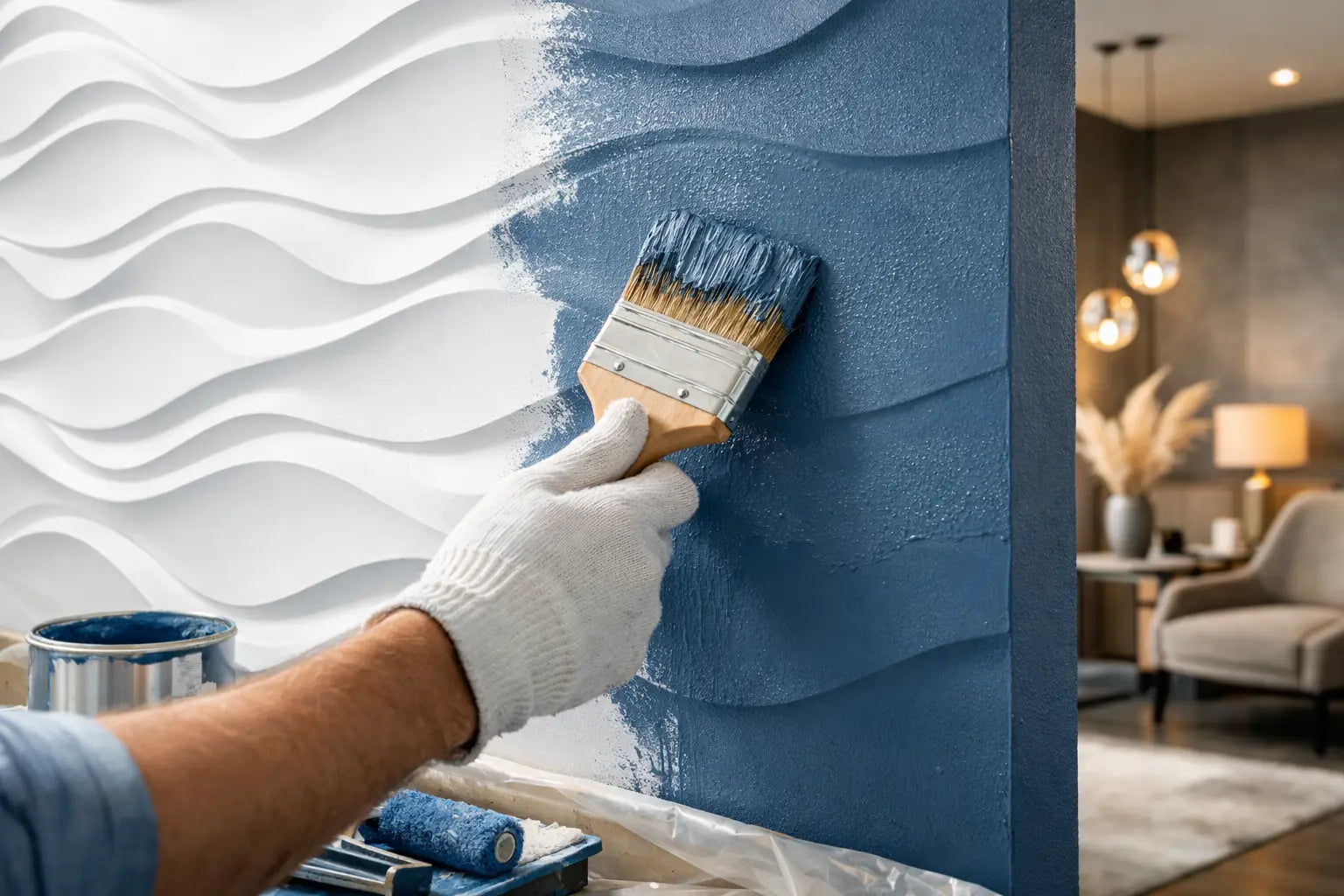
A textured wall can transform a room, then need a fresh look a few years later. The good news is that, in most cases, you can repaint wall panels. The real question is not simply whether it is possible, but how to repaint without losing the relief, the fine detail of the design or the elegance of the whole surface.
Can you repaint wall panels? Yes, depending on the material
Not all wall panels respond to paint in the same way. This distinction makes all the difference. Decorative plaster, MDF, PVC and already lacquered panels require different preparation and types of finish.
3D plaster panels are among the easiest to personalise because their surfaces are naturally suited to an appropriate paint. This is one of their main strengths in a lasting decorative project. You can change the colour over time without replacing the wall covering.
By contrast, laminated, melamine-faced or very smooth panels may require a specific bonding primer. Without it, paint may adhere poorly, mark quickly or flake at the edges. Repainting is therefore possible, but the requirements differ.
What to check before repainting
Before opening a tin of paint, inspect the panel's condition. A clean, stable, dry surface accepts a new finish much better than a dirty or already weakened substrate.
If your panels have impact damage, hairline cracks at the joints or powdery areas, deal with these first. Otherwise, the new colour will highlight the flaws rather than hide them. On decorative relief, light emphasises everything, both the beautiful and the imperfect.
Also check the thickness of existing coats. If the panel has already been repainted several times with heavily applied paint, the pattern may lose definition. This is particularly true of fine geometric designs or delicate waves, where every line contributes to the wall's high-end character.
The case of 3D plaster wall panels
Plaster panels appeal precisely because they combine style with freedom of finish. They add relief, improve visual comfort and can be repainted to suit a new decorative scheme. Mineral white, enveloping greige, deep taupe or architectural matt black: the surface adapts as the project evolves.
This solution is particularly appreciated in contemporary interiors seeking a strong visual impact without major building work. With quality panels designed for painting, the result can stay crisp and sophisticated for a long time, provided the preparation stages are followed.
Which paint gives an elegant result?
The choice of paint affects both appearance and durability. On decorative wall panels, a matt or soft-sheen finish often works better than gloss. It subtly enhances the relief, avoids harsh reflections and retains a more refined presence.
A good-quality acrylic paint is generally the safest choice. It dries relatively quickly, produces less odour and works well on textured surfaces. In a damp room, such as a well-ventilated bathroom, however, check that the product is suitable for that use.
Satin can work if you want a slightly tougher or easier-to-clean surface, but it emphasises irregularities more. In a living room, bedroom or decorative hallway, a premium matt finish often remains the most harmonious option.
Do you need an undercoat?
Often, yes. If the panel is bare, porous or repaired in places, an undercoat helps even out absorption and prevent variations in colour. If the substrate is very smooth or already painted, it improves adhesion.
This is a stage many people try to skip, then regret once the paint dries. A beautiful colour applied to a poorly prepared surface will never achieve the expected depth. On a decorative wall, that lack of definition is immediately visible.
How to repaint without damaging the relief
It is tempting to load the roller heavily to work faster. That is exactly what you should avoid. Too much paint can bury details, build up in recesses and make the design look heavy.
Ideally, work in thin, even coats. A roller suited to lightly textured surfaces works well on the main areas, while a brush reaches recesses and more pronounced contours. Depending on the pattern, a spray gun can also provide a very even finish, especially on large decorative walls or in professional settings.
Then allow the specified drying time between coats. Trying to cover everything in a single pass rarely produces a high-end finish. Two thin coats are almost always better than one thick coat.
Should you sand?
That depends on the substrate. On plaster panels in good condition, a light sanding may be sufficient, or unnecessary if the surface is clean and compatible with the chosen primer. On a panel already painted with satin or gloss, light sanding often improves adhesion.
The key is a gentle touch. The aim is not to erase the relief, but simply to prepare the surface. Working too aggressively on fine patterns can blunt the edges and diminish the design.
Mistakes that spoil the result
The first mistake is treating a wall panel like a flat wall. It is a different surface, with a different interaction with light. The paint should support the form, not suppress it.
The second is choosing a colour without considering shadow. On a 3D panel, the shade changes with exposure, artificial lighting and the orientation of the relief. A soft beige can look very sophisticated, while a poorly chosen grey can make the entire room feel harsh.
The third is neglecting joints and perimeter finishes. On a decorative wall, every detail matters. A poorly prepared transition around sockets, corners or skirting boards disrupts the architectural effect.
Repainting to modernise or to correct?
Repainting does not always have the same purpose. Sometimes it is simply a matter of refreshing white paint that has become dull. At other times, the aim is to transform a room's atmosphere completely.
In a minimalist interior, a light shade highlights the geometry and gives the space breathing room. In a bolder scheme, deep tones can make the relief more sculptural and enveloping. There is no single correct answer: there is the right balance between the panel's design, the room's lighting and the desired effect.
For a rental property, a timeless colour often remains the wisest choice. For a main home or a distinctive design project, you can choose a more adventurous palette, provided it remains consistent with the surrounding furniture and materials.
Can you repaint wall panels without losing their character?
Yes, provided you treat the panel as an element of architectural decoration, not simply a background to cover. That is the difference between a repainted wall and a wall that has truly been enhanced.
A well-designed panel retains its character when repainted carefully. Better still, it can reveal a new reading of the relief. Some shades soften the lines; others strengthen their depth. In premium decorative collections, this ability to evolve is part of the product's value.
For lovers of carefully considered interiors and professionals alike, this is a practical advantage. A wall covering that can be repainted offers more freedom over time without sacrificing elegance or perceived quality. It is also one reason brands such as EFFET MARBELLA focus on surfaces designed to combine visual impact and personalisation.
When is it better not to repaint?
There are still cases where repainting is not the best choice. If panels are badly damaged, poorly installed, swollen by moisture or covered in a peeling finish, paint will not solve the underlying problem.
Similarly, if your aim is to correct an outdated design or a relief that no longer suits the space, replacing the panels may make more sense than adding a new colour. Paint changes a great deal, but it does not alter the visual structure of the pattern.
When the substrate is sound, however, repainting remains one of the simplest ways to refresh an interior intelligently. You retain the covering's material, volume and comfort while giving the room a new presence.
Before choosing your final shade, always look at the panel at different times of day. On a relief surface, colour never acts alone: it interacts with light, shadow and the room's architecture.


