
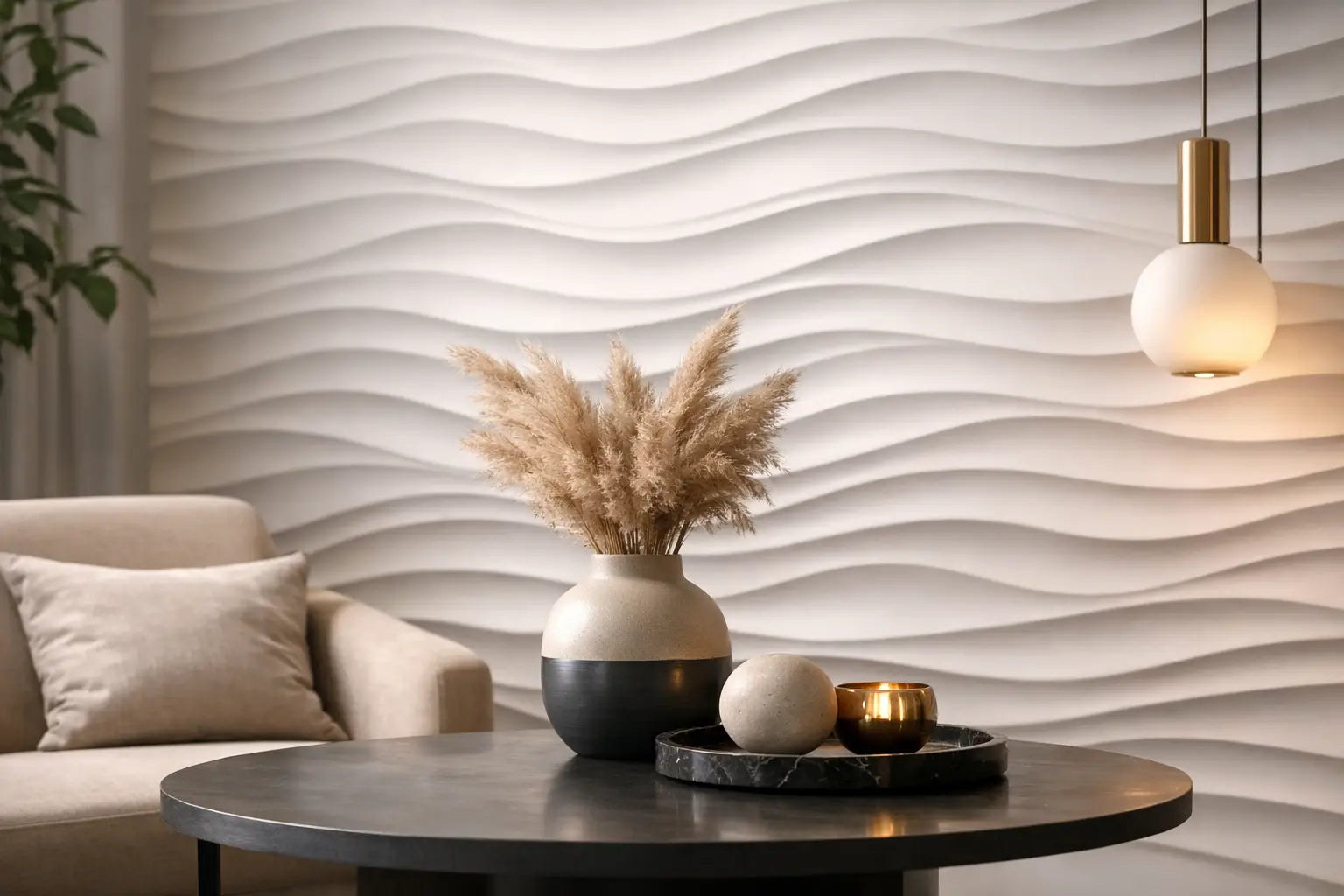
A plain wall can do its job without ever leaving its mark on the space. Conversely, wave panels for interior walls immediately change the perception of a room: they capture light, create rhythm, and establish an architectural presence without overpowering the overall design. This is precisely what appeals today to homeowners renovating their properties, decorators, and project managers looking for a more expressive finish than a simple coat of paint.
The success of this type of wall covering lies in a rare balance. The visual effect is strong, almost sculptural, yet the usage remains simple. A good 3D wall panel isn't just beautiful; it must also integrate easily, be paintable, contribute to acoustic comfort, and maintain an elegant appearance over time. This is where the choice of model, material, and placement becomes decisive.
Why wave panels for interior walls are so appealing
The wave pattern brings movement without agitation. Unlike some highly graphic, more assertive or colder reliefs, the undulating line creates a sense of fluidity. In a living room, it softens volumes. In a bedroom, it visually calms the space. In an entrance or hallway, it enlivens a surface that would otherwise remain secondary.
This relief works particularly well in contemporary interiors, but it is not limited to a single style. Depending on the chosen paint, lighting, and wave width, the result can become minimalist, enveloping, hotel-like, or distinctly architectural. It is a decorative solution that allows for interpretation, making it very attractive for those who want a unique interior without falling into an overly trendy look.
Another strong point is the visual value achieved with a relatively targeted intervention. It is not necessary to cover an entire room. A single wall panel can be enough to create a strong focal point behind a sofa, a headboard, a dining table, or in a professional reception area.
Where to install wave panels for interior walls
The right location depends less on the size of the room than on how light passes through it. 3D panels reveal their relief when shadows can naturally fall on the curves. A wall well-exposed to lateral light will often give a more refined result than a surface uniformly lit from the front.
In a living room, the TV wall is a classic, provided a balance is maintained. If the audiovisual equipment is visually imposing, it is better to choose a regular wave pattern and a sober shade. If the layout is more streamlined, the wall can take on a stronger decorative role.
In a bedroom, the headboard is undoubtedly the most compelling application. The relief adds character without requiring many decorative objects around. The result appears more structured, more upscale, especially when the finish remains matte and the lighting is subtly designed.
For a hallway, a stairwell, or an entrance, wave panels bring a sense of interior architecture where often only neutral walls suffice. It is a relevant choice to give a clear identity from the very first steps.
What to expect depending on color and light
A wave panel is never perceived the same way depending on its finish. In off-white, it appears luminous, almost mineral. In warm beige or greige, it gains in softness and sophistication. In a deep shade, such as a muted green, a browned terracotta, or a felted anthracite, it becomes more theatrical.
However, one simple principle must be accepted: the darker the color, the more pronounced the relief will be. This is superb in a well-proportioned room, but it can visually constrict a cramped space. Conversely, a light color expands the visual perception of the wall and is better suited for compact rooms or interiors seeking subtle elegance.
Artificial light matters as much as paint. Wall sconces, an LED strip, or indirect lighting can magnify the curves. However, excess must be avoided. If everything is over-emphasized, the wall loses its nobility and becomes ostentatious. The most beautiful result often remains the one that appears natural.
The material changes everything
Not all decorative panels offer the same durability or presence. For a demanding interior, 3D plaster panels hold a special place. Their appearance is denser, more precise, and their surface offers true finishing quality. The visual rendering is clean, elegant, and durable, with that sense of material often lacking in lighter solutions.
Another advantage is that plaster is very well suited to painting. This allows for precise adjustment of the wall to the desired ambiance. In a residential project as in a more ambitious decorative project, this freedom is essential.
There is also an often underestimated functional benefit. A relief wall covering can contribute to perceived acoustic comfort, especially in rooms where hard surfaces dominate. The effect depends on the configuration of the place, of course, but in an open living room, bedroom, or office, this dimension adds real value. A slight contribution to thermal comfort can also come into play depending on the chosen system and installation.
How to choose your wave panels for interior walls
The first criterion is not the pattern itself, but the scale. A wide, gentle wave will be more suitable for a large surface. It breathes more and enhances the impression of continuity. A tighter wave can be very beautiful on a more compact wall or when seeking a more sustained visual rhythm.
The second criterion is the decorative context. If the furniture is already strong, with distinct materials, marble, veined wood, or very present textiles, it is better to choose a fluid and readable relief. If the ensemble is more minimal, the wall can take up more space in the composition.
One must also consider the ceiling height. Panels with vertical or slightly stretched movement often better enhance standard rooms, as they give a sense of height. Wider, horizontal waves broaden the view, which can be interesting in a narrow room.
Finally, there is the very practical question of the expected finish. If you want a premium result, the joints, the alignment of the pattern, and the preparation of the support are as important as the design of the panel itself.
Installation, preparation, and final result
A successful decorative wall begins before installation. The support must be clean, stable, and properly prepared. 3D panels do not forgive approximations on an irregular surface. Good preparation ensures a cleaner assembly and continuous reading of the relief.
Installation may be suitable for a careful DIYer, but it requires method. The initial layout is very important, especially for centering the pattern and avoiding an awkward cut at the ends. In a visible and structural project, the intervention of a professional can make all the difference, especially if the wall integrates lighting, outlets, or technical constraints.
Once the wall is installed, the finishes give the project its true stature. Touch-ups, light sanding if necessary, appropriate primer, then well-chosen paint: these are the steps that transform a decorative covering into a finished architectural surface.
An aesthetic choice, but not only
Wave panels are not just for embellishment. They bring a sense of depth often missing in overly flat interiors. They also reduce the need to multiply decorative objects to create personality. The wall becomes an integral element of the design.
This also explains their growing place in high-end projects as well as in targeted renovations. One invests in a surface that works for the space every day, without visual saturation and without depending on the most ephemeral trends.
For a brand like EFFET MARBELLA, this logic makes perfect sense: offering panels conceived as true interior finishes, with a strong design, a durable presence, and an implementation compatible with the expectations of a demanding individual as well as a professional.
The right wave panel is one that does not seek to steal all the attention, but immediately elevates the room. When the relief, light, and shade are well matched, the wall ceases to be a background. It becomes the silent signature of the interior.


