
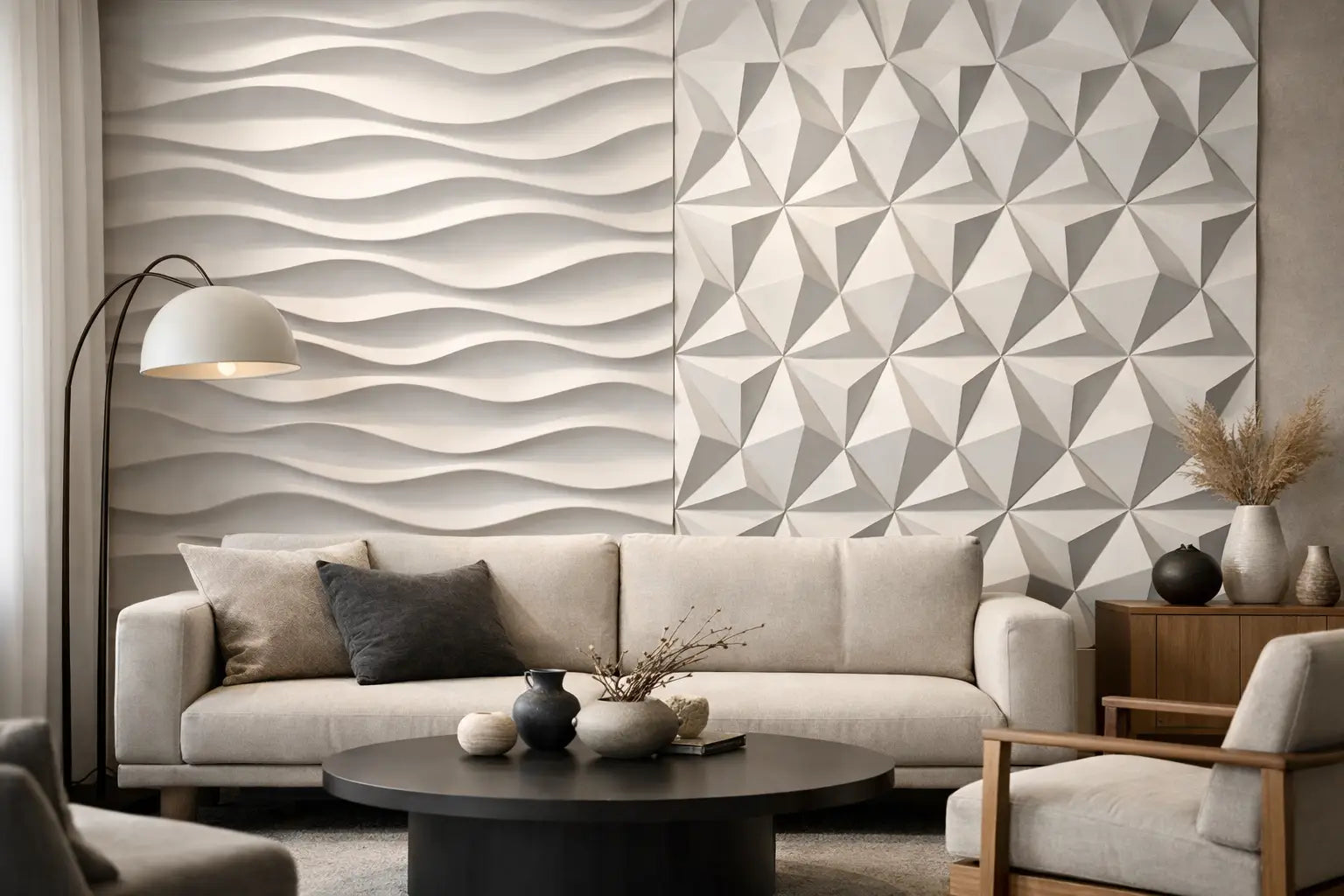
A living room can be impeccably furnished, well-lit, yet still lack character. What often makes the difference is the main wall. Installing a sculptural wall in the living room provides true visual architecture to the space, without requiring heavy construction work. The relief attracts light, structures volumes, and immediately creates a more refined, thoughtful, and high-end impression.
This choice is not merely aesthetic. A well-designed 3D wall also brings a sense of comfort, softens acoustics, and transforms a simple sofa or TV backdrop into a cohesive focal point. To achieve this result, everything hinges on the balance between the right location, the right pattern, and expertly executed installation.
Why installing a sculptural wall in the living room truly transforms the space
In a living room, large vertical surfaces have significant visual weight. A smooth wall remains discreet, sometimes too much so. Conversely, a sculptural wall introduces rhythm without necessarily over-decorating. It's a more subtle and durable way to create character than with an accumulation of objects, frames, or strong colors.
The relief also interacts with natural light and evening lighting. Depending on the angle, shadows create softer or more graphic lines. This is what gives the decor a lively presence. A geometric panel will offer a clear and contemporary interpretation, while a wavy pattern will bring a more fluid, enveloping ambiance.
There's also a practical advantage often underestimated. 3D plaster decorative panels can contribute to the thermal and acoustic comfort of the living room. In an open living space, where sounds circulate quickly, this dimension is as important as the visual effect.
Where to place the sculptural wall in the living room
The best location isn't always the largest wall. You need to choose the one that deserves to be looked at first. In most cases, the wall behind the sofa works very well, as it frames the reception area without disrupting the layout. The TV wall is another strong option, provided a controlled composition is maintained so that the screen and the relief don't compete with each other.
In a living room open to the dining room, a sculptural wall can also serve to define the living area. It then plays an architectural role, almost like a visual partition, but without closing off the space. For more compact interiors, it's best to avoid covering all walls. A single well-chosen surface is ample to create the desired effect.
The scale of the room remains decisive. A small living room can handle a 3D wall very well, but it's important to choose a pattern that allows the overall space to breathe. Overly complex reliefs in a narrow space can make the perception feel heavy. Conversely, in a large volume, a more assertive design prevents the wall from appearing timid.
Choosing the right panel style for an elegant result
The choice of pattern must extend the identity of the living room, not contradict it. If your interior is contemporary, with clean lines, sober materials, and structured furniture, geometric panels are often the most appropriate. They bring a very controlled graphic sophistication.
If you're looking for a softer, more organic atmosphere, wavy panels create subtle and calming movement. They are particularly suitable for living rooms where you want to enhance a feeling of comfort without falling into a demonstrative decorative effect.
Models incorporating a play of light, such as panels designed to accommodate LED lighting, can produce a spectacular rendering. But here, everything depends on the project. In a main living room, the effect can be remarkable if designed from the outset. However, if the lighting is not perfectly integrated, the result can quickly lose elegance. On this point, restraint is often more luxurious than accumulation.
The finish matters as much as the relief. One of the great advantages of plaster panels is their paintable surface. A mineral hue, an off-white, a greige, or a stone tone highlight the shadows with great subtlety. Highly contrasting colors can work, but they require a perfectly cohesive living room. If the goal is a timeless result, sober shades remain the best choice.
Installing a sculptural wall in the living room without missteps
Before installation, the support must be clean, dry, sound, and as even as possible. Decorative panels are not designed to mask an unstable wall. Serious preparation guarantees a neat alignment and more discreet joints. This is often what distinguishes a high-end installation from an approximate rendering.
The tiling layout phase requires real attention. The complete composition must be visualized before gluing the first panel. This avoids awkward cuts on the edges, especially around outlets, switches, or technical elements. In a living room, where the wall is highly exposed to view, symmetry or visual balance must be considered from the outset.
The installation itself can be accessible to a careful individual, especially with panels designed for simplified installation. But everything depends on the level of requirement, the size of the wall, and the complexity of the pattern. For a small decorative section, a precise amateur can achieve an excellent result. For a large continuous wall or a project with integrated lighting, professional intervention can save time and ensure a secure finish.
Once the panels are installed, joint treatment and painting are essential. This is when the wall truly becomes sculptural, in an architectural sense of the term. A poorly finished relief looks like a covering. A perfectly unified relief becomes a decorative signature.
The most common mistakes
The first mistake is choosing a pattern solely from a photo. A living room has its own light, volume, furniture, and materials. A very appealing design in an image can turn out to be too busy or too dense in reality. You should always think about the wall in its context.
The second mistake is to overload the surrounding decor. A sculptural wall doesn't need to be accompanied by strong wallpaper, heavily patterned curtains, and multiple accessories. The more prominent the relief, the more controlled the rest should remain. It's this contrast that creates an impression of luxury.
You must also be wary of poor lighting. A misplaced wall light or overly cold light can flatten the relief instead of revealing it. In most living rooms, warm, subtly directed light offers the most beautiful result.
Finally, many neglect the proportion between the wall and the furniture. A very expressive relief behind visually heavy furniture can create a confused ensemble. If the sofa is massive, it may be preferable to choose a more fluid pattern. If the furniture is minimalist, a more structured graphic can, on the contrary, reinforce the composition.
A decorative investment that remains practical
The real advantage of a sculptural wall in the living room is that it combines visual impact with daily use. It's not a fragile or purely demonstrative decor. When well-chosen, 3D plaster panels offer a durable, paintable solution designed to adapt to the evolution of the interior.
It's also a smarter investment than a mere passing trend. A beautiful wall relief doesn't depend on a fleeting fashion, especially when it features sober lines and an elegant palette. It adds depth to the room today, and it retains its relevance as the furniture, textiles, or colors of the living room evolve.
For individuals as well as more ambitious residential projects, this solution meets a very current expectation: creating a distinctive interior without sacrificing comfort or the readability of the space. It is precisely in this balance that collections like those from EFFET MARBELLA find their strength, with panels designed to combine style, ease of installation, and architectural presence.
The right time to take action
Many living room projects remain unfinished because the wall treatment is postponed until the end, as a detail. In reality, it is often the element that gives coherence to everything else. When the foundation is strong, furniture naturally finds its place, light becomes more beautiful, and the space immediately gains poise.
Installing a sculptural wall in the living room does not necessarily require a complete renovation. Sometimes, a single wall is enough to transform a room from acceptable to remarkable. If you are looking for a visible, elegant, and durable transformation, start with the wall that everyone looks at without really seeing it – that's often where the living room finally reveals its true potential.


