
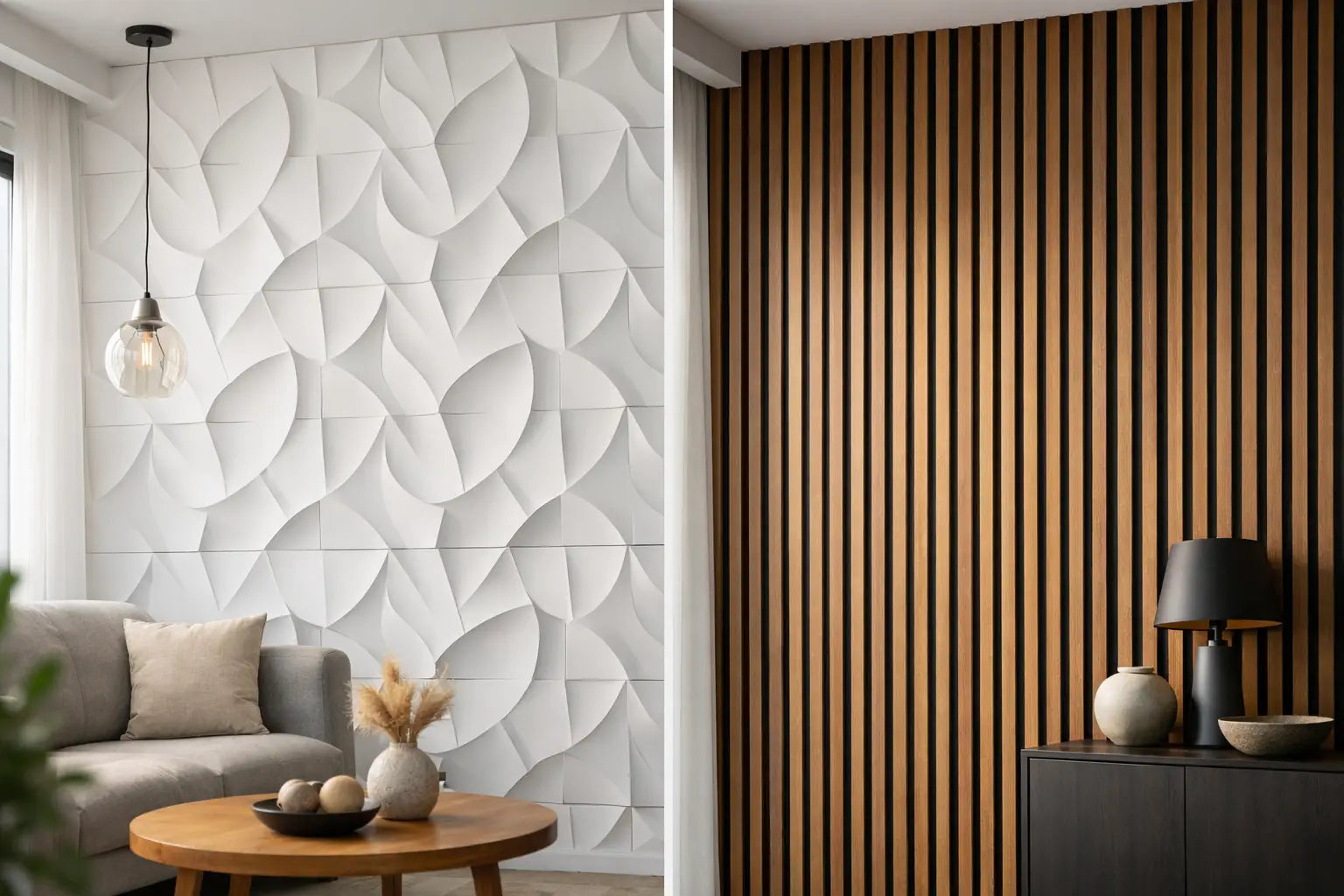
A living room wall doesn't have to remain a neutral surface. Between the sculptural relief of a mineral panel and the warm rhythm of wood, the choice immediately changes the perception of a room. The debate between decorative gypsum vs. acoustic battens is therefore not just a matter of trend: it concerns the character of the place, its acoustic comfort, the light, and the desired quality of finish.
For a renovation, a contemporary apartment, or a more ambitious development project, these two wall coverings respond to very different intentions. Comparing them precisely allows for choosing a sustainable solution, consistent with the interior style, and adapted to the wall's constraints.
Decorative Gypsum vs. Acoustic Battens: Two Visual Signatures
Decorative gypsum creates an architectural presence. Composed of molded plaster panels, it plays with hollows, lines, waves, or geometric shapes to give volume to a wall. Its strength lies in its monolithic appearance: once the joints are treated and the surface painted, the wall seems custom-designed. It can evoke a hotel alcove, a sculpted headboard, or a subtly refined living room backdrop.
Acoustic battens rely on a more linear language. They generally combine vertical wooden or wood-finish slats with a dark felt backing. The ensemble brings rhythm, warmth, and an immediately recognizable texture. This solution is particularly popular in Nordic, contemporary, or Japandi-inspired interiors.
The difference is clear: battens emphasize verticality and warm up the space, while decorative gypsum creates a true wall relief. If you're looking for a decor that blends into the room's architecture, gypsum is often more relevant. If you want to introduce wood as a visible material and create contrast with light walls, battens make more sense.
The Influence of Light
Light reveals the two materials very differently. On battens, it draws fine, regular shadows between each slat. The effect is elegant but remains graphic and repetitive. On a 3D gypsum panel, side lighting highlights each curve and depth. Indirect lighting, a well-placed wall lamp, or integrated LED lighting can then transform the wall throughout the day.
This sensitivity to light deserves to be anticipated. In a dimly lit room, a very deep relief will benefit from being accompanied by soft light. Conversely, in a sun-drenched living room, a more subtle geometric pattern can offer a sophisticated presence without overpowering the decor.
Acoustic Comfort: Not to Be Confused with Absorption and Diffusion
The word "acoustic" might suggest that all battens significantly reduce noise. In reality, their effectiveness depends on their composition. Models with an absorbent felt, sufficient thickness, and, ideally, an air gap behind the slats can limit some reverberation in a room. They are interesting in an office, a media room, or a living room with very hard surfaces.
Decorative gypsum does not act in the same way. Its rigid, embossed surface does not replace true sound absorption, but it can break the flatness of a wall and help diffuse sound waves. Combined with curtains, rugs, textile furniture, and other soft elements, it contributes to a less cold and more enveloping atmosphere.
The right choice therefore depends on the problem to be solved. To correct a pronounced echo in a large minimalist room, a batten system with acoustic backing is generally more suitable. To enhance the comfort of a residential interior while favoring a high-end decorative effect, relief gypsum offers a more integrated result. In both cases, no wall covering alone provides complete sound insulation between two dwellings: this performance requires a specific partition composition.
Which Solution for Each Room?
In a bedroom, both options work well, but they tell different stories. Battens behind the bed create a warm and soft atmosphere, especially with natural linens and oak furniture. Decorative gypsum panels, on the other hand, form a more sculptural headboard, which can be painted in the same shade as the wall for a calm and enveloping look.
In a living room, gypsum often has the advantage when it comes to creating a signature wall. A composition of waves, facets, or fluid lines enhances a sofa, a fireplace, or a low cabinet without imposing the presence of a wooden material. Battens remain an excellent option around a screen or in an office space, especially when one wishes to soften the acoustics while visually delimiting an area.
In an entryway or hallway, the issue of bulk matters. Battens add a certain thickness and their interstices require regular installation. Gypsum panels allow for controlled relief, particularly interesting for enlivening a narrow wall with more continuous elegance. Their surface can also be painted according to the evolution of your decor.
For professional projects, hotels, restaurants, reception areas, or high-end residences, decorative gypsum allows for the development of a strong identity over large surfaces. It easily blends with a color palette, signage, or scenographic lighting. Battens will be more suitable for spaces where the wood accent and the need for acoustic absorption are at the heart of the specifications.
Installation, Maintenance, and Longevity
Acoustic battens are attractive due to their often accessible installation principle. Pre-assembled panels are usually fixed to a prepared wall or a framework, depending on the model. The difficulty lies in cutting around outlets, switches, and corners, as well as in the impeccable alignment of the slats. A misalignment of a few millimeters can become visible over the entire height of the wall.
Gypsum panels require careful preparation: a clean, flat, and dry substrate, suitable adhesive, precisely treated joints, and then a paint finish. This extra step is also what distinguishes them. Once installed, the surface gives the impression of a decor custom-made for the space, with no visible seams between the panels. For a large area or a complex pattern, hiring an experienced installer ensures a more demanding finish.
In terms of maintenance, battens can retain more dust in the crevices between the slats. A vacuum cleaner with a soft brush or a regular duster is recommended. Painted gypsum panels are maintained like a wall, with delicate dusting and, depending on the chosen paint, light cleaning. A washable finish is advisable in a hallway, dining room, or high-traffic area.
Durability primarily depends on usage and installation quality. Gypsum, a mineral material, retains its elegance when protected from significant impacts and direct humidity. Battens, on the other hand, require a finish adapted to light exposure and indoor air stability, in order to preserve the appearance of the veneer or wood.
Budget and Customization Freedom
Comparing prices solely per square meter would be reductive. With battens, you need to factor in edge finishes, cuts, potential framework, and end treatment. With decorative gypsum, the budget includes panels, adhesive, jointing, paint, and labor if entrusted to a professional.
Customization is a decisive argument in favor of gypsum. It can be painted in a mineral white, a warm beige, a deep gray, or a more daring color, then repainted as the room's universe evolves. EFFET MARBELLA's collections of 3D panels thus allow working with material, geometry, and light without sacrificing this chromatic freedom.
Battens offer more limited customization, even if oak, walnut, or black décors create very distinct atmospheres. Their rendering relies precisely on the visibility of the material. If you tire of this wood tone, the transformation will be less simple than with a painted mineral surface.
The most beautiful choice is the one that serves the atmosphere you want to feel every day. For a room that deserves depth, continuity, and sculpted elegance, let the relief of gypsum become an integral part of your interior architecture.


