
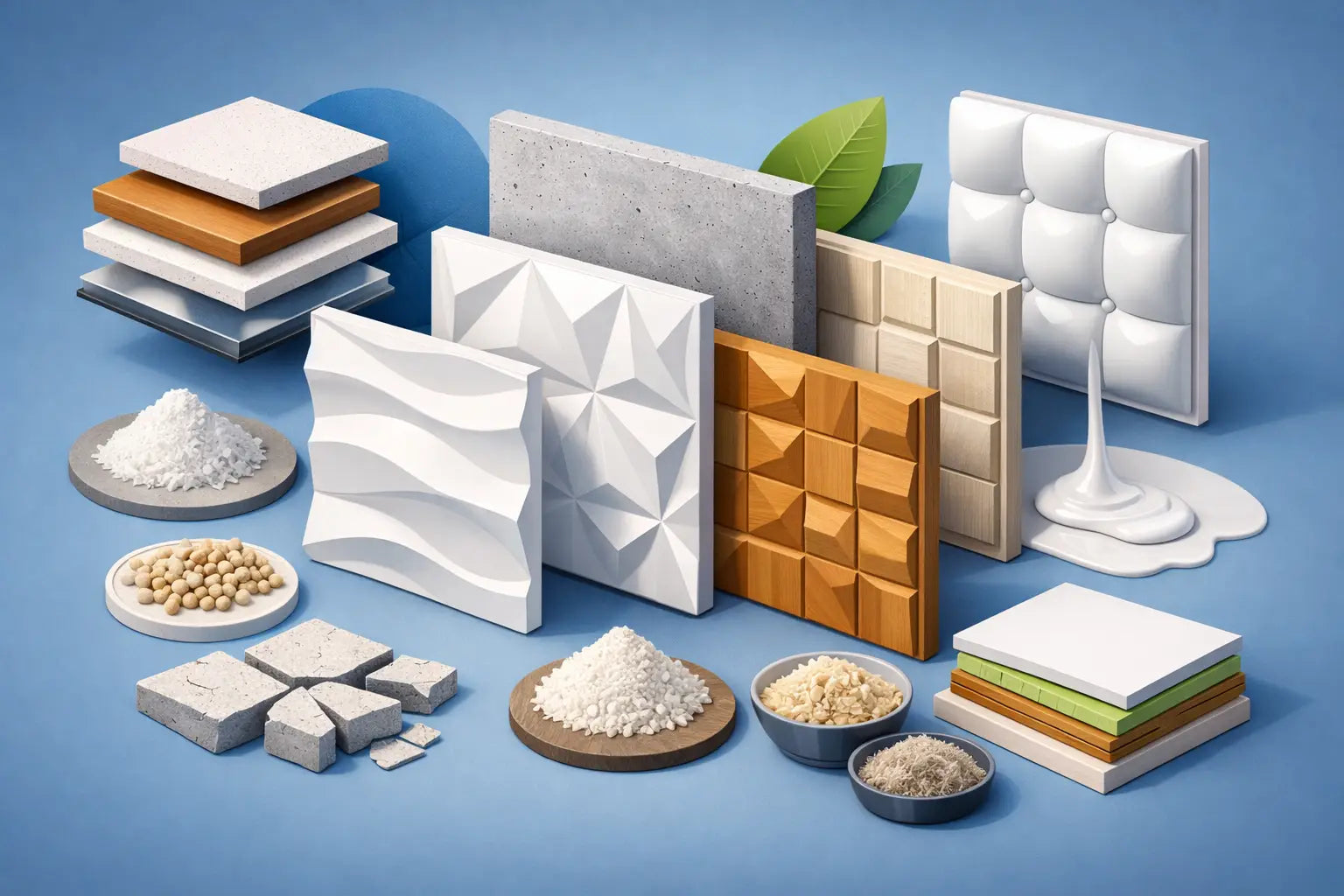
When a wall looks flat, cold, or untextured, it's not always a matter of color. Often, it's the material that's lacking. If you're wondering what 3D wall panels are made of, the answer changes a lot of things – from visual appearance to durability, including installation, painting, and acoustic comfort.
The choice of material is therefore not a mere technical detail. It's what determines the elegance of the relief, the quality of finish, and the panel's longevity. For a carefully designed residential interior, a contemporary apartment, or a more ambitious decorative project, it's better to understand what you're buying before choosing a pattern.
What are 3D wall panels practically made of?
3D wall panels come in several materials, but they are not all in the same category. On the market, you mainly find gypsum, PVC, MDF, certain compressed vegetable fibers, as well as foams or decorative composites. All create relief, but not all offer the same level of finish or the same material feel.
In terms of high-end decoration, gypsum remains one of the most sought-after materials. It allows for crisp lines, a more authentic architectural presence, and a paint-ready surface that truly enhances light. Conversely, lighter materials like PVC primarily focus on ease and cost, with a result that is often less mineral, less deep, and sometimes more decorative than truly architectural.
Gypsum, a benchmark material for a premium finish
Gypsum is a mineral material widely appreciated in the world of 3D wall decoration. Its main asset is simple: it gives the relief a true visual density. Shapes appear more precise, shadows more elegant, and the wall immediately gains character.
It is also an excellent surface for paint. Once properly installed and prepared, a 3D gypsum panel can be painted in the shade of your choice to integrate into a minimalist, warm, or very contemporary interior. This freedom of finish appeals as much to individuals who want to personalize their living room as to interior designers looking for aesthetic continuity on a complete project.
Another important advantage is that gypsum contributes to indoor comfort. Depending on the wall configuration and installation, it can help improve the acoustic perception and thermal comfort of a room. It is not a technical insulator in the sense of a construction complex, but it is a material that adds presence, mass, and a very different sensation of quality than a simple thin coating.
Finally, we must talk about longevity. A well-installed gypsum panel, in a suitable indoor space, retains its appearance with great stability. It is a consistent choice for those who want a durable decor, and not just a trendy effect.
Other materials used for 3D wall panels
Not all 3D panels are made of gypsum, and some materials may be suitable depending on the budget, the room, or the aesthetic requirements.
PVC is common in entry-level or mid-range offerings. It is lightweight, easy to handle, and often simple to maintain. However, its appearance can seem more artificial, especially in interiors where a sophisticated ambiance is sought. It is more suitable for quick decorative uses than for truly high-end wall staging.
MDF, derived from wood, can also be used for certain decorative panels. It offers good dimensional stability, but its aesthetic largely depends on the finish. It can be interesting in certain contemporary projects, even if it does not produce the same mineral and sculptural sensation as gypsum.
Panels made of pressed vegetable fibers are also found. They sometimes appeal due to their lightness and decorative positioning, but their resistance, relief precision, and final appearance vary greatly depending on manufacturing quality. For an elegant living room or an accent wall intended to remain impeccable, one must look beyond the simple material argument.
Why the material truly changes the final result
Two panels with a similar pattern can produce a radically different effect depending on their composition. This is often what is discovered after installation. The design is important, of course, but the material is even more so.
A mineral panel like gypsum subtly captures light. The reliefs seem more natural, the transitions are more refined, and the whole evokes more of a decorative work integrated into the architecture. In a living room, a bedroom, or an entrance hall, this nuance makes all the difference.
Conversely, a material that is too light or too shiny can break the desired illusion. The relief exists, but it appears applied rather than constructed. For an interior aiming for a real upgrade, this point deserves to be taken seriously.
What are the most durable 3D wall panels made of?
When it comes to durability in interior use, gypsum panels are among the most convincing options. They withstand time well when installed on a suitable substrate, in a dry room, and with a careful finish. Their denser structure gives them a stable presence, which is appreciated in spaces where the wall becomes a true design element.
That said, durability also depends on the context. In an area exposed to direct humidity or frequent splashes, it is always necessary to check the compatibility of the product and the chosen finish. All 3D panels, even high-quality ones, require a minimum of coherence between the material, the room, and the actual use.
For a living room, bedroom, office, staircase, or reception area, gypsum panels meet this search for durable elegance very well. This is precisely what appeals to clients who don't just want to cover a wall, but to transform the ambiance of the room.
And for installation, are all materials equal?
Not really. Lightweight materials may seem easier to handle, but that doesn't mean they offer the best result. A gypsum panel requires careful installation, with proper substrate preparation, precise alignment, and clean finishes. In return, you get a much more integrated look.
For a careful amateur, some projects are perfectly accessible. For a more ambitious wall composition, a large format, or a perfectly continuous finish, calling on an experienced installer often remains the best choice. This is even more true if you want to exploit the full potential of the relief with a uniform paint and discreet joints.
Ease of installation should therefore not be the only criterion. A decorative wall covering is seen every day. It's better to invest in a material and an installation that truly enhance the space.
How to choose the right material for your project
The right choice depends first and foremost on your objective. If you are looking for a strong decorative wall, with crisp relief, a paintable finish, and a timeless aesthetic, gypsum is the natural choice. It is particularly suitable for interiors where design matters as much as perceived quality.
If your absolute priority is a minimal budget or very quick installation in a secondary space, other materials can be considered. But you must accept their limitations, particularly regarding visual depth, surface nobility, and sometimes long-term aesthetic durability.
For an elegant residential project or a more prescriptive realization, it is often more relevant to consider the final value rather than the immediate cost. A beautiful 3D wall panel does not only fulfill a decorative function. It structures the gaze, gives rhythm to the volume, and transforms an ordinary wall into an interior signature.
This is the logic that guides the premium collections offered by specialized brands like Effet Marbella, where wall relief is not just an accessory, but becomes a compositional element in its own right.
What to remember before buying
The real question isn't just what 3D wall panels are made of, but what result you expect from your wall. If you're aiming for a chic, durable, customizable, and visually rich finish, gypsum remains one of the best choices on the market. It brings that sculptural dimension that immediately adds character to an interior.
Before choosing, always observe three things: the quality of the relief, the exact nature of the material, and the desired effect in the room. A successful 3D panel doesn't shout. It imposes a calm, elegant, almost obvious presence. And that's often where the most beautiful interiors stand out.


